Conservation districts are turning to voters for new sources of funding
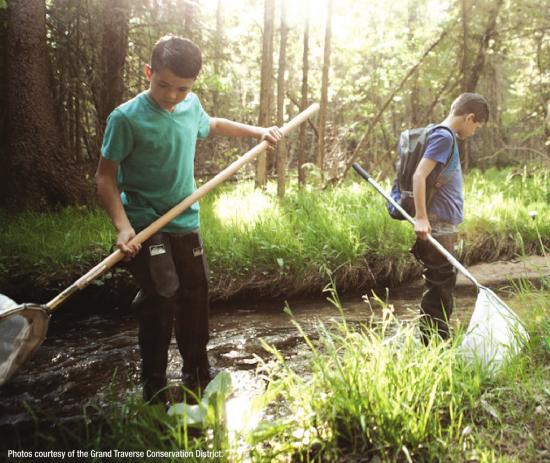
WHAT IS A CONSERVATION DISTRICT?
Every county in Michigan has a conservation district or shares one.
Not to be confused with nonprofit organizations, conservation districts are actually government offices created across the United States in response to the Dust Bowl of the 1930s, an environmental catastrophe that saw fertile Great Plains farmland swept away by wind, drought and poor farming practices. The overall mission of conservation districts? To maintain healthy and productive soil, water and air quality, and wildlife landscapes.
A decade ago, Michigan, which boasts 77 conservation districts, ended funding to its conservation districts.
There’s still plenty of state and federal money spent on programs that conservation districts can access, but whether that money reaches a particular county depends on the effectiveness of that county’s conservation district office. In recent years, some districts have asked voters to approve millages to in order to keep afloat.
When Mary Schoenherr moved to a lakeside home in Antrim County three years ago, the view was great, but the lot was on the verge of crumbling into the water.
“We were new owners of a piece of property on Torch Lake, and we had a very steep, high, elevated lot,” Schoenherr said. “I’m a typical downstater that moved up here, and I appreciate the outdoors, but I am certainly not a soil erosion expert.”
One of the contractors she called about reconstructing the “rickety and dangerous” stairs down to the lake had some alarming news.
“He said, ‘This is a big deal: You can’t just replace this. Really, you need to call the Antrim Conservation District,’” Schoenherr said. “I didn’t know a thing about conservation districts.”
AN EDUCATION IN CONSERVATION
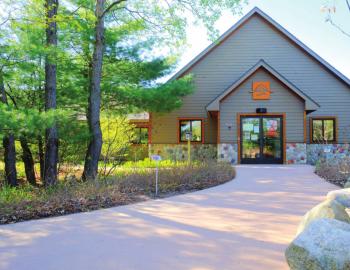
A soil erosion control officer inspected Schoenherr's property, and Schoenherr said what she learned about bluff erosion, stormwater runoff and cliff-side wetlands was a revelation.
“Basically, as a city girl, my mouth just dropped, all of the complexity that went into it,” she said. “It just turned into a big, big lesson for me.”
The experience was also a great inspiration, prompting her evolution from a city girl who didn’t know what a conservation district was to a board member of her county’s conservation district.
Today Schoenherr is leading a campaign to save her county’s conservation office. The district is asking for .1 mills on the Aug. 2 ballot to raise $175,000 a year for four years.
Schoenherr said that since she’s been on the board, she’s seen how the district has been stripped down to a skeleton staff, and she believes the office could do a lot more if it had an executive director.
“In order to be on top and in line for grants, you have to be constantly studying what’s become available,” she said. “That’s one of the things that has fallen by the wayside.”
The current staff have applied for and received an invasive species grant that runs a program in four counties, but that runs out this year.
“I know that the current staff has been trying to keep up,” Schoenherr said. “They are, quite frankly, overworked.”
Heidi Shaffer, the Antrim County Soil Erosion Control officer, said that, with millage funding, her office will be able to do a lot more. On the list: Building mountain bike trails to bolster tourism in Mancelona.
“There are recreation grants that we could secure, but we need someone to write those grants,” Shaffer said.
BENZIE COUNTY PIONEERS
Benzie County was only the second district in the state to go for a millage in 2010.
In the decade since Michigan stopped funding conservation districts, each one has settled on its own priorities and scrambled to figure out how to pay for them, whether through its county’s budget or through fundraising and grants.
In Benzie, the choice was between a millage or closing the office, said Tad Peacock, executive director.
But a millage request in Benzie County, where so many are shot down, seemed daunting.
“It was challenging, and honestly, very, very few people gave us any chance whatsoever,” Peacock said. “No other offices in the Lower Peninsula were funded by a millage or even had tried to get a millage.”
Peacock said he and the board set out to calculate the least it would take to run an effective office, and they settled on .1 mills to raise $110,000 per year.
“When we got our first millage passed in 2010, it passed by 62 votes,” Peacock said. “It was a great shock and a very exciting moment.”
And when they went back for a renewal in 2014, the millage passed again — this time by 1,350 votes.
“What that tells me is that people are understanding what we’re doing, and they are supporting what we’re doing,” Peacock said.
In addition to connecting farmers and landowners with state and federal conservation programs, the Benzie district focuses on water quality. They undertake two annual river cleanups on the Betsie and the Platte, and they’ve expanded the number of grants they receive, enabling them to fund programs that keep track of water quality in the lakes.
DISTRICTS ARE LIKE FUNNELS
Lori Phalen, executive director of the Michigan Association of Conservation Districts, said conservation districts were slow to ask for millages because they hoped state funding would return, or they had found other ways to scrounge together a budget.
Manistee and Missaukee counties won millages in 2014. This year, in addition to Antrim County, Kalkaska County is seeking a millage.
Phalen said the pitch for a conservation district millage should be an easy one — she likens it to paying for a funnel that will bring money into the county through state and federal programs: The bigger the funnel, the more the money flows. But without the conservation office, that money will go someplace else.
Phalen said conservation districts lost state funding during the Granholm administration because the budget was tight, and conservation districts offered a cut that lawmakers found irresistible.
“There was extreme stress on the general fund, so programs such as these, conservation district funding, were at extreme risk, and it was eliminated,” she said.
In 1998, however, the legislature gave conservation districts the power to attain millages with the consent of their county boards. Schoolcraft County in the Upper Peninsula got one early on, years before Benzie made their bid.
EVERY DISTRICT IS DISTINCT
Over the years, conservation districts have evolved to serve the particular natural resources of their locations, said Christine Crissman, executive director of the Watershed Center Grand Traverse Bay.
“When conservation districts started, it was all in response to the Dust Bowl era — it was all about keeping soil in place,” Crissman said.
For evidence of how each district is distinct today, Crissman has to look no further than the Watershed Center’s region of Antrim, Grand Traverse, Kalkaska, and Leelanau counties.
“Each one of those four are very different from each other in terms of the things that they do,” she said.
Compare Kalkaska and Grand Traverse, for example: Kalkaska employs one person, and Grand Traverse staffs a dozen, plus runs a nature center.
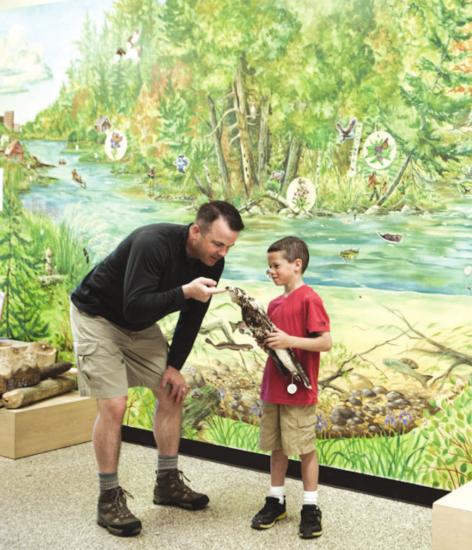
Grand Traverse Conservation District Executive Director Marsha Clark said her district’s nature center exists because the community wanted it at a time when Traverse City’s Clinch Park Zoo was about to close. It also provided a home for the zoo’s collection of mounted animals.
The district has expanded upon its original mission, but Clark said the conservation spirit informs everything they do.
“We do conservation work, just like all the other conservation districts. And in addition to that, we run the nature center, and we are the stewards of the Boardman River. And that is unique. And we’ve been doing that for about 20 years,” Clark said.
The Grand Traverse Conservation District also manage 3,000 acres of parkland for the county and townships, another function that makes it unique.
The Grand Traverse Conservation District is funded through grants, contracts, program fees and donations. It receives only five percent of its roughly $800,000 annual budget from the county, so when commissioners slash department budgets, as they have in the past year, the conservation district emerges relatively unscathed.
A FRAGILE WATERSHED
Clark said her district has considered launching a campaign for a millage because its mishmash of funding sources is unstable.
“Many people believe that the conservation district is funded by the state, and there’s a line item in the budget, and that we have money, so why would we need money, because we already get money,” Clark said. “We don’t get any money at all.”
The district does have programs funded through the Michigan Department of Agriculture and Rural Development, such as a program that assists farmers to ensure their practices are environmentally sustainable. And some funding comes from the United States Department of Agriculture’s Natural Resource Conservation Services. Clark says the district does win grants and does collect program fees.
But it survives by finding missions that need to be fulfilled.
“That is how we adopted the stewardship of the Boardman River, because it was seen as a need by the community,” Clark said.
Stewardship of the watershed has become an intense responsibility — especially as dams are removed, and the flow of the river is rerouted to its natural place. As ponds are drawn down, vast swaths of land open up, bare and vulnerable to invasive plants.
The district writes grant requests, enlists volunteers, and funds the planting of tens of thousands of native plants to take hold in the bottomlands.
“People say, ‘Why [are invasives] a problem?’ It’s a problem because invasive plants aren’t native to the area, for one thing, and so they don’t attract the insects, so insects don’t feed on the plants, and then the birds don’t have anything to eat, and so the whole food chain is disrupted,” Clark said. “We call them invasive because they just keep growing. There’s nothing that controls them. Once [a place is] invaded, you can have an entire area where there’s no wildlife.”
PROTECTORS OF KALKASKA’S FORESTS
Meanwhile, the Kalkaska Conservation District is asking for .25 mills in August.
Executive Director Mark Randolph said his office wanted to ask for as little as possible, but it needed to ask for more when the county requested the district take over household hazardous waste disposal.
The task seemed like something that fits the group’s mission because some of that hazardous waste might otherwise get dumped in the woods.
“We don’t want five gallons of concentrated insecticide rusting away out in the woods somewhere and contaminating the groundwater,” Randolph said.
Randolph said he’s seen firsthand the impact of sound conservation practices. A decade ago, the invasive garlic mustard plant had taken over Coy Mountain in Alden. In the years since, waves of volunteers have attacked the plant.
Randolph recently visited with a group of volunteers.
“When we left, there was no garlic mustard, there were no mature garlic mustard plants,” he said. “Ten years ago, it was just covered in garlic mustard. I would never have expected it to look as good as it does today.”
Randolph believes the conservation district is as important now to the environment and economy of Kalkaska as it’s ever been. The district helps landowners responsibly manage and harvest their woodlands by connecting them with funding and programs to manage the land.
The district also helps protect the resources. The Asian longhorned beetle poses as big a threat to maple trees as the emerald ash borer poses to the ash trees that have recently disappeared. A well-functioning conservation district is the first line of defense against that threat, he said.
“We know it would come into the area in firewood or in raw wood products, so if you know the vectors, you can anticipate where it’s most likely to start, and you can monitor those areas and nip that infestation in the bud,” Randolph said.
FUNDED WITH BEACHGRASS
The Charlevoix Conservation District employs two people and receives funds from the county and state agriculture programs; coordinator Alison Adams said her district has no immediate plans to go for a millage.
“It’s come up before — it definitely seems to be assisting a lot of other conservation districts,” she said. “I don’t know that we’re at a point where we would need that to sustain where we are.”
Charlevoix, however, has a unique asset: Its district’s budget is supplemented through its semi-annual beachgrass sales.
Adams said operating the district’s American Beachgrass Nursery and selling to customers is a big job, but it supplies native plants to stabilize lakeshore and dunes throughout the country, and it earns the extra money needed to run the office. (It also has called on a pint-sized army, with much success; last fall, the district got help from- Charlevoix Elementary School sixth graders.
“It’s a big project for a small outfit,” Adams said.
In Antrim County, conservation district supporters believe if they can get voters to understand what the district does, it will be able to win the millage.
A big disadvantage, however, is that it will not be the only millage request on the ballot. Shaffer said there’s a lot of competition for those dollars, so she remains realistic about the district’s chance of winning what it needs: “Antrim County tends to be very conservative, and there are four millages on the ballot, so I don’t know,” she said. “I hope so.”
View On Our Website