Connecting to the Past and Guiding the Future
Little Traverse Bay Bands on preserving indigenous identity
By Eric Cox | Dec. 13, 2025
The first time Danielle Gibson heard the thump of live powwow drums she felt a calling, a tug that pulled her toward the rhythm and ignited a desire to dance.
“Something within my spirit made me feel like I needed to be out there, dancing,” she says. “Later, I had a dream that I was in an arena and was in a jingle dance.”
The jingle dance is part of the Ojibwe healing tradition, with the jingle dress’s cones sending waves of healing sound as the dancer shuffles and twirls.
Fast-forward 11 years and Gibson, a citizen of the Little Traverse Bay Bands of Odawa Indians (LTBB), is now an active jingle dancer, having realized the colorful vision she’d had more than a decade ago. Gibson says she didn’t set out to protect one of her tribe’s traditions—she was called to it.
Knowledge and Traditions
Yet, preserving tribal traditions isn’t always that easy. Many aren’t guided by visions, and the work of safeguarding important cultural practices is left to tribal government, elders, and the Native community at large.
“It can be difficult to preserve traditions among historical and modern-day challenges,” says LTBB Cultural Services Specialist Theresa Chingwa. “There’s boarding school trauma, land displacement, poverty, systemic racism, and cultural pressures of assimilation.”
Those obstacles haven’t deterred the LTBB from fielding a spectrum of projects aimed at protecting historical Odawa traditions in music, dance, food, arts, language, and more.
“Tribal citizens are resilient and eager to revitalize historical knowledge, traditions, languages, beliefs and values as it’s a central aspect of our cultural identity,” Chingwa says. “[We are] connecting generations to their past and guiding their future.”
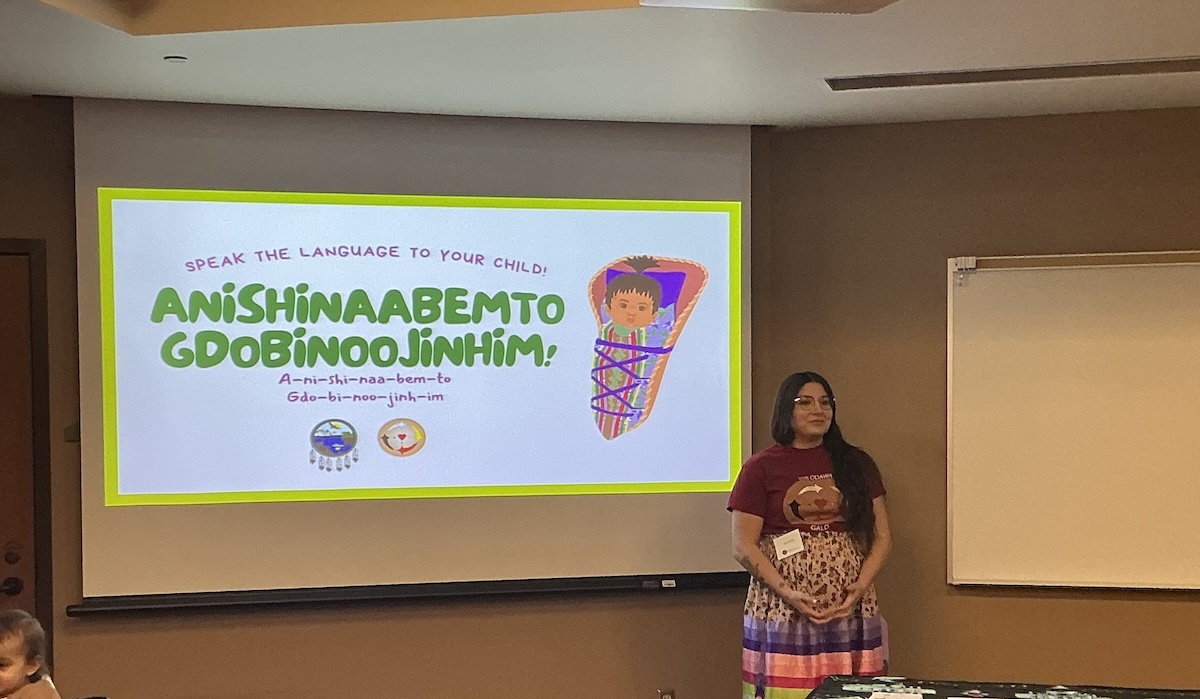
Through a variety of ongoing programs, the Tribe has created a solid foundation of cultural knowledge and customs they hope will endure. For example, the Gijigowi Anishinaabemowin Language Department (GALD) promotes the preservation and revitalization of Anishinaabe language and culture. GALD develops Anishinaabemowin publications, learning materials, educational language programs, and language documentation.
“GALD is very interested in connecting with elders, and members who speak our native language,” the Tribe’s website says. “Even if it is only a few words, we’d like to hear from you.”
Chingwa says such public outreach efforts help expand the tribe’s lexicon and draw citizens closer to their heritage. “The wisdom of our elders is a valuable resource for traditional knowledge, language, and history,” she tells us. “There's a wide range of ongoing efforts and initiatives involving cultural collections for community access, language apps, digitizing traditional stories, oral histories, and children’s books, to name a few.”
Indeed, the Language section of the LTBB government website features an array of tools anyone can use to learn the Odawa-Anishinaabe language. Users can hear and see selections in Anishinaabemowin, and it’s even possible to slow down the recordings in order to better hear and understand pronunciations. Users have their choice of many cultural collections and connections to other Native American portals and services.
Other language department services include access to teaching materials, online courses, and language immersion events.
Additionally, the LTBB’s Aankwadong project is creating a two-year, four-semester, online language program, to be delivered at the high school and college level, as well as a community class.
Lost and Stolen Language
Preserving native languages has become a major challenge, not just for the Little Traverse Bay Bands, but for indigenous peoples generally. According to Harvard University’s Pluralism Project, an ongoing study that documents the changing religious landscape in the United States and globally, most Native American languages are endangered, if not extinct, in large part due to the assimilation pressures of the 1800 and 1900s.
“And yet this is also a moment of profound rebirth of Native languages, cultures, traditions, and life ways,” the Pluralism Project’s website says, pointing out an unusual dichotomy. “Though many Native people still speak their original tongue as their first language, many have lost the ability to speak their languages.”
The Pluralism study cited 1990 census data which revealed, “70 percent of Navajo children in Arizona between the ages of five and 17 spoke the Navajo language at home. Among Lakota Sioux children the same age, the figure was 15 percent. Among Ojibwe children, the number was closer to 4 percent. Among most Native communities, however, the numbers are, sadly, even lower.”
Further, a 2023 Bureau of Indian Affairs study revealed that approximately 167 Indigenous languages are spoken in the U.S., and it’s estimated that only 20 will remain by 2050.
While those may be alarming statistics, it’s important to note the bright spots, just as The Pluralism Project does: “While some languages and cultural traditions are in danger of being relegated to the pages of ethnologists’ books, the more surprising fact is that many Native communities enjoy a thriving original language and vibrant cultural traditions.”
Elders and The Next Generation
The Little Traverse Bay Bands of Odawa Indians are a good example of that. While they strive to revitalize their indigenous language, they’re equally interested in preserving traditional foods, music, arts, and dancing.
Danielle Gibson’s calling to the jingle dress illustrates these heartfelt efforts to share and, thereby, protect and prolong Native traditions. Becoming a jingle dancer isn’t as easy as simply buying the necessary regalia and learning the dance. There’s a rich story and deeper meaning, meaning that can only be properly interpreted and appreciated by consulting tribal elders.
And it’s through these handed-down customs and the generational sharing of knowledge that sacred traditions like the jingle dance are made durable.
“You want to take your tobacco and seek out elders,” Gibson explains. “Ask them about things you don’t understand and they’ll share information.” She used social media to acquire some needed regalia and leaned on elders’ advice for creating her own jingle dress and bead work.
“None of my family are powwow people, and I had no idea how to sew,” Gibson confesses. “Making your own outfit is normal, so I got more involved in the powwow. I picked up my own sewing machine and the different materials, and I went out and basically taught myself sewing and beading.”
Now, with years of jingle dancing behind her, Gibson is creating a new jingle dress for someone who’s physically small, but large in spirit: her daughter, the next generation to ring out the jingle dance’s healing vibrations.
“She’s picking up on it and she’s only three,” Gibson says.
Such transfers of knowledge and rituals between generations is critical for all cultures, but particularly important to Native Americans.
“While each tradition is profoundly rooted in its emergence from the very landscape which became America, all have shared the common challenges of life under colonization, especially dispossession and forced assimilation,” the Pluralism Project concludes. “So while traditional ways of life vary greatly, all Native communities have shared the common challenge of balancing those traditional ways of life with the changes necessary to survive in a new world on their own terms.”
The Little Traverse Bay Bands of Odawa Indians aren’t just surviving; they’re actively building bridges between the past and present, using their own language and customs to pave the way.


Trending

Welcoming the Winter Solstice: Rituals & Events for the Shortest Day of the Year
With the winter solstice quickly approaching, it’s hard not to notice how dark each day feels. Astronomically, this is… Read More >>
Camp Greilick Now Open!
It’s been a long road for the century-old Camp Greilick, which, after several dormant years, was acquired by Grand Tra… Read More >>
Men and Ugly Sweaters
Those two things don’t always go together, but on Dec. 19, you’ll see both out and about in Petoskey and Harbor … Read More >>