Reaching the Boiling Point
Traverse City’s International Affairs Forum welcomes author Stephen Kinzer to discuss the Russia/Ukraine war
By Art Bukowski | Oct. 31, 2026
“Unprovoked.” There was that word again. Over and over and over. It was enough to drive Stephen Kinzer nuts.
When Russia invaded Ukraine in February of 2022, the focus was on Russian President Vladimir Putin’s display of (as it was widely referred to) unprovoked aggression. Much of the world condemned the action at the time and still views it primarily as a war of Russian hostility.
Stephen Kinzer knows better. The former New York Times foreign correspondent and historian has authored several books about American intervention in other countries, and he’ll tell you of a long and sometimes sordid history of American actions (and inactions) that ultimately “set the stage” for war in Ukraine.
“What really set me off was that one word. [The invasion] was illegal under international law, but unprovoked, it certainly was not,” Kinzer says. “If you look at what happened on February 22, 2022, [you assume] that the whole war is Russia’s fault. But that one day should actually be seen as just one frame in a very long movie. And if you haven’t seen what led up to it, you don’t understand it.”
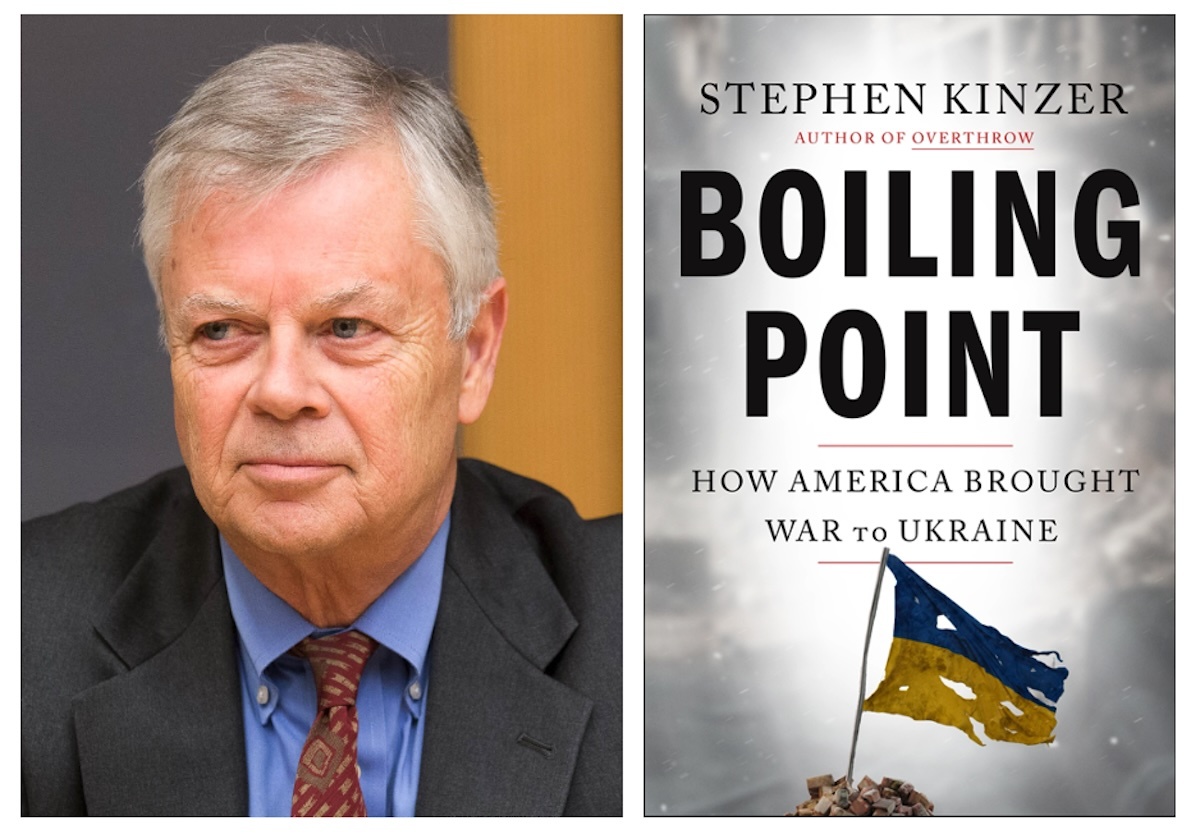
Kinzer set out to explain all of this backstory in Boiling Point: How America Brought War to Ukraine, out Nov. 3 from Henry Holt and Co. He’ll be in Traverse City to discuss this book at the 33rd season of the International Affairs Forum on Nov. 12.
IAF leaders are excited to have Kinzer discuss one of the most significant geopolitical events of this generation.
“Our strength is bringing the most timely, relevant, expert voices and scholars and thought leaders to the community whenever we can and as often as we can,” IAF Director Alex Tank says.
A History of Poking the Bear
Kinzer’s book details more than seven decades of American activity in Ukraine that ultimately led to war, starting right after World War II when the “CIA started dropping armed commandos into Ukraine with the aim of fomenting a war” followed by “all kinds of propaganda and covert action” in the decades since.
All of this had the goal of keeping Russia in check, if not directly antagonizing Russia or its leaders, Kinzer says.
“This book goes back 75 years and shows how the United States has been relentlessly seeking to use Ukraine as a battering ram against Russia,” Kinzer says.
The real turning point came in 1991, Kinzer says, with the fall of the Soviet Union and the independence of Ukraine. Instead of agreeing that Ukraine should be neutral, the United States has tacitly (and at times explicitly) pushed for Ukraine to join the North Atlantic Treaty Organization (NATO), which was formed to counter Soviet influence and aggression.
“We ignored Russian protests and insisted that we were going to push NATO right into Ukraine, and that Russia would have to accept an enemy military alliance right on its border. It would be the equivalent of, say, a Chinese naval base in Mexico, which the United States of course would never accept,” Kinzer says. “There were many experts who pointed out that Russia was not always going to be prostate, and no country can accept the advance towards its border of a military alliance of which it’s not a member. But we felt we had Russia at our mercy and that there wasn’t anything they could do about it.”
The result was “the liquidation of the possibility that a peaceful Ukraine could have been a bridge between East and West rather than a territory they would both fight over,” Kinzer says.
“We drew on decades and generations of anti-Russia passion that could have all disappeared with the end of the Soviet Union, but it didn’t,” he adds.
The United States has sent mixed messages during the recent war itself, but Kinzer argues it was glad to see someone take up arms against Russia.
“[Ukrainian President Volodymyr] Zelenskyy at the beginning was willing to make a peace deal, but the Americans and the British refused to accept that and sent an envoy to Kiev to tell Zelenskyy not to sign,” Kinzer says. “So right now I think Zelenskyy might be thinking to himself, ‘Trump is angry at me because I’m not making a deal, but the reason I’m not making a deal is because the Americans told me not to make a deal.’”
Ultimately, Kinzer has tremendous sympathy for the Ukrainian people. He covered the Contra war in Nicaragua in the 1980s, and he sees plenty of parallels.
“Poor Nicaragua just happened to be the stage on which giant outside powers fought and the country was destroyed, tens of thousands of kids were killed,” he says. “I think something similar is happening in Ukraine. I feel so sorry for Ukraine, that Ukraine by an accident of history and geography wound up being the stage on which Russia and the United States are working out their anger toward each other.”
Telling the Story
Very few Americans are aware of this history, Kinzer says, and he’s glad to be able to put it all out there.
“All of this campaign against Ukraine over 75 years unfolded more or less in secret. Nobody’s ever put the story together the way I have in this book,” Kinzer says.
That said, he wants people to come to their own conclusions.
“My book is strictly a presentation of fact. It is not a polemic. It doesn’t make an argument. Every sentence or every paragraph has a footnote in the back. Everything in there is what happened,” he says. “My only goal is that when people make up their minds about how the Ukraine war started, that they at least know the facts and just don't swallow it all in one word: Unprovoked.”
Kinzer leans heavily on primary source documents in this and other works.
“One theme in all of my writing has been trying to place facts in connection with each other, to show you how one thing leads to another,” he says. “I think Americans have this idea that world crises tend to explode out of nowhere. That they just burst out mainly because people are evil, people are warlike, but this is actually not true.”
While this blend of historical and political nonfiction can seem unapproachable to some readers, Kinzer prides himself in crafting a compelling read.
“I am a great believer in telling stories. I like to be cinematic [and] I like to bring readers into the story,” he says. “I do not write scholarly analyses. I want a story to be fast-moving and character driven, and in this book, you’re going to meet some amazing characters.”
He learned many things himself while writing and researching, which he says is “the best part of writing a book.”
“One of them is that for decades, United States policy toward Russia and toward Ukraine was made by officials in Washington whose ethnic background was in Eastern Europe or the former Soviet Union. These are people who grew up with impassioned hatred for Russia. It was bred into them with their mother’s milk,” he says. “There’s no other example in the history of American foreign policy of people from a region penetrating so fully into the American foreign policy establishment and shaping hostile policies towards the power that they blame for their families’ ancestral troubles.”
About the Event
Catch Kinzer at Traverse City’s IAF on Thursday, Nov. 12, at Milliken Auditorium (1701 E. Front St.) in Traverse City. A reception is set for 6pm and the event will start at 7pm. Signed copies of Boiling Point will be available from Artemis Books & Goods. In-person admission is $20/person ($25 at the door), $10 for virtual admission, and free for students, educators, and IAF members. Get tickets and learn more at tciaf.com/event-november-12-2026.

Trending
Heal Yourself: Volunteer!
When Melissa’s son, Jake, died by suicide just shy of his 30th birthday, she and her family needed an outlet for their… Read More >>
Traverse City Children’s Book Festival 2026
Need something fun and bookish to do with the kiddos this weekend? Head to City Opera House for the return of the Traverse C… Read More >>
Shopping for a Cause in TC
Yes, believe it or not, we’re inching closer to the holidays. Save your future self from Black Friday madness or last-… Read More >>