TC Leaf Pickup by the Numbers
How the city processes fallen leaves and what residents can do to help keep their neighborhoods clean
By Ren Brabenec | Oct. 3, 2026
Walk or drive any Traverse City neighborhood, and one of the first things you notice is the mature tree canopy that seems to shade every parcel, sidewalk, and street corner.
According to Michigan Public, a University of Michigan radio station, Traverse City boasts one of the densest urban tree canopies among Michigan metropolitan areas, with tree cover at 43 percent and rising (the state average is 38 percent, and the national average is just 26 percent).
All those trees produce a significant amount of leaf litter every autumn, so we checked in with the City of Traverse City to learn what goes into collecting and processing it.
Preparing for Falling Leaves
As the Director of Mobility Infrastructure for Traverse City, Christopher Weber is deeply involved with leaf pickup. Animated and smiling, Weber spoke excitedly about leaf pickup, saying it’s a project he and the team look forward to each year.
“We do not hire any additional staff specifically for leaf collection,” Weber tells us. “We all want to take turns with it, and as our department has 15 full-time staff members, we typically dedicate approximately 8-10 employees to leaf collection during the roughly 1.5- to 2-month fall collection period” which runs early-to-mid-October to mid-December, or whenever the snowfall prevents them from collecting.
Weber adds that, while the leaf pickup season varies each year, the City always sends out a mailer to all residents announcing the start date for leaf pickup. Residents can also check the City of Traverse City’s official website or Facebook page for updates.
Given the extensive tree canopy, leaf pickup is a significant seasonal operation for the department. Weber says they typically run two collection crews throughout the workday, nonstop, for the full season. Furthermore, Weber sends crews out again in the spring to pick up whatever was missed last fall, as there are always more than a few stubborn trees that hold onto their leaves well after the snow flies.
How Leaves Are Collected
Weber pulls out his mobile phone and shows us photo after photo he and his crew had taken of the leaf collection process.
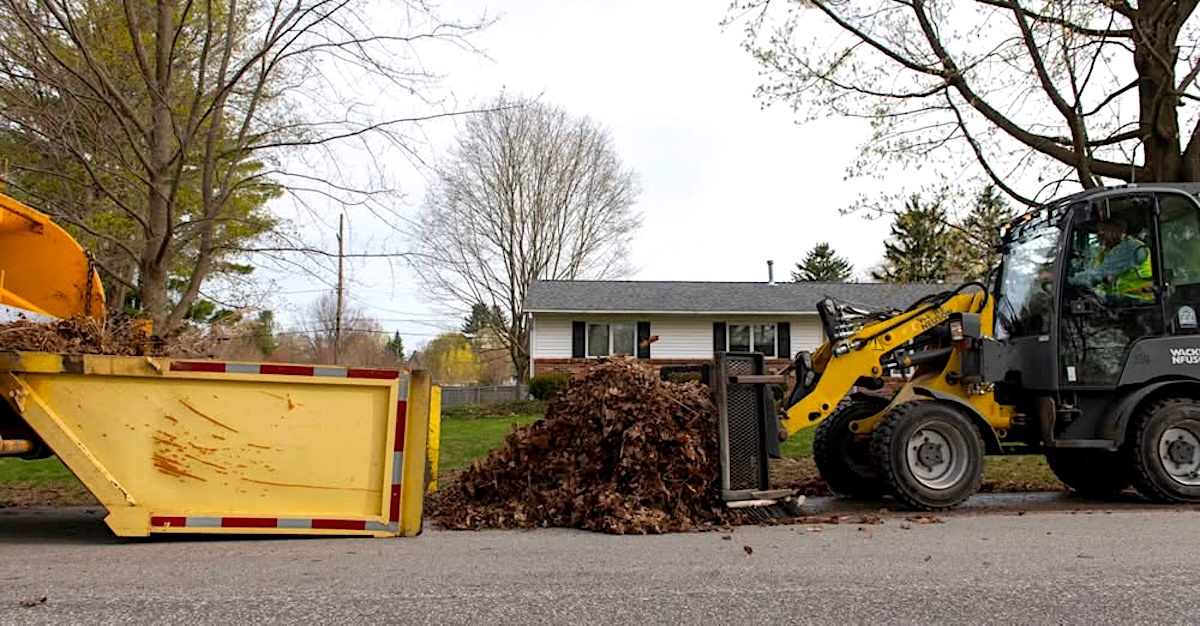
“We use a variety of equipment throughout the collection and composting process,” Weber says. “Each crew uses a rear-load garbage truck equipped with a shop-built loading pan. A compact front-end loader pushes the leaves into the pan, which is then raised to load the material into the rear of the truck.”
“How much leaf material is collected is always fun to estimate,” Weber says, answering our next question before we’d asked it. “Our team measures the material primarily by volume rather than weight. In a typical year, the City collects approximately 8,000-10,000 cubic yards of leaves and other yard waste.”
Where Do All Those Leaves Go?
Once collected, the leaves are transported to the City’s composting facility at 2471 Keystone Road. At the facility, City employees use specialized composting equipment, including a compost windrow turner and a topsoil screen.
“Through the composting process, that material breaks down considerably, ultimately producing approximately 4,000-6,000 cubic yards of finished compost,” Weber says.
The composting process takes approximately nine months. During that time, staff monitor the internal temperature of the windrows and periodically turn the material to incorporate oxygen and moisture into the material. Over time, the leaves and yard waste break down into finished compost.
“One of the more interesting parts of the program is that the material essentially comes full circle,” Weber says, swiping through the last of his photos of the collection process and landing on a new batch showing the composting facility and heavy equipment used to compost the leaves. “After the leaves have been composted, the finished material is then reused on various City street, landscaping, and parks projects.”
Weber added that the public can also purchase finished compost for $5 per cubic yard. “The leaves we collect from residents ultimately come back into the community as a useful soil amendment,” he says.
Beyond the recycling aspect of leaf collection, Weber explained that it keeps leaf organic material out of the City’s stormwater system and catch basins and out of the bay.
“If it wasn’t for leaf collection, a lot of these leaves would end up in the landfill or East or West Bay,” Weber explains.
He holds up a photo of a crew member smiling while operating heavy machinery and collecting leaves. “Out of all the services we provide at the City, our leaf pickup is probably tied with snow clearing for most appreciated by residents. We’re all working together as a community to keep the city clean and to do so in an environmentally sensible manner. What’s not to love about that?”
Best Practices for TC Residents
The City’s leaf pickup works only when residents work with the City to move leaves from yards to the street.
“The biggest thing residents can do to help is make sure their leaf piles contain only leaves and acceptable yard waste, such as grass clippings, plants, and very small twigs,” Weber says. “Foreign materials can slow down collection, damage equipment, and potentially injure employees.”
Weber begins ticking items off on his fingers, counting the oddities he and his crews have found in leaf piles.
“Lumber, bricks, metal, cinder blocks, dead animals,” Weber says. “One of the more memorable examples was someone who apparently collected a significant amount of dog waste and buried it in a leaf pile. The crew discovered it pretty quickly once they started moving the pile, and the smell was unlike anything any of us had ever experienced!”
While Weber says that particular example was more unpleasant than dangerous, materials such as bricks, metal, and lumber become a safety hazard for the City’s employees and equipment. Sticks hidden in leaf piles can bend, break, or shoot up and out of the pile during compaction, potentially injuring an employee; hence the need to move only leaf litter and the smallest twigs “no bigger than a thumb” to the street.
“Ideally, the piles would be just leaves, no twigs at all,” Weber emphasizes. “We have a separate operation for brush pick up, with different collection equipment and a different processing facility for that material.”
For residents who can’t physically move the leaves to the street, Weber recommends private lawn care companies. For those who can’t afford a contractor, Weber suggests contacting the Commission on Aging for assistance.
Photo courtesy of the City of Traverse City


Trending

The Tasting Room Is Now Cellar & Flame
Listen to your customers. That’s the lesson Carolyn Weeks took to heart, and it’s the reason The Tasting Room be… Read More >>
Cozy Cottage Concerts
If you loved Music Under the Pines in the summer, head to Twisted Fish Art Gallery in Elk Rapids for Cottage Concerts! Enjoy… Read More >>
Running toward Fall in Frankfort
Fall festivals are going to be running nonstop from now until November, and Frankfort is no exception! The annual Frankfort … Read More >>