Bridging the Political Divide
The science of working together, and how we’re doing it in northern Michigan
By Mitchell Ryan Distin | March 21, 2026
In his 1796 Farewell Address, George Washington warned that party conflict could harden into vengeance, describing “the alternate domination of one faction over another, sharpened by the spirit of revenge…[as] itself a frightful despotism,” and cautioning that parties can become “potent engines” for those who would “usurp… the reins of government.”
Years earlier, John Adams posed a similar fear in a 1780 letter: “There is nothing which I dread so much as a division of the republic into two great parties…This, in my humble apprehension, is to be dreaded as the greatest political evil under our Constitution.”
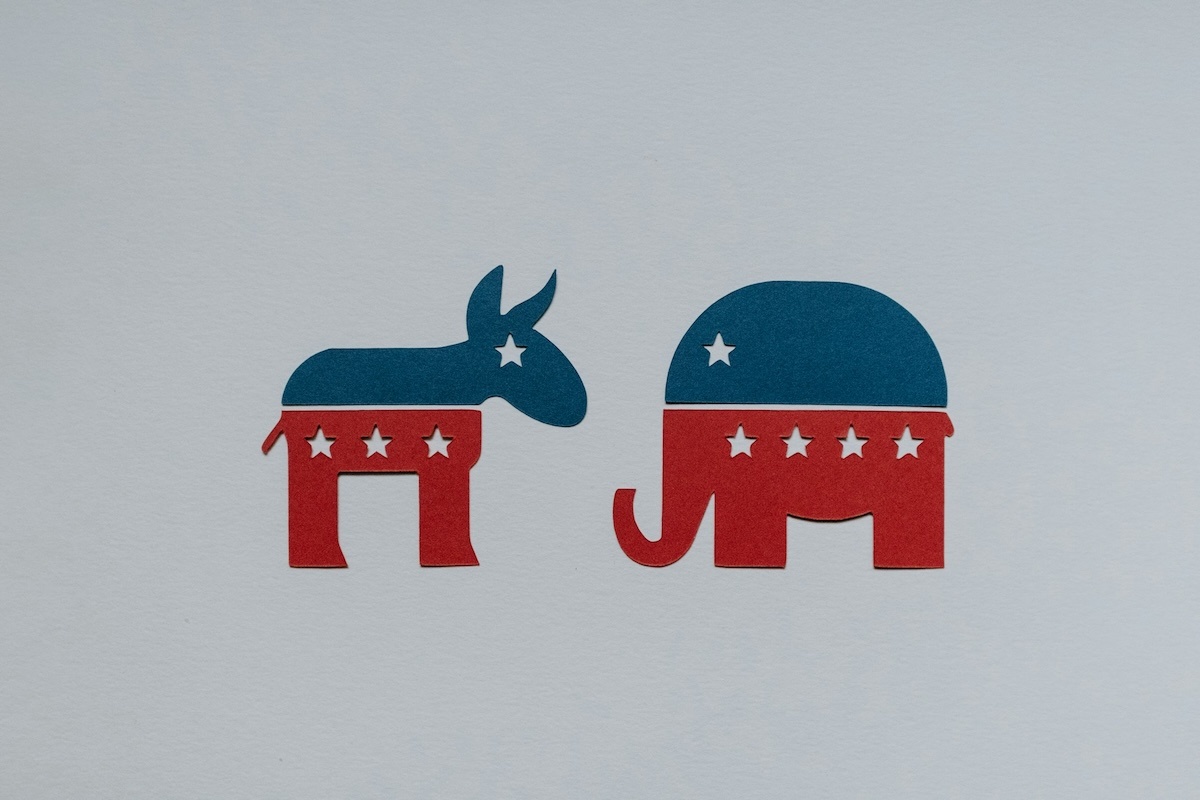
As the United States approaches its 250th birthday, those early warnings by our founders ring truer than ever. Partisanship has indeed hardened into a firm tribalism, and the clash of competing factions now threatens to test—perhaps more so than at any point in living memory—the durability of the “American experiment.”
A 2024 Gallup poll found a record-high 80 percent of U.S. adults believe Americans are “greatly divided” on the most important values, a level that has steadily climbed in recent decades.
Significant majorities now see the other party as immoral, as Pew research indicates 72 percent of Republicans and 63 percent of Democrats view members of the opposing party as more immoral than other Americans, up sharply from 2016.
None of this is particularly surprising to anyone watching American politics today. Political identity increasingly shapes not just our institutions but our social networks, our media consumption, and even our perception of reality itself.
But both social science and local efforts suggest that this trajectory is not irreversible.
The New Science of Cooperation
Division may dominate today’s headlines, but it is not inevitable. In fact, recent science suggests that division is the exception rather than the norm for most of human history. Human beings evolved as profoundly social creatures—or “ultrasocial,” in the words of anthropologist Joseph Henrich—whose survival depended on cooperation in large groups.
Behavioral science has long shown that cohesive societies are built not by amplifying differences but by cultivating shared identities and shared goals. When people see themselves as members of the same group working toward a common purpose, cooperation becomes far easier.
The late political scientist Elinor Ostrom, who was the first woman to win the Nobel Prize in Economics in 2009, spent decades studying how communities around the world successfully managed shared resources without collapsing into conflict, effectively solving the longstanding issue known as “The Tragedy of the Commons.”
The defining research question she asked was: why do some groups cooperate while others fail?
Her research took her to communities across the world. She identified a set of conditions—known as the Core Design Principles (CDPs)—that allow diverse groups to cooperate effectively at multiple scales.
These principles enumerated are: (1) clear group identity and shared purpose, (2) equitable distribution of benefits and resources, (3) fair and inclusive decision-making, (4) transparency of behavior, (5) graduated responding to helpful or unhelpful behavior, (6) fast and fair conflict resolution, (7) authority to self-govern, and (8) collaborative relations with other groups (using principles 1-7).
Ostrom found that when any social group accomplished all eight of the CDPs, then they can overcome any social dilemma that might otherwise undermine cooperation and collective action at a higher level.
What makes Ostrom’s work especially relevant today is that these principles appear to be remarkably universal. They apply across cultures and contexts, from pastoralist cultures in east Africa to irrigation farmers in Nepal to fishing villages in Turkey to youth sports teams to businesses and corporations.
For much of American history, we embodied this common identity described in Ostrom’s work, however imperfectly realized. The challenge before us is not to “reinvent the wheel,” so to speak, but to relearn the deep-seated principles of cooperation that we’ve allowed to fade.
A New “Experiment” in Northern Michigan Civics
For many northern Michiganders, the rift between Democrats and Republicans has become too much to bear. Rather than wait for solutions from our politicians, they have taken it upon themselves to try and fix the political divide.
The Purple Assembly, a grassroots initiative recently started in Traverse City, grew out of a gnawing sense that Americans need to relearn how to hold constructive, civil dialogue.
“We were exhausted by the constant fighting we see on television,” says Tina Allen of Traverse City, one of the organizers. “It feels like politics has become a game where one side wins and the other loses, which typically ends in perpetual gridlock, and nothing ever gets solved.”
Allen and a handful of neighbors decided to try something different. They invited people with different political views into the same room and asked them one simple request: talk to each other—respectfully, of course.
Their first meeting, held this past February, drew more than 70 participants from across the region and all walks of life. “It was a success,” Allen says, “but more needs to be done. We’re still learning how to hold this space for everyone.”
Around the same time, another northern Michigander arrived at a similar conclusion. Sam Getsinger, an 82-year old retiree from Leelanau, began organizing “Common Ground Gatherings” that included people from all different demographics and political affiliations.
“The goal,” Getsinger told our sister publication, The Leelanau Ticker, “is to break down barriers of thinking so we can listen to one another and work together.”
“In kindergarten, the kids for the most part really liked each other,” Getsinger continued. “It always made me wonder what happened later in school, where they didn't anymore. I think, often, what we do to kids is separate them, and not show each of them what they have to contribute.”
Kalkaskans Come Together
These new initiatives coalesce with recent events such as the fight against data centers in Kalkaska, where members of the Kalkaskan Democrat party were fighting alongside members of the Kalkaskan Republican party—for the first time in living memory.
Ryan Wagner, County Chair of the Kalkaska Republican Party, describes the rare agreement in stark terms: “I don’t believe the unity against billion dollar corporations has been stronger. These data center developers make big promises that they don’t intend to keep.”
For Wagner, the issue transcended partisan politics entirely. “This had nothing to do with politics. I think the people cared more about the environment and the health of their children.”
“I believe people are tired of being lied to,” Wagner continues. “Environment and health are major concerns for us true Michiganders. We are surrounded by fresh Great Lake water that we must protect at all costs. These data centers are water-depleting vacuums, and the more research people do, the risks clearly outweigh the rewards to local communities.”
A Washington Post article, “How Data Centers Are Shifting the Political Landscape,” highlighted how the data center phenomena is exposing that Americans share far more in common than they typically realize, the same pattern observed in Kalkaska. Maybe, just maybe, we’re not so different after all.

Trending
75 Years of the Little Traverse Bay Humane Society
At the Little Traverse Bay Humane Society (LTBHS) in Harbor Springs, their answer, whenever possible, is yes: yes to adoptio… Read More >>
Compost Crawl Across Michigan
Sept. 13-26, the entire state is going to the worms with the Great Michigan Compost Crawl. Put on by Landscape for the Lakes… Read More >>
“Frame the Theme” Call for Art
Traverse City-based nonprofit The Folded Leaf Foundation (sister organization to the bookstore founded in Cedar) is issuing … Read More >>