Fall Hunting Preview
Updates from the DNR on deer, elk, and more
By Victor Skinner | Oct. 10, 2026
As Michigan hunters prepare to head out to the woods, Department of Natural Resources officials are highlighting a slate of regulation changes this year for deer and elk, with more to come in 2027.
The Buck Stops Here
“The objective in the Lower Peninsula is we’re continuing to see our hunters almost always take more bucks than antlerless deer,” says Brent Rudolph, the DNR’s deer, elk, and moose specialist. “So we’re reducing the number of days to take a buck” with a firearm.
“We’re hoping that will push our harvest ratio a little to favor antlerless deer,” he adds.
Between 2001 and 2024, there were only three years in which hunters in the northern Lower Peninsula harvested more does than bucks, and that reality is complicating efforts to reduce an overpopulation of deer in many areas.
“It’s the population management aspect of it,” Rudolph says. “We really depend on hunters to take antlerless deer to manage our population.”
Date Changes
Among the biggest changes for 2026 is a shortened December muzzleloader season, which was renamed the December Firearm Season in the Lower Peninsula. The previously nine-day hunt was “reduced to just three days,” Rudolph says, now running the first weekend in December.
The Dec. 4-6 firearm season, the last to harvest a buck, is followed by a late antlerless firearm season that will run from Dec. 7 through Jan. 1. Despite the changes, “for the Lower Peninsula, folks aren’t losing any days of hunting,” Rudolph says.
While hunters can use any legal firearm during the new December Firearm Season, the Upper Peninsula will remain muzzleloader only during the three-day hunt.
Officials also eliminated an extended late antlerless and January archery seasons, concluding all hunting by Jan. 1. The traditional archery deer season, Oct. 1-Nov. 14, as well as regular firearm deer season, Nov. 15-30, remain unchanged.
Other smaller changes for the Northern Lower Peninsula include new early and late antlerless seasons for Beaver and Garden islands, where “there’s been some concerns about deer numbers impacting habitat,” Rudolph says.
There are also new limits on universal antlerless licenses across the Northern Lower Peninsula based on county, with most in the northwest limited to three, and Manistee County limited to five.
“The vast majority of our hunters don’t use up to three,” Rudolph says.
E-Tagging
DNR officials this year also expanded e-tags, or electronic licenses, to deer after testing the digital tags for turkey in recent years.
Hunters who purchase a license through the DNR’s HuntFish app are no longer required to affix a permanent tag to the deer if it’s kept in their possession or dropped at a processor or taxidermist.
“If they give it to someone else to transport or they leave it at a buck pole … they will need to put a permanent tag on it,” Rudolph says, adding the homemade tag must be constructed of “durable material with a license number written on it with permanent ink.”
“If you want a physical tag, you can still do that through the website or a vendor,” he says.
The app is available for download at the Apple App Store or through Google Play for Android devices.
Beyond license purchases and harvest reporting, the app includes regulations and guides, license history, registration for Outdoor Skills Academy classes, maps, DNR messages, current weather conditions, and sunrise/sunset tables.
Elk Update
DNR officials implemented changes to elk season dates, as well, extending both the early and late season. “The early hunt is now all contiguous days” running Sept. 23-Oct. 4, Rudolph says. The early hunt previously ran for three days in late August, and three days each during two weeks in September.
“Having it open in late August was awfully hot, and it was not a successful time period,” Rudolph says. “We’re trying to minimize the chances of it being really hot and uncomfortable, while still aligning with the rut in mid-September.”
The early elk hunt, focused outside the core elk range, is followed by a late season both inside and outside the core range, which was rescheduled from Dec. 13-21 to Dec. 1-15, a move intended to avoid overly snowy conditions and conflicts with holiday activities, he says.
Conditions Report
Vern Richardson, DNR biologist stationed in Cadillac, says he expects conditions across the region to be similar to 2025 when hunters head out this fall.
“They are starting to cut silage around me, which is pretty much on schedule,” he says. “In my area, it looks like it’s progressing as normal.”
Reports on hard mast have been mixed, he says, suggesting acorn production could be a factor deer hunters can exploit in some areas.
“I’ve seen and heard from people out bear hunting [that] acorns are prevalent in spots,” Richardson says. “There’s certainly a lot of areas with acorns, which is great for hunters who can find those. My recommendation would be to do some scouting and find productive oak trees.”
Other factors impacting hunting success, such disease die-offs or widespread winter deaths, are not an issue in 2026, Richardson says.
“I don’t think we’ve had any severe winter resulting in deer mortality the last few years,” he says. “I think the deer population should be very similar to last year.”
“We’re pretty much disease free,” Richardson adds. “We have not had any positive tests” for EHD, CWD, or TB in 2026.
More Changes to Come
DNR officials are planning further changes for the deer season in 2027 that were approved by the Michigan Natural Resources Commission in May.
Starting March 1, 2027, hunters in Michigan will be restricted to a single buck per year in the Lower Peninsula, though regulations for the Upper Peninsula will go unchanged.
A single deer license will be restricted to bucks with at least three points on one side, or an antlerless deer. Hunters who purchase a combination license will be allowed one antlered deer and one antlerless deer, or two antlerless deer. Current Deer Management Unit point restrictions will remain in effect.
Richardson notes that while most hunters are familiar with antler point restrictions in the region that have been in place since 2013, which limit buck harvests to those with at least three points on one side, many hunters are misinformed about how that regulation is enforced.
“There’s a commonly quoted definition of a point as something you can hang a ring on, but that’s not the legal definition,” he says, noting the actual regulation counts each point that’s at least one inch, measured from the main beam.
Find more updates and information at michigan.gov/dnr/things-to-do/hunting.
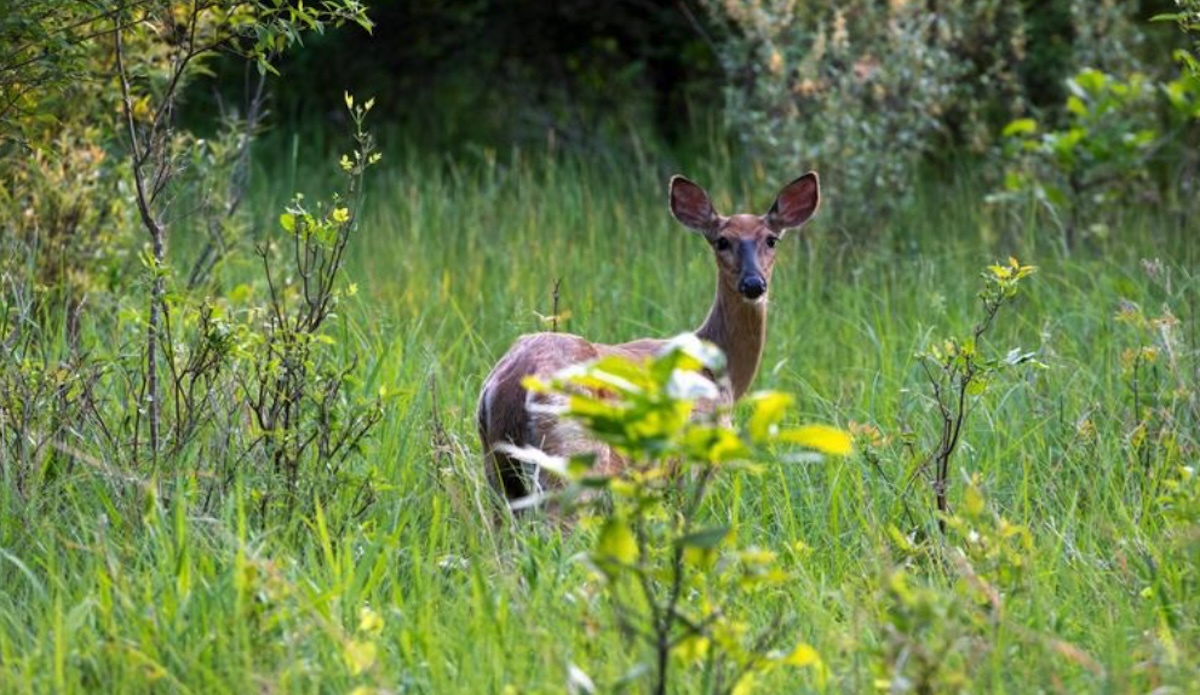
Photo courtesy of the Michigan DNR


Trending
Disconnect to Reconnect at Water & Woods
In August, Kaleva welcomed its first wellness retreat to the heart of Manistee County. Located at 15271 Makinen Road, Water … Read More >>
Spotlight on Frankfort Film Festival
The 18th Annual Frankfort Film Festival runs Oct. 15-18 at The Garden Theater, with films including A Private Life, sta… Read More >>
Downtown Sound Returns
Crooked Tree Arts Center makes a point of bringing in top talent in the off-season in Petoskey with their annual Downtown So… Read More >>