Growing Organically at Bear Creek Farm
How an animator and architect launched Petoskey’s first certified organic farm
By Kierstin Gunsberg | May 9, 2026
“There was no time to lose, no time to waste in rest or play,” wrote Laura Ingalls Wilder in 1933’s Farmer Boy. “The life of the earth comes up with a rush in the springtime.”
A lot has changed in the century since the children’s classic was published, but the rush to prep their soil and plot their summer harvest after a long, cold winter remains for northern Michigan farmers like Anne and Brian Bates.
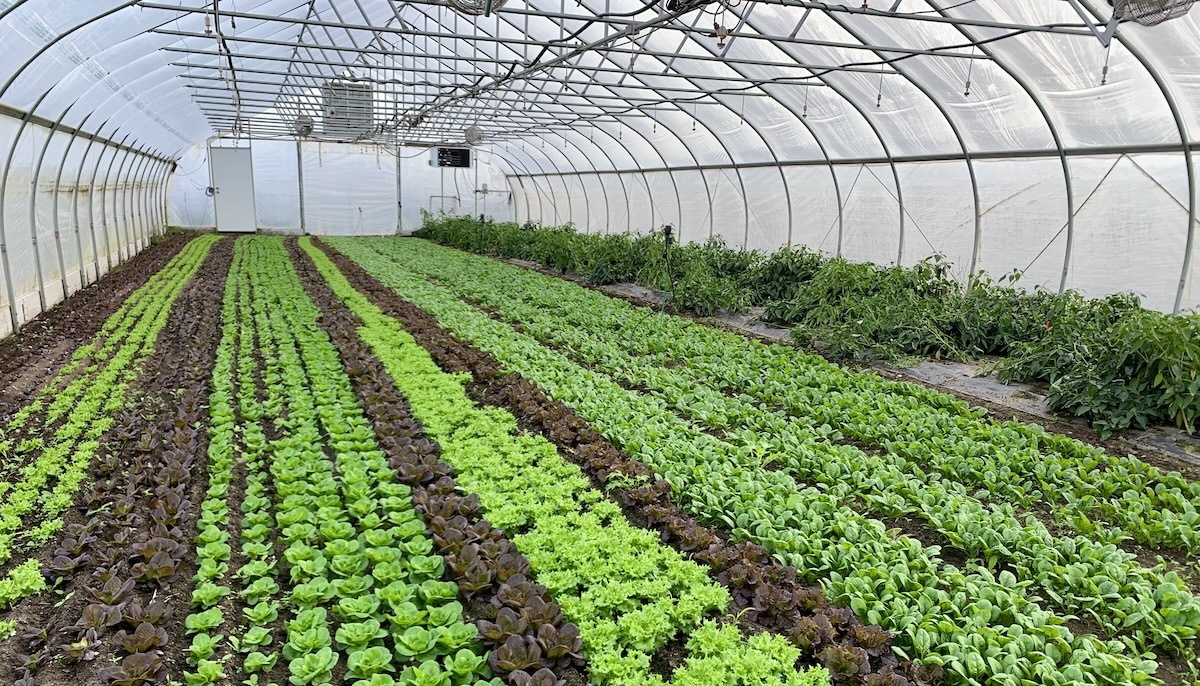
This time of year, the Bates, who own Bear Creek Organic Farm in Petoskey, wake just before the sun to tend their 75 acres, eight of which are fruit, veggie, and herb crops. Around 8am their farm crew arrives to help gather from the greenhouses.
“We usually harvest microgreens, spinach, or lettuce first,” says Brian. Then, it’s onto the basil, cilantro, dill, and edible flowers they’ll package to sell at their year-round, onsite market or incorporate into the dishes they dole out at their seasonal food truck.
Later, with their three children in tow, Brian and Anne will trail down row after row, watering hundreds of thousands of baby plants—something they do twice a day to prepare for the coming months of growth.
“Some of [the kids’] earliest memories are being carried through the greenhouse as we watered the plants,” says Anne. “No matter what they choose to do when they grow up, we hope that they see their early years on the farm as an absolute blessing.”
Never Say Never
Unlike Almanzo, the main character and “farmer boy” of Wilder’s book, Anne and Brian aren’t generational farmers, and they hadn’t really even spent much time on farms before launching their own.
In fact, the crux of Bear Creek Organic’s lore is that if the two hadn’t met by happenstance in 2007 on a college campus in Wisconsin—back when Anne was pursuing a career in animation and Brian was getting ready to study landscape architecture—the farm wouldn’t exist at all. Their college years led Brian, who began volunteering on an organic vegetable farm, and Anne to become more concerned about the environment and conservation.
So by the time the pair married in 2013, they were also celebrating the simultaneous milestone of purchasing 75 acres of land with the hope of giving sustainable, organic farmsteading a serious go. “We felt like food was a good place to put our energy,” says Brian.
Thinking they’d just soak up the beauty and peace of rural northern Michigan while producing their own food and selling whatever was left over, the Bates had no idea that over the next decade they’d end up building an operation that sees anywhere from 60,000 to 90,000 annual visitors, sells more than 90 percent of its offerings within a 12 mile radius, and takes a rotating crew of 12-30 employees (depending on the time of year)—plus a couple of orange tabby cats named Frick and Frack—to pull it all off.
Then again, as Brian says, he and Anne both have a never-say-never attitude.
Which is probably why, after six and a half years of selling their bounty at farm markets and setting up and tearing down up to three times a week in sticky summer heat (while also wholesaling their brand to grocery stores), the Bates saw COVID lockdown limbo as a chance to rethink their trajectory. Worried about how long the pandemic would hurt the farm markets they’d planned the majority of their business around, they built a temporary market right there on their own farm.
It was such a hit with the community that the wholesale side of things became too much to juggle, and in a if-you-build-it-they-will-come move, the Bates decided to expand the public side of their farm rather than continuing to spread themselves thin across outside endeavors.
A food truck offering a menu sourced from the farm—like fries made of organic heirloom potatoes—that was added directly across from the market in 2024, a kids’ play area with swings and tractor tires, and three greenhouses have made Anne and Brian’s farm into a day trip for both tourists and locals, the latter of which make up 85 percent of their annual business.
Farming Against the Forecast
For many northern Michiganders, one of the sweetest rewards for getting to the other side of April is the opening of farm stands and markets. But as year-round farmers, getting to the other side of April for Anne and Brian means battling the snow, ice, and freezing rain Mother Nature sends their way for nearly half the year. (That’s to say nothing of the super-short growing season and subsequent super-short customer traffic season, both of which last only from around May through October.)
And despite the last 13 years resulting in a huge loyal following and scenes of overflowing success—piles of butternut squash, ruby red apples, and sunset hued peaches fill their Instagram grid—it hasn’t been without trials and sometimes even heartbreak.
“Farming Up North is definitely over-idealized,” says Brian. As newbies he and Anne received a crash course in the realities of winter-farming, like the time they tried building their first greenhouse during 2013/2014’s polar vortex. “It was a catastrophe,” he says. “Every time we got started, it snowed in.” Then there was the time they bought their own plow truck to clear the way as snow blanketed their property, only to have AAA pull them out of their own driveway ditch twice that winter. “We’ve gotten smarter now,” says Brian.
But even after buying a bigger truck with a bigger plow and sowing years of salad greens and tomatoes, which make up most of their cash crops, some things can’t be outwitted.
The ice storm of 2025, which created $137 million dollars in damage across the state, was “easily our darkest moment on the farm,” says Brian. “Sometimes it feels like we really shouldn’t keep growing through the winter.” It’s something he and Anne waffled on for a couple years, ultimately deciding to stay open six days a week, growing smaller yields and stocking their market with fresh pies, produce, homegrown freezer meals, and staple ingredients throughout the off season in order to literally weather it out for the locals who shop their market for everyday groceries.
Being present for their Petoskey community, whether by hosting field trips for college students or buying back Halloween candy from kids (who get a store credit in lieu of the candy that’s shipped to soldiers overseas) is what’s motivated the Bates to keep on keepin’ on even when times are tough.
At the end of the day, all their best moments, both as a family and as business owners have happened right there on the farm. “It sounds cheesy,” Brian says. “But it’s really true.”
Certified Organic
Bear Creek Organic Farm has been certified organic since 2013 and became Michigan’s first B-Corp status farm in 2020. Anne and Brian explain what that means, and why being “unconventional” isn’t really all that radical after all (or at least, shouldn’t be).
Express: You’re a 100 percent USDA Organic and B Corp Certified farm. Walk us through how that looks.
Brian: Being USDA Organic requires that we avoid the use of conventional chemical sprays and synthetic fertilizers while focusing on building our soil health and promoting biodiversity. It’s a whole-systems approach to managing our farm’s relationship with nature. That “USDA Organic” label is also one of the only legally binding labels that can be placed on food packaging.
As for the B Corp status, the certification process is easily the most rigorous inspection we’ve ever been through [Note: businesses have to score at least an 80 out of 200 points in the B Corp assessment; Bear Creek currently lands at 105.2]. It was 28 days of audits, external reviews, interviews, and document submissions where they examined every aspect of our business from supply chain and wages to our environmental impact and fair labor practices.
Express: What exactly does it mean to practice organic farming vs. conventional farming?
Brian: Organic farming is the conventional, historical, cultural way to grow food. For 99 percent of human history, all farming has been organic. It’s been less than 100 years of chemical farming—how the chemical farmers have co-opted the term “conventional” is beyond me. What sets us apart from chemical farming is that we don’t use synthetic inputs. We don’t use GMO seeds, forever chemicals, petroleum-based fertilizers, or any fungicides or herbicides. When we grow and harvest our crops, we can walk through our fields and pick fruit off the plant whenever we want.
Express: What motivated you to be this kind of farm?
Anne: For us, we got into the world of business and sustainability to walk the walk. A lot of people talk the talk, but we’ve been committed to walking the walk from day one. If we want to build a better future, we can’t sacrifice working conditions or environmental standards in the name of financial gains. We need to achieve business success with healthy working conditions, healthy environmental stewardship, and positive business relationships.
Find Bear Creek at 4012 Atkins Rd. in Petoskey. bearcreekorganicfarm.square.site


Trending

The Tasting Room Is Now Cellar & Flame
Listen to your customers. That’s the lesson Carolyn Weeks took to heart, and it’s the reason The Tasting Room be… Read More >>
NoMi’s Own Renaissance Faire
Step back in time at the St. Ambrose Faire! Held on the grounds of the popular Beulah meadery and winery, this Oct. 10 event… Read More >>
Five Impact100 Winners
When Traverse City’s Impact100 first started, the goal was to raise $100,000 per year to support a local nonprofit, wi… Read More >>