National Parks at the Center of Debate Over How to Tell America’s Story
The Trump administration is rewriting signage at federal parks, but historians are pushing back
By Ren Brabenec | May 9, 2026
About 10 percent of Michigan land is managed by the federal government, with nearly 3.6 million acres maintained by the U.S. Forest Service and National Park Service (NPS). Most of this land is untouched wilderness, a pride and joy for hunters, foragers, and backcountry campers.
Some federal lands in Michigan have been carefully developed into popular park sites, designed to celebrate and preserve natural, cultural, and historical wonders like Sleeping Bear Dunes, Pictured Rocks, Keweenaw’s Copper Mines, Isle Royale, the River Raisin Battlefield Site, and more.
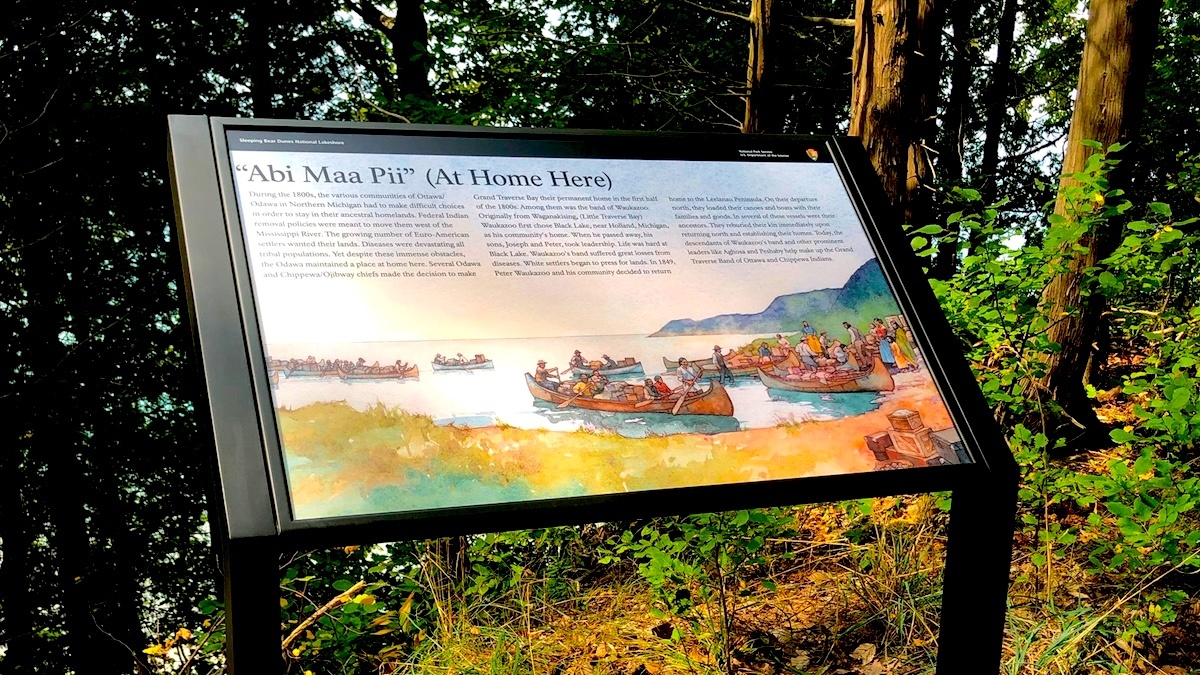
When exploring the trails, boardwalks, and byways of these parks, one will inevitably find the wayside signs: large-format outdoor panels used by the NPS to help visitors interpret landscapes, cultural sites, historical events, and the environment.
But, if the Trump Administration perseveres in lawsuits filed against its May 2025 “Restoring Truth and Sanity to American History” Executive Order (EO), many of the signs could be rewritten.
Interpreting History
2026 is the United States Semiquincentennial, or the nation’s 250th year since the Declaration of Independence was signed on July 4, 1776. Historical societies across the nation are gearing up for the big celebration, and many historians believe that how we interpret the past contributes to how we lay the foundation for our future.
“We’re always talking about interpretation when it comes to history,” says Kim Kelderhouse, executive director of the Leelanau Historical Society (LHS). “History is not chemistry. There are hard truths, yes, but we are always analyzing historical events and learning more about them, and as we learn, our perspective shifts and we’re able to craft a better understanding of what happened.”
Kelderhouse says that every historical analysis has some bias or slant, but federal institutions like the NPS and the Smithsonian are, by and large, very credible and trustworthy. She worries that the Administration’s EO seeks to fundamentally change how federal agencies like the NPS and Smithsonian interpret history, to the point where entire chapters of America’s story won’t be told accurately, if at all.
Kelderhouse pulls up the EO and quotes a line from it. “‘President Trump further ordered that the Secretary [of the Department of the Interior] shall take action, as appropriate and consistent with applicable law, to ensure that all public monuments, memorials, statues, markers, or similar properties within the Department’s jurisdiction do not contain descriptions, depictions, or other content that inappropriately disparage Americans past or living (including persons living in colonial times), and instead focus on the greatness of the achievements and progress of the American people or, with respect to natural features, the beauty, abundance, and grandeur of the American landscape.’”
Text Targeted for Removal
At the time of this writing, a new resource, missingparkhistory.org, has blown the whistle on the Trump Administration’s targeting of 443 signs within federally-managed parks across the nation. In Michigan, 17 signs across six parks have been flagged by the administration as being in contravention of the EO.
To give readers context on what types of language the administration considers disparaging or inappropriate for public consumption, we located examples of specific text on wayside signs that the administration has flagged for heavy editing or complete removal:
Sleeping Bear Dunes National Lakeshore: “During the 1800s, the various communities of Ottawa/Odawa in Northern Michigan had to make difficult choices in order to stay in their ancestral homelands. Federal Indian removal policies were meant to move them west of the Mississippi River. The growing number of Euro-American settlers wanted their lands. Diseases were devastating all tribal populations. Yet despite these immense obstacles, the Odawa maintained a place at home here.”
Sleeping Bear Dunes National Lakeshore: “Increasing occurrences of volatile weather, due to climate change, is impacting this beach and others throughout the park.”
Sleeping Bear Dunes National Lakeshore: “Seeds of invasive plants stick to your shoes. Walking off boardwalks and designated trails spreads invasive species that crowd out native plants.”
River Raisin National Battlefield Park: “Facing U.S. expansion in the early 1800s, diverse Native Nations united under Shawnee war chief Tecumseh. This Native Confederation, the largest organized Indigenous resistance ever, fought to protect their families, lands, and traditions against U.S. encroachment during the War of 1812.”
Pictured Rocks National Lakeshore: “The Anishinaabeg people (or Ojibwe) have lived here for centuries. Despite colonization and forced removal from their homeland, their connection with this place endures. Their deep knowledge and commitment to these plants, animals, and living waters form the foundation of Anishinaabeg culture.”
Isle Royale National Park: “Marine debris is entirely preventable. This is a global problem caused by people, and we can be the solution.”
Telling the Full Story
Kelderhouse says the EO is an affront to the American people, as it suggests Americans can’t handle hard truths or the occasionally grim realities of the nation’s past and how those realities influence the present.
Critically, the EO isn’t saying that the current NPS signage is factually wrong or even misleading. It just says signage should be removed when it “disparages” past Americans in relation to indigenous displacement or the transatlantic slave trade.
Similarly, when it comes to the environment and park landscapes, the EO isn’t saying climate change or invasive species aren’t real; rather, it says NPS signage should focus on the beauty of American landscapes, not on how humanity is contributing to a changing environment that may harm or permanently change those landscapes.
“Furthermore, studies consistently show the American people want to know the full story,” Kelderhouse adds. She refers us to the American Association of State and Local History (AASLH), which has published studies on the subject.
According to the AASLH, 78 percent of Democrats and 74 percent of Republicans “…support the appropriateness of confronting painful history. Asked whether it was acceptable to make learners uncomfortable by teaching the harm some people have done to others, over three-fourths of respondents said it was.”
A Local Victory
To the point of Americans being ready to learn the hard truths of the nation’s 250-year-long story, Kelderhouse talked about how LHS has been collaborating with Sleeping Bear Dunes National Lakeshore on an extensive research and documentary film project about one of the first African American families to homestead in Leelanau County, Anna and Levi Johnson.
“We were ready to premiere The Search for Anna & Levi: A Lost History of Black Homesteaders in Leelanau County, around the same time the Trump Administration handed down its EO, and we were a bit nervous,” Kelderhouse says. “But we’ve shown the film about six times to packed audiences with standing room only, and we haven’t gotten a single negative comment. We think that’s because the core of the film and its message is about coming together and healing past wounds. Anna and Levi Johnson were former slaves who persisted against nearly insurmountable obstacles to come to Leelanau, own land, farm it, develop a homestead, and make a free life for themselves.”
The film was just one part of LHS’s campaign to document African American history in Leelanau County. LHS also worked closely with the Park Service at Sleeping Bear on drafting, designing, and writing text for a new wayside sign to be installed in the park. The sign describes the family and identifies the site of the Johnson’s homestead. The sign has not yet been installed, but it was printed and unveiled at the documentary premiere in February 2025.
Any new signage placed in national parks must receive approval from the Department of the Interior, and Kelderhouse tells us the sign is currently pending approval for installation.
Kelderhouse says she’s optimistic the sign will be approved, but even if it isn’t, the sign will likely find an alternative home at LHS. Because LHS is an independent nonprofit, it can fill in the gaps and tell the stories the federal government does not.
“The Leelanau Historical Society’s mission is to preserve and share history of the Leelanau peninsula for future generations,” Kelderhouse says in closing. “The ‘Restoring Truth and Sanity to American History’ executive order is in conflict with our mission and the best practices upheld by history professionals, and because of that it is not something we can support.”
Kelderhouse continues, “The LHS deeply values and respects our colleagues at Sleeping Bear, and know that we share many common priorities as servants of the greater good and stewards of history. We always appreciate opportunities to collaborate with Sleeping Bear on historical research, events, and projects like the Port Oneida Fair and the The Johnson Family interpretive wayside.”

Trending

Saturday Suds in Cadillac
Grab a tasty craft brew or choose from a variety of NA flavors at Cadillac’s Craft Beer Festival, overlooking Lake Cad… Read More >>
Halloween Begins on Silver Lake
If the decorations around town haven’t been a sign, then consider this your official notice: spooky season is here! Ho… Read More >>
Revisiting Memory
How does a memory change when we revisit it? This is the question that Echoes, the newest exhibit at Crooked Tree Arts Cente… Read More >>