
Prosecuting Corruption, Defending Democracy
Former U.S. Attorney turned author Barbara McQuade explains why she believes the rule of law is under threat in her new book
By Kelsey Sanders | July 4, 2026
Barbara McQuade knows a thing or two about organized crime.
Before she became the New York Times bestselling author of Attack from Within in 2024, she was a prosecuting attorney. Her decades-long career included being the assistant U.S. attorney before being appointed the U.S. Attorney for the Eastern District of Michigan by President Barack Obama, where she was the first woman to serve in her position from 2010-2017.
During that time, she became involved in a variety of corruption, fraud, terrorism, and organized crime cases, including prosecuting former Detroit mayor Kwame Kilpatrick, the “underwear bomber” Umar Farouk Abdulmutallab, and Volkswagen for emissions violations. She also served as vice chair of the Attorney General’s Advisory Committee and co-chaired its Terrorism and National Security Subcommittee.
McQuade continues her work as a law professor at the University of Michigan, her alma mater, where she teaches classes in criminal law, criminal procedure, national security, and data privacy. She is also a legal analyst for NBC News and MSNBC, and a co-host of the podcast #SistersInLaw.
Now, she’s back with her second book, The Fix (released June 2), an exposé on what she believes is the escalating threat of far-right politics as well as a roadmap of “guardrails” for how to save and preserve our democracy, both as citizens and at a higher level.
“I think of myself first and foremost as a lawyer and an educator, and because I’ve had some experience and training as a journalist, I think that helps me communicate what I’m trying to teach about the law,” McQuade explains. “Experience has helped me communicate what the law is, and my goal isn’t so much to express an opinion as it is to help people understand what the law requires and how it works so they can make informed judgements and form their own opinions.”
McQuade will be in Traverse City visiting the National Writers Series on Monday, July 13, to tell us more about The Fix.
How It Began
McQuade was first drawn to the law during the Watergate scandal. Some of her first memories of current events were the hearings and she can remember as a young child being very aware of the fact that the president had done something terribly wrong.
“I didn’t quite understand exactly what it was, but I knew that it was something that was wrong, and I remember being deeply offended that someone who had had the privilege of serving as the President of the United States could do something so wrong,” she shares. “The president was a position that I considered exalted, and this man had abused his power and was being forced to leave. As I watched those hearings, it really struck me that misconduct in office is a terrible thing, but the people have the ability to serve as watchdogs and to hold people accountable when they abuse that authority. I think that feeling has really driven everything I’ve done in my career.”
McQuade’s years of prosecuting have provided her with a view of what corruption looks like inside and out as well as the warning signs, the tactics, and the personalities of those often implicated.
“I was involved with all these cases of extortion, bribery, and fraud, and some of the things I learned are some of the tactics I see in our current government,” she says. “Building leverage over other people, finding ways to inflict pain on victims and then by inflicting that pain, coercing people to come to the table to negotiate their own punishment. And the truth is that once you pay a bribe, then the extorter owns you.”
Fuel for The Fix
Several moments during the current administration pushed McQuade to write The Fix, including the appointment of certain cabinet officials, the dismissal of bribery charges against former New York mayor Eric Adams, executive orders against several law firms, and pardoning individuals who engaged in violence at the Capitol.
“I think some of the signs we’ve seen [from organized crime cases that we see in our administration now] are these efforts to use leverage and also this idea of kind of creating an appearance of invincibility,” McQuade explains. “One of the things we see in corruption cases and mob cases is a feeling of omnipresence, of omnipotence, and of power. And it creates a feeling of hopelessness and helplessness.”
Part of the blame also falls on the many forms of media and the information warfare that weakens the system that is trying to be preserved.
“We live in a world where anybody can become a publisher, and in some ways, it’s a wonderful thing, but it also means that anyone can say anything whether it's true or not, and many people will believe it just because they read it,” McQuade says.
“Thankfully,” she continues, “we are learning better than to believe everything we read online now; however, I do worry that we are seeing an erosion of trust in anything that we read, and that can have a harmful effect as well. We don’t know what to believe anymore and so we begin to believe everybody’s corrupt, everybody’s making stuff up, and that causes a cynicism and a disengagement from politics.”
What Everyday Citizens Can Do
McQuade says that the prevalence of misinformation and corruption means each person needs to put in more work to read, research, and sift through what’s out there to learn as much as possible before elections, because America’s systems are only as good as the people elected. While everyday Americans are entitled to “the rule of law,” morally just individuals need to be elected to help uphold those laws because most laws aren’t black and white.
“‘The rule of law’ means that we’ve all agreed through our elected representatives in the legislature to make laws that all of us will follow,” McQuade explains. “Sometimes there are gray areas, and so courts are there to help us fill in the gaps and to interpret the law and to administer it when there are disputes in the law. Although we may disagree about various things, we respect the law and we recognize that it will be applied evenly to all of us—that no one is above the law.”
In her book, McQuade expands on the connections between her long prosecuting history and what she sees in the current political climate to paint a picture of what we can do to preserve America’s democracy. McQuade shares several “guardrails” to reform and strengthen our democratic institutions from the way members of Congress are selected to the number of members in Congress to creating term limits for those members.
“I think there are some things that [we could do that] are very achievable, and that we ought to look at as a society to remove some of the partisanship from Congress, because I think with a robust Congress, they could push back against an executive branch through their oversight, through their power of the purse, and even through their impeachment power to hold a president accountable,” she explains.
Her advice to Americans who worry about what the present and future hold for democracy is simple: “We all have so much more power than we give ourselves credit for. Nobody can get elected to higher office without our vote. And our vote is valuable, and we should not give it away to people who are unworthy.”
McQuade also encourages people to join nonpartisan collective action movements like the League of Women Voters or Indivisible, to campaign for individuals they believe in (especially in local elections), and to continue to have conversations with those you’re closet to, even if you don’t agree on everything.
“I think one of the most important things we can do is to remember that we all love America,” she concludes. “There has been an effort to stoke rage and hate and to look at each other as enemies—you’re either red or you’re blue. There's an effort to divide and conquer us, but I think if we come together and remember that we all have a lot in common and all we really care about is a good government, then we can come together and work toward the fix ourselves.”
About the Event
Barbara McQuade will be joined in conversation with #1 New York Times bestselling author and National Writers Series co-founder Doug Stanton on July 13 at the City Opera House. Doors open at 6pm with live music, and the conversation begins at 7pm. This event includes a Q&A session and an author signing immediately following in the lobby. For more information, visit nationalwritersseries.org.
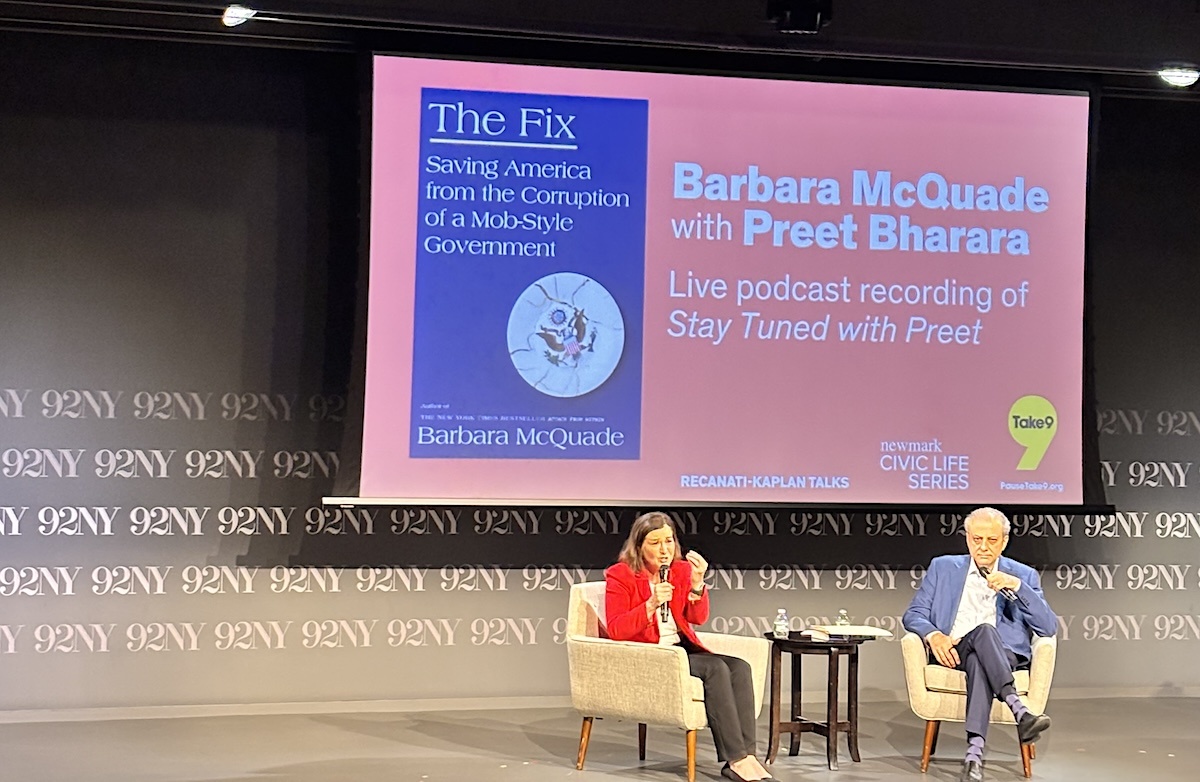
Pictured: McQuade with former federal prosecutor Preet Bharara at an event in NYC.


Trending

Disconnect to Reconnect at Water & Woods
In August, Kaleva welcomed its first wellness retreat to the heart of Manistee County. Located at 15271 Makinen Road, Water … Read More >>
Spotlight on Frankfort Film Festival
The 18th Annual Frankfort Film Festival runs Oct. 15-18 at The Garden Theater, with films including A Private Life, sta… Read More >>
Downtown Sound Returns
Crooked Tree Arts Center makes a point of bringing in top talent in the off-season in Petoskey with their annual Downtown So… Read More >>