Shapes of Things to Come: A New Study Forecasts the Impact of Sprawl Gone Wild by the Year 2040
March 13, 2002
Suppose you could gaze 40 years into Northern Michigan‘s future through a crystal ball. Would you still find a place of forests, farmland and wildlife habitat?Not if the predictions of the Michigan Land Resource Project ring true. Issued in December, 2001, the study offers bad news for agriculture, forestry, tourism and mining in the state unless current trends in urban sprawl are stopped in their tracks.
Specifically:
• Michigan will lose 25% of its orchard land in the next 40 years.
• The state’s destination resorts, particularly those in Northern Michigan, are threatened by the blight of development along the highways that lead to them.
• Michigan will lose 1.9 million acres of farmland in the next 40 years.
• As land becomes more fragmented, the price for harvesting Michigan’s timber will increase.
• Land available for hunting will dramatically decrease, while “edge” species such as white-tailed deer will continue to increase in numbers.
• “Built” land in the form of new homes, business and roads will increase by 4.1 million acres across the state, more than tripling the existing amount of developed land.
Another major finding of the Project is that agriculture, mining and forestry are unable to compete with the value of the land for other uses, such as new housing subdivisions. A local example is the sale of farmland between Traverse City and the growing commuter town of Elk Rapids.
THE BACKGROUND
The Michigan Land Resource Project is a “land transformation model“ developed by researchers at Michigan State University. The project attempts to map the future of Michigan for the years 2020 and 2040 using current data. This “map“ of the future forecasts the impact of sprawl on the land-based industries of agriculture, forestry, tourism and mining.
“These industries represent approximately one-third of Michigan’s economy,” states Al Almy of the Michigan Farm Bureau.
The project was organized by the Michigan Economic and Environmental Roundtable (MEER) and Public Sector Consultants, Inc., both of the Lansing area. Overviewing the project was an advisory group with members from the Michigan Farm Bureau, Michigan Chamber of Commerce, Michigan United Conservation Clubs, Crystal Mountain Resort, International Paper, and MSU Fisheries and Wildlife.
THE STAKES
Natural resources have served as the base of Michigan‘s economy dating back to the days of the Native Americans. Today, the resource-based industries of agriculture, forestry, tourism and mining account for $63.2 billion (29 percent) of Michigan’s economy.
Then there‘s jobs. Tourism, so dear to the heart of Northern Michigan, provides 350,000 jobs and $12 billion to the state‘s economy. Forestry brings 150,000 jobs and $9 billion to Michigan‘s economy. Forest-related tourism and recreation (camping, snowmobiling, etc.) provides another 50,000 jobs and $3 billion.
With 37 million acres, Michigan is a storehouse of natural treasures, including 11,000 inland lakes, 36,000 miles of rivers and streams, 75,000 acres of sand dunes, 3,288 miles of Great Lakes shoreline, 38,000 square miles of Great Lakes waters and 7.5 million acres owned by the state and federal governments.
Yet sprawl threatens to blight the state by disrupting wildlife habitat and greenways, destroying pastoral vistas, paving over farmland and trashing tourist areas with strip development.
Former Michigan Governor William Milliken best described the finite quality of our resources when he pointed out that “the 37 million acres that are Michigan is all the Michigan we will ever have.“
SAY IT AIN‘T SO
Although the Project forecasts a state that is increasingly denuded of its wildlife and natural charm, it‘s important to note that it‘s still possible to turn back the tide of sprawl.
“Though the trends presented may not be the image of Michigan that we cherish, it’s not too late,” says Chris MacInnes, Senior Vice President for Crystal Mountain Resort. “People can make a difference. We can help change these trends and still have time to make important choices. We can support policies and regulatory changes designed to preserve the character of our 37 million acres for the next generation. Or we can accept the status quo.”
Controlling sprawl is urgent, considering the following projections of how Michigan may change:
• Michigan had 11 million acres dedicated to agriculture in 1980. That will dwindle to 9.1 million acres by 2040 -- a loss of 17% of our farmland.
• Michigan had 2.3 million acres of property occupied by buildings, parking lots and roads in 1980. Developed property will increase to 6.4 million acres by 2040 -- an increase of 178%.
• There was 18.2 million acres of private forest land in 1980. Private forests will decline to 16.9 million acres in 2040 -- a decrease of 8%. State lands are also being sold or logged off, compounding the problem.
• Other vegetation is expected to decline by 24% in the state over the next 38 years. Some 400,000 acres of wetlands will also be lost, a decline of 10%.
POPULATION MYSTERY
One of the ironies of the report is that sprawl is not the result of a population boom. In fact, Michigan‘s population is at a modest growth level at a time when more forest and farmland is being consumed than ever.
What the Project shows is that barring some future disaster such as gas rationing which restricts the automobile, more of us are opting to live farther from urban centers, literally sprawling across the countryside.
For instance, during one 15-year period from 1980 to 1995, the Project studied sprawl patterns in a 17-county region. In 1980, the region had 6.13 million residents, a figure which rose to just 6.30 million residents by 1995.
Yet, although the population in the area rose by just 3%, sprawl had increased by 25%, from 1,851 square miles of development in 1980 to 2,322 square miles in 1995. On the average, researchers found an eight-fold increase in sprawl in the state.
LOST FARMLAND
Farmland is one of the areas hardest-hit by sprawl. “The number of farms in Michigan is projected to decline from 42,000 in 2000 to about 24,000 by 2040. The number of very small farms will not change much, but dramatic reductions will be noted in farms of 50 to 500 acres.“
While Michigan could lose up to 17% of its farmland overall (25% in metropolitan counties), factory farms such the so-called “hog hotels“ are expected to increase. “Farms over 1,000 acres will increase significantly,“ states the report.
Farmers are under heavy market pressure to sell their land to developers. Higher taxes in metropolitan areas and tempting real estate deals mean that more farmers are bailing out. In one area of southern Michigan, land was appraised at $1,839 per acre for farming, $2,739 per acre for recreation usage, $7,423 per acre for residential, and $19,495 per acre for commercial/industrial use.
The good news is that “the output of Michigan agriculture will continue to increase as farmers extract more product from less land and less labor.“
Unfortunately, that output will come at the expense of the state‘s beauty and quality of life as more farmland is developed.
One way to encourage the preservation of farmland would be for more communities to develop programs such as the Purchase of Development Rights currently in use on Mission Peninsula.
FRAGMENTATION AND RECREATION
The “fragmentation“ of Northern Michigan by new development offers both good and bad news for those who love the outdoors.
On one hand, many new rural landowners are creating or maintaining wildlife habitat around their homes in the way of ponds, woodlots, bird feeders and preserving wetlands as buffer zones.
Fishing and golf are two other recreation activities that benefit from sprawl, since the trend means more owners of water frontage and a growing class of persons who see golf courses as “last open space in many communities,“ outside of their parks.
On the other hand, fragmentation is playing havoc with the state‘s 6,000 miles of snowmobile trails as more homeowners decline access to their land.
Hunting is also affected.
“The great challenge for hunters will be finding huntable lands and gaining access,“ the Project notes. “Opportunities for hunting will shift away from the countryside near major population centers as new neighbors arrive and safety zones are created. With a safety zone of 450 feet from a structure off limits to hunting without permission, this means that every 30 x 30 foot structure constructed removes 15.6 acres of land for hunting.“
A problem for resort areas such as Traverse City and Petoskey arises as the result of tourists being turned off by miles of strip development on their way into town on vacation.
“As people move to destination resort areas to take advantage of the amenities and views, those areas may lose the character and quality that defined them as a destination,“ the Project notes. “It is often reported that the journey to the destination resort is an important element of the entire trip.“
WHAT TO DO?
“While the year 2040 may -- at first glance -- appear to be far into the future, it is important to recognize that from the year 2001, we are only talking about a generation and a half of Michiganders,“ the Project notes. “For those in their twenties and thirties, we are talking about the Michigan that their children will experience. And for those in their forties, fifties, and sixties we are talking about the Michigan that their children and grandchildren will inherit.“
So what to do about sprawl and its threat?
Talk, be aware, get involved.
“This project was not meant to be a crystal ball. However, it does provide very realistic projections about changes in the state’s land-based industries over the next 40 years,” says Bill Rustem, Project manager and vice-president of Public Sector Consultants. “It is intended to spark discussions and debate about where our state is headed if current land use trends continue. If those trends do continue, the study shows dramatic effects on both the state’s economy and our quality of life.”
The Michigan Land Resource Project is available on-line at http://www.publicsectorconsultants.com.


Trending
Summer Hot Spot: Median Sale Price for Area Homes Up 88 Percent Since 2019
Summer has long been the most active season for buying and selling real estate in northern Michigan. So, how was summer 2026… Read More >>
Donating Ahead of Cold Weather
Hard to believe, but winter is not that far away. Jubilee House, Traverse City’s only drop-in day shelter for adults e… Read More >>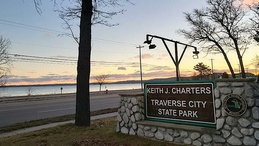
TC State Park Reopening in October
Construction work on the Keith J. Charters State Park in Traverse City is wrapping up early, according to the Michigan DNR, … Read More >>