Koch‘s no rookie
Sept. 12, 2007
Jeff Koch might seem like a gracious guy behind the counter of Garfield Auto, a car repair shop that he owns with his dad, but he’s not quite so laid back when he gets on his bike. Koch (pronounced cook) is a former cycling pro - he raced professionally for almost five years - and he’s screamed downhill with some of the country’s fastest cyclists. Now 36 years old, he no longer competes full-time, but still races around the country as a semi-pro. This will be his third Tour de Leelanau - “I’ve done the tour from the beginning,” he says. Here are his insights into the race and what it means to bicycle professionally.NE: Where have you raced?
JK: Ah, gosh, you name it. All over the United States, in Mexico. I haven’t had the opportunity to race in Europe.
NE: Tell me about your race team—Priority Health.
JK: There are two squads. The A squad are paid professionals. They race all over the country against other pros. It’s their job. The B squad, the squad I’m on, is made up of semi-pro riders who focus on regional races. Occasionally we have the opportunity to race at some of the big races with the pros, like when the A squad can’t fill their roster or can’t get their pro team from one race to another in time. The B squad also includes a junior development squad which consists of only cyclists under the age of 20. One of the members of the junior squad is local rider Larry Warbasse, who’s now racing with the U.S. National Team in Switzerland. Larry and I train together quite a bit.
NE: And Derek Prechtl used to be on the B squad with you?
JK: Right, he used to race with us and was one of our fastest cyclists. He has a couple of children now and a full-time job with Hagerty Insurance, so he can’t travel like he used to. He started the local Hagerty team (that will race in the Tour de Leelanau).
NE: How fast do you ride?
JK: It depends on the type of race. We just did a criterium (urban) race in Windsor, Ontario on Saturday and we averaged
28.6 miles an hour for 2 hours on a flat course. On downhills, it can get really fast; around 60 mph.
NE: Is it scary?
JK: Yes, it’s scary when you’re going at those speeds with 100 guys in a pack.
NE: At least they know what they’re doing.
JK: Yeah, but things can happen.
NE: Tell me the mistakes of amateurs that drive you crazy.
JK: Making unpredictable, twitchy movements—not holding their line. Scalping a corner—that means if you go into a corner, you start hard on the outside and dive on the inside, with no concern with the 50 other people who are also going around the corner. To ride in a pack, you’ve got to be really, really steady. That’s because you’re literally bumping elbows at some points.
NE: Have you ever crashed?
JK: Many times.
NE: What happened?
JK: Just silly stuff—coming off a corner—someone takes you out. What usually happens is a domino effect. Just one person making a screwy error or not paying attention and touching your back wheel; then one guy goes down and often takes at least five or six others with them.
NE: What are the team tactics in the Tour de Leelanau?
JK: There are sprint and hill climb bonuses in the early part of the race that tally points for cash awards, so what you’ll see is a small group that will attack at the very beginning and make a breakaway. Those guys will do everything they can to stay away for as long as possible and collect all the bonus points. These small groups will usually get caught around about Lake Leelanau or Suttons Bay, and then the attacks will start again. Another group usually forms and the winner will be decided from this group.
NE: What are you going to do?
JK: Hang on for dear life. There will be actually a lot of pro riders this year. Priority Health was the only team with a large amount of pro riders for the first two races. Now there will be some more complete pro squads. A guy like me will try to hold on, get lucky and slip into a group.
NE: How much do you train?
JK: Depending on the week, between 15 to 25 hours. I do speed intervals, hills and distance rides. It’s more the time and quality you put in, rather than the number of miles.
NE: Have you been training in Leelanau County?
JK: A little bit. I just tried to do a lot of racing in-state and out-of-state. But we’ve been training on the course for a few weeks.
NE: I noticed there are far fewer women in the race. Why is that?
JK: That’s a good question. I think one reason is location; we’re so far north. For one, there needs to be enough events in the race to make it worth the travel time. A one-day race is a crap shoot to bring eight riders for. They can’t control it. But if it’s for three or four days, they have better odds of controlling it with their numbers.
NE: So the number of men and women are more equal in other national races?
JK: No, there is still a disproportionate number of men in national racing as well.
NE: I have read that these races can get kind of brutal—other racers hitting or bumping you.
JK: Not at this level, no. Maybe at lower levels out of pure inexperience. Most of these guys are paid professionals—they’re not going to do that. They’re representing sponsors. It’s their job.
NE: Speaking of sponsors, did you have to pay for your bike?
JK: I get a deal on the bike I ride, which is a Specialized. McLain’s Cycle is one of my sponsors and Bob McLain has helped with bike deals since I was 19 years old. He’s always gone out of his way to support local riders and local racing. The bike is very light—about 17 pounds. It’s worth about $5,000 or $6,000.
NE: Do you have a pet name for it?
JK: I call it the torture machine.
NE: Tell me about your pro-racing days in the late 1990s. Did you have groupies?
JK: No, nothing like that. I was the low man on the pro team. I was the guy who had to get the water bottles.
NE: What’s the lifestyle like?
JK: You go from race to race, stay in a lot of hotels. You eat a lot of macaroni and cheese and ramen noodles. And you do a lot of conditioning, weight lifting and cross training in the winter. I did it for almost five years. It’s fun, but you get to a point when you want to stay in one place and I settled down here with the local bike scene. I met my wife riding locally—she raced mountain bikes.
NE: Is there a doping issue at this level?
JK: Yes, they test for drugs at all the professional races. They’ll test at this race. I suppose it could be an issue. But as for the performance enhancing drugs, you typically only see their use among the upper echelon pro riders in Europe. These drugs are very expensive, and it’s unlikely that a domestic pro could afford it. At best, they make $20,000 or $30,000 a year.
NE: One more question: Did you bike to work?
JK: I didn’t today, but I’ll ride home. I live in Elk Rapids, about 20 miles from where I work.

Trending
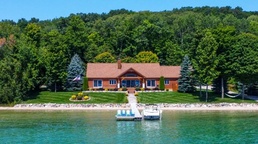
Summer Hot Spot: Median Sale Price for Area Homes Up 88 Percent Since 2019
Summer has long been the most active season for buying and selling real estate in northern Michigan. So, how was summer 2026… Read More >>
Donating Ahead of Cold Weather
Hard to believe, but winter is not that far away. Jubilee House, Traverse City’s only drop-in day shelter for adults e… Read More >>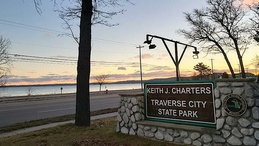
TC State Park Reopening in October
Construction work on the Keith J. Charters State Park in Traverse City is wrapping up early, according to the Michigan DNR, … Read More >>