Sea of Change
Aug. 15, 2007
Sea of ChangeCan we save the bays of Northern Michigan?
By Greg Reisig
Trawl nets filled with algae, round gobies replacing native fish, quagga mussels impacting bottomlands, declining water levels – these are all matters of great concern to the experts who study the bays of Northern Michigan. All of these signs mark a dramatic change in the chemistry and ecology of the 10,000 year-old bays.
Most of these changes are occurring at the bottom of the bays, but the impacts are manifested in periodic algae wash-ups on area beaches. Once the algae begins to build up, it releases an unpleasant sewage-type odor. In some locations, algae wash-ups have been over one foot deep and 200 feet in length. Beaches filled with algae have been reported on both Little and Grand Traverse Bay, and along Lake Michigan.
Grand Traverse Baykeeper John Nelson, whose family has lived on the bay for five generations, keeps a careful watch over a body of water he calls “special, unique. There’s nothing else like it on the entire planet. The bay defines our region and is irreplaceable.”
He is one of only three waterkeepers in Michigan. His work is connected to the Waterkeeper Alliance and the Watershed Center in Traverse City.
Nelson’s family roots run so deep he still maintains a family log cottage built in the 1930s near Northport. Living close to the water, he’s been quick to note changes in the bay through the years.
“Invasive species are changing the chem-istry and balance of the entire ecosystem,” he explains. “All of these changes have been based on human judgment but are now occurring at a much faster rate.”
INVASIONAL MELTDOWN
The local bays’ connection to Lake Mich-igan means they are open to 183 invasive species which are now inhabiting the largest system of freshwater lakes in the world. The Great Lakes hold 20 percent of the world’s water, yet biologists who study the lakes have called these changes “invasional meltdown, a giant outdoor biology experiment and an accidental zoo” with no one taking control. Grand Traverse Bay sits at the heart of this vast freshwater system with Little Traverse Bay only 55 miles to the north.
“There does not seem to be a political will to change the situation,” says Tom Kelly, executive director of the Inland Seas Education Association, who has been conducting research on the bay since the 1980s. “We know the problem -- we know the solution -- still, there is no action to govern and make the necessary changes.”
Kelly says his research has shown the water clarity of the bay has doubled in just a few years and now reaches to 75 feet. This has been caused by zebra and quagga mussels who are prodigious algae feeders, producing clearer bay water that spurs the growth of cladophora, a plant that grows quickly, dies, and washes to shore and rots on beaches.
The increased sunlight reaching the bottom also helps increase algae growth. Divers recently confirmed that algae near the bottom has doubled in the last five years. Increasing phosphorous loads coming into the bay from 122 tributaries is thought to be another reason for explosive algae growth. Most of the phosphorous comes from lawn fertilizers and aging septic systems.
NEW SPECIES
“It is likely the 184th, 185th, and 186th invasive species are already here but have not yet been identified,” Kelly said. New invasive species arrive in the lakes on an average of every seven months with no apparent end in sight. They quickly spread into Grand Traverse and Little Traverse Bays. Scientists believe quagga mussels, the tougher cousin of the zebra mussel, are eating tiny particles of food that native fish need to survive. In some areas of Lake Michigan, quagga mussel densities reach 16,000 mussels per square meter.
The next potential invader, the Asian Carp, is only 50 miles from Lake Michigan in the Illinois River. The EPA predicts the carp would disrupt the entire food chain and could become the dominant species in the Great Lakes within a short period of time. These fish are in excess of 100 pounds and consume vast amounts of food. They were imported by catfish farmers in the 1970s to remove algae and suspended matter from fish ponds and were released during flooding in the early 1990s. A $9.1 million barrier has been erected by the U.S. Army Corps of Engineers to keep them out of Lake Michigan.
GREAT LAKES LEVELS
Many researchers are also concerned about the impact of global warming on the Great Lakes. Changes in the temperature of the lakes can accelerate algae growth and create a more favorable environment for invasive species, which come into the lakes through the ballast water of ocean-going ships. Some scientists have predicted a three- to five-foot decline in water levels on Lake Michigan by the year 2040 but also say much more research is needed. Lake Superior levels are now at their lowest since 1926.
Evaporation may also be a contributing factor to lower lake levels. If there is no ice to shield the sun’s rays from hitting the open waters of the lakes and bay, the rate of evaporation greatly increases. In a typical year, 26 inches of water evaporates from the surface of the bay. With lower than average precipitation levels for the last five years and conditions bordering on drought, there is reason to be concerned about the future.
WHITEFISH DECLINE
Kelly says the lack of ice cover greatly impacts the eggs of native whitefish stocks. “It’s easy to see the bay freezes over less and less frequently. The ice provides protection for the whitefish eggs.” It appears many of the native species, including whitefish and lake trout are being crowded out by the invasives. Research indicates tiny diporeia, which provide food for whitefish, are disappearing at an alarming rate. Many of these tiny creatures are being eaten by zebra and quagga mussels.
Catches of whitefish continue to decline in northern Lake Michigan. Commercial fishermen have reported catches of emaciated whitefish, some at half their normal weight. Many scientists say invasive species are devouring diporeia and other food sources normally eaten by whitefish and lake trout. Diporeia, which are one-quarter inch long and live in the bottom sediment, are estimated to be about 70% of the whitefish’s food source.
Even more disturbing in recent months has been the spread of a fatal fish disease known as, viral hemorrhagic septicemia (VHS). Researchers believe VHS was likely imported into the Great Lakes by an ocean-going freighter. The disease is already spreading quickly and has killed thousands of fish from 20 different species in four of the five Great Lakes. The presence of VHS in northern Lake Michigan was recently confirmed.
GLOBAL PROBLEM
Invasive species, increased algae growth and declining water levels are also evident on large lakes throughout the world. Chesapeake Bay and San Francisco Bay are also being impacted with a similar set of circumstances. Lake Okeechobee in Florida is experiencing record lows. Okeechobee is the second largest freshwater lake in the contiguous U.S. with Lake Michigan being the largest.
Grand Traverse Bay is currently about 18 inches below its average level and four feet below its highest level in 1987. This mounting evidence suggests global warming is having a major impact on the water resources of the entire planet.
Nelson says stormwater runoff is also a major problem for the bay. “People need to remember all the rainwater falling on streets, roofs, and parking lots eventually runs into the bay.” Stormwater also carries sediments and nutrients which have a major impact on fish habitat. Nutrients speed up the aging process of lakes and streams. Aging septic systems near the bay are also a factor. “Almost everything happening on the land reaches the water,” Nelson emphasized. “It does not magically disappear through any form of filtration system.”
SHORELINE DEVELOPMENT
As a fifth generation resident of the bay, Nelson recalls his boyhood days roaming the beaches near Northport. “The shoreline was relatively undeveloped until the ‘70s and ‘80s when the trend to build larger year-around homes began. Up to that time only a scattering of seasonal cabins dotted the shoreline. Now, around 75% to 80% of the shoreline is developed. The more impervious surfaces we create the more sediment and nutrient run-off into the bay. Natural shorelines are being replaced by fertilized lawns running to the water’s edge.”
Despite all the shoreline development, the Grand Traverse Regional Land Conservancy has worked to preserve dunes and natural shorelines scattered along the eastern edge of the bay. Some of these preserves include: the Deepwater Point Natural Area, the Maple Bay Farm, the Wilcox-Palmer-Shah Preserve and the Antrim Creek Natural Area. All are open to the public.
Nelson and many others are also extremely concerned about the impact of alterations to the bay’s shoreline caused by low water levels. Extreme changes occurred last November when the Cherry Tree Inn, located in East Bay Township on U.S. 31, sent a bulldozer and backhoe into East Bay to remove hydric soils from a coastal wetland complex apparently to create a sand beach where none historically existed. “This showed an ignorance and self interest,” Nelson stated. “We are now paying the price as this coastal wetland complex has been fragmented. They have tried to create a beach that was never there. This goes far beyond the parameters of beachgrooming.”
PRESERVATION AND PROTECTION
“What’s remaining of this wetland complex, running along the southeast shore of East Bay, should be preserved. The rest should be restored,” Nelson emphasizes. He also believes the Department of Environmental Quality (DEQ) should visit sites where violations have gone beyond the law and take strong actions to prevent changes to the natural shoreline of the bay.
Despite all the threats, Nelson remains optimistic. He mentioned a $40 million state-of-the-art wastewater treatment plant recently built by the City of Traverse City as a major accomplishment in protecting the bay. In addition, he said Garfield Township’s recent efforts to restore areas of Kid’s Creek have been outstanding.
“More and more people are shedding their ignorance and learning about the need to protect the natural systems of the bay,” Nelson continued. “99% of the people want to do the right thing to protect this incredible natural resource which is the region’s largest economic draw.”
Greg Reisig is a member of the board of the Northern Michigan Environmental Action Council (NMEAC).
Little Known Facts About Grand Traverse Bay
• The Bay holds about nine trillion gallons of water.
• 640 million gallons per day enters the Bay from 122 tributaries.
• Torch Lake was once the third arm of the Bay until approximately 4,000 years ago.
• Water remains in the Bay for approximately 26 years.
• 26 inches of water evaporates from the Bay’s surface each year.
• 60% of the water entering the bay comes from the Elk River Chain of Lakes.
• 30% of the water entering the bay comes from the Boardman River.
• About 200 inland lakes are in the Bay’s watershed.
• The Bay’s shoreline is 132 miles.
• 51 storm drain outlets flow to the Bay or to the Boardman River in Traverse City.
• Record low levels of the Bay were recorded in 1964, record high levels in 1987.
• More than 110,000 people live within the bay’s 976 square mile watershed.
• Since 1997 the Bay has only frozen over once.
• There are three islands in the Bay including: Power, Bassett & Bellows Island.


Trending
Summer Hot Spot: Median Sale Price for Area Homes Up 88 Percent Since 2019
Summer has long been the most active season for buying and selling real estate in northern Michigan. So, how was summer 2026… Read More >>
Donating Ahead of Cold Weather
Hard to believe, but winter is not that far away. Jubilee House, Traverse City’s only drop-in day shelter for adults e… Read More >>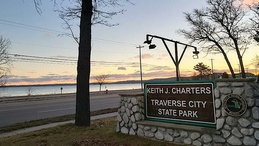
TC State Park Reopening in October
Construction work on the Keith J. Charters State Park in Traverse City is wrapping up early, according to the Michigan DNR, … Read More >>