Stories from the Edge of Hope: An Evening with Frances Moore Lapp
Sept. 3, 2003
On Friday, September 12 at 7 p.m. at the Milliken Auditorium, residents of Northern Michigan will have the opportunity to hear first-hand the internationally-known author Frances Moore Lappé. For those unfamiliar with her, she is the author of *Diet for a Small Planet,* a 1971 groundbreaking bestseller. For those who have read it, many report that it changed their lives.Last year, Frances along with her daughter Anna Lappé, released the 30th anniversary sequel *Hope’s Edge: The Next Diet for a Small Planet.* Jane Goodall said of the book: “Absolutely one of the most important books as we move further into the 21st century.” Today, Lappé’s books are used in hundreds of college courses in more than 50 countries and have been translated into over a dozen languages. She has received 15 honorary doctorates, and in 1987, Lappé became the fourth American to receive the Right Livelihood Award, sometimes called the “Alternative Nobel,” for her “vision and work healing our planet and uplifting humanity.”
As part of its 30-year anniversary, Oryana Natural Foods Market is hosting this event. Following Lappé’s presentation, a reception is being organized in her honor at the Oleson Center. Because locally-grown and organic food is key to both a thriving local economy and community health, Oryana is teaming up with NMC’S Great Lakes Culinary Institute and local farmers to prepare a “Local Foods Reception” inspired by recipes found in *Hope’s Edge* and *Diet for a Small Planet.* This is the first time that the Great Lakes Culinary Institute and local farmers will work together on a project of this scale. Tickets are $10 for the presentation and $15 for the presentation and reception and are available at Oryana. You can also join Lappé at Horizon Books on Thursday, September 11 at 7:00 pm for a book signing.
The following interview with Frances provides a brief glimpse of one of the most visionary and realistic thinkers of our time.
NE: The title *Hope’s Edge* is such a great title. Did you ponder that for awhile? How did you come to it?
Lappé: It took a long while. Hundreds and hundreds of titles went through the mill and were rejected. In the final throes of the process, during a writing retreat, while brainstorming for the umpteenth time, Anna came up with the title even though she herself thought it was kind of “cheesy.” Ultimately, we decided to go with it because it’s not cheesy or bland, it actually comes from a place deep within. Hope is not what we find; it’s what we become in action. Hope is what we feel when we are actually doing something for our lives and the planet.
NE: Some of the questions you raise in *Hope’s Edge* really made us ask who we are on a very deep level. They include: “Why as societies have we created that which we as individuals abhor? Why do we collectively allow things that we don’t individually support? Why do we allow ourselves to be reduced to passive consumers, acquiescing to a world we feel we’ve never chosen?” Can you expound on them a bit?
Lappé: These questions all revolve around one of the themes of our next book, which is a companion book to *Hope’s Edge* and delves deeper into issues about fear. Fear is what keeps us creating a wall we don’t want. It’s very tribal, very primal. We evolved in tribal bands and if we were cast out, we were dead. As human beings, we’re totally socially connected and terrified of being isolated or different. Our great strength and our vulnerability as social animals, is our innate compassion and we’re losing that connection with each other.
We have become a global tribe on a death march toward global devastation. We need to discover how to pull back. We need to find the courage to break with the dominant tribe and find strength. We can do this by bringing into our lives people who will listen to our heart and who are willing to risk that disconnection. We need to find new tribes. Our not so secret motive in writing *Hope’s Edge* was to rub elbows with the Wangari Maathais of the world, though I may never be as courageous as she.
NE: But as you say breaking free isn’t that easy because of the dominant mental maps, or thought traps lock us into certain ways of seeing. Even though there are solutions originating all around us, we can’t see them because they don’t fit our expectations. The media is one dominant mental map that comes to mind. How significant a role do you believe the media has in shaping the current paradigm?
Lappé: HUGE HUGE HUGE. We need a “News Diet” a “Hope Diet.” We have to focus on being conscious; paying attention to what we put in our minds is equally as important as what we put into our mouths. Most of the mainstream media is caught up in innuendo and fear, which drains our energy. Fear is not bad if it motivates us to take action. A “News Diet” consciously chooses sources of information that aren’t fear-mongering. These sources of information would include alternatives weeklies and news on-line. News should be something that actually helps shape the future and include real analysis as well as ideas about what you can do right now to make a difference. Mainstream media is no longer an institution of democracy; something that runs counter to our founding father’s intention. News has become a commodity with its main purpose to sell other commodities, in particular products about our own fears.
NE: What do you think is one of the most exciting solutions we can tap into, act on, on a national basis today?
Lappé: An existing grassroots effort to revive a genuine political process. Our political system has become a commodity. We need to create a grassroots political process where people can discuss and become involved in it. The Howard Dean campaign is one example of this. We need to get big money out of the campaign process.
NE: In *Hope’s Edge,* you state that genetic engineering may be what finally shocks us into finding our voices to ask the questions we must if we are to heal our planet. Do you believe that the American public has been shocked into raising their voices over this issue?
Lappé: Not nearly enough. China now requires labeling of GMOS. How can a totalitarian country can do this and we can’t? Monsanto is suing a dairy in Maine because they want to label their product GMO-free.
NE: One idea that really resonated with us was the idea that “Every choice we make can be a celebration of the world we want.” How can the average person in the suburbs of Detroit make choices that celebrate life and make them feel like they are “affecting something”?
Lappé: I think it’s incremental and starts with what you care most about. For a parent, one of the major concerns is about the health of one’s children. Questions like: How do I provide food that is healthy for my children are key choices we can make. Ultimately, we need to ask ourselves how do I create a life where I don’t feel powerless? How do we each find that voice that is particular to us, our individual voice, not our collective voice? It’s important whom we choose to associate with. Find a friend who is asking the same questions, a buddy that will make you feel less like a victim and more powerful.
NE: You talk about dissonance and say if “we’re lucky, or if we stretch, or if life simply hits us over the head with the proverbial two-by-four, we can each experience that moment of internal dissonance.” Can you say a little more about what you mean by dissonance?
Lappé: I think we have them a lot. For example, if you’re walking by a homeless person, you may ask yourself: How can the richest country in the world have homeless people? Often we just walk by, avert our eyes and cringe. We need to listen to our inner discomfort and not use distractions like “comfort food” to fill us up and stuff our feelings. When we have the moments of dissonance, typically we try to forget them. Instead we need to let in our discomfort. In this society we’re taught not to listen but to our own internal discomfort. We use distractions to keep us from acknowledging our pain and our own lack of fulfillment. During these moments of dissonance we need to say: “I’m not going to stuff this one.” I’m going to take some action, find some solutions. And that can be as simple as getting a book, volunteering, taking a day off and finding people who are excited about life, in other words, doing things that fulfill ourselves.
NE: You explain that when we have those moments of dissonance, we face fear. And since fear doesn’t feel that good, it may be our struggle to avoid it that most traps us, and that most keeps us creating a society that violates our deepest selves. Where does this fear originate?
Lappé: It’s the fear of being kicked out of the tribe, of exclusion, of abandonment. We’re hardwired to have physical reactions to threat. The trick for this stage of our evolution is to acknowledge that those physical responses were appropriate on the savannah as survival mechanisms, but now they are anti-survival mechanisms. Today, feeling fear doesn’t necessarily mean to stop, on the contrary it means keep going, it means “I’m pushing my growth edge”. Feeling these fears may be exactly what we are suppose to be doing in spite of the physical signs our body is giving us. Instead of looking at this as being on the wrong path, we need to look at it as being on the right path. In this new stage of evolution, feeling fear may mean exactly the opposite of what is used to.
NE: I read in your book that you had this dissonance and many of us have these too, but not everybody does anything about it. What motivates you to walk this particular path? I guess in some way I’m asking if you have a set of spiritual beliefs that guide you?
Lappé: I do in the sense that my god is love. I believe that there is an energy of love in the universe that we all are a part of. Fear detaches and disconnects us from that source. Fundamentally there are two forces in the universe: fear and love. If I stay in the place of love of others, and myself, the fear dissolves. In my own life, I’m happiest when I feel that I’m connecting my gifts to the manifestation of love in the world. I’m no different from other people. All humans want to express their own piece of that universal desire to manifest love. It’s the highest joy there is. This is an extraordinary time to be alive. Even though fear is the emotional plague of the planet, a more positive love-based energy is emerging in the world. We can witness our own journey and ask ourselves as we see more fear and more destruction of the planet: “Are we choosing to react to that fear or are we choosing to create more love?”
NE: I was inspired to read that you believe in the real possibility of planet-wide breakthroughs even though we are pushing our little planet closer to hope’s edge. Do you feel that we are on the verge of a shift? What are some of the positive signs you see happening here in the U.S.?
Lappé: I’m a possibilist. Change does not occur in neat measured increments; it never has. How can I sit here and say something is not possible. We’ve had huge breath-throughs. For example, the Berlin Wall. All we can say for sure is that these enormous break-throughs can happen. One of the positive signs I see happening is the Howard Dean Campaign.
NE: You also state that things are shifting right now, that it’s not about starting the river flowing; it’s about jumping in. But many people hesitate to jump in because it means acknowledging how bad things are and why we need to have “courage of an expanding heart.” What do you mean by this?
Lappé: This is so important. People think that the only way they can maintain their ground is by blocking out the bad news and stuffing the pain. But we need to really acknowledge the depth of our pain. We need to grieve in order to find our courage. Grieve-ins could pull everyone together regardless of his or her political position. As we grieve together we can find the energy to discover solutions. Acknowledging our grief and feeling that pain is the first step.
NE: You also talk about how fear is an endogenous energy that comes from inside us, not outside. Therefore we can harness our would-be fears, harmonize our energies and channel them into courage. How does the average person do this?
Lappé: I really believe that we all want to be heroes. Being a hero to oneself has nothing to do within anyone else. What may be a challenge for one person is not for another. We all have our own personal edge. What is a triumph for me may not be for you. The point is to recognize our fears, however large or small they may be, and find the courage within to move that edge a little further out.

Trending
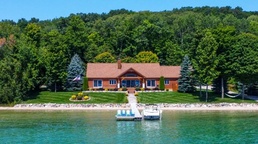
Summer Hot Spot: Median Sale Price for Area Homes Up 88 Percent Since 2019
Summer has long been the most active season for buying and selling real estate in northern Michigan. So, how was summer 2026… Read More >>
Donating Ahead of Cold Weather
Hard to believe, but winter is not that far away. Jubilee House, Traverse City’s only drop-in day shelter for adults e… Read More >>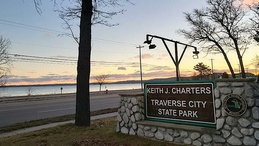
TC State Park Reopening in October
Construction work on the Keith J. Charters State Park in Traverse City is wrapping up early, according to the Michigan DNR, … Read More >>