One with the Land: New Exhibit Tells the Story of the Anishinaabek People
May 12, 2004
Wherever you go in Northern Michigan, you’ll find the footprints of the Anishinaabek people -- the “First People” -- whose footprints go back hundreds of years in the region.Those footprints also run through a time when the Anishinaabek were robbed of their land by white settlers, and stripped of their language, culture and religion. Only in recent years, after hard-fought battles in federal and state courts, have the Anishinaabek risen to the path of reclaiming their heritage.
It’s a long and often painful story, and it will be told in photos and artifacts this summer when the Grand Traverse Heritage Center hosts an exhibition entitled “One with the Land: the Anishinaabek of Grand Traverse Bay” from May 15 – Sept. 29.
The exhibition is a collaborative effort between the Heritage Center and the Grand Traverse Band, says Daniel Truckey, executive director of the center. Tribal traditionalist Jack Chambers and an advisory council of tribal elders provided guidance and resources for telling the Anishinaabek story through their eyes.
“This is the most in-depth study we’ve ever done on the Grand Traverse Band,” Truckey notes. “We wanted to give a broad timeline that brought the history of the Anishinaabek in the region up to the present.”
A REVELATION
The exhibition, centers on 300 years of Ottawa and Ojibwa culture, tells of the period before contact with Europeans through the recognition of the Grand Traverse Band in 1980. It will explore Anishinaabek spiritual beliefs, the clan system, social customs, treaty rights, Indian Schools, and changes in tribal culture since the 1600s.
The story is told largely through 60 photographs -- some of which date back to the 1870s -- as well as paintings and Indian artifacts. The exhibition opens with a community celebration on Saturday, May 15 at noon, featuring traditional Anishinaabek singing, dancing and drumming with the Medicine Lodge Singers of Peshabestown, and traditional Ottawa and Ojibwa food samples.
For those whose background on Native Americans is limited to films such as “Dances With Wolves,” the exhibition is likely to be a revelation.
For starters, consider the map of Northern Michigan. Virtually every community of any size here was once an Anishnabek village. “You can almost put a shovel in the ground anywhere here and find something related to that time,” says Truckey.
Petoskey, Elk Rapids, Omena, Old Mission, Leland and Manistee were originally homes of the semi-nomadic Anishinaabek. “Traverse City was a central gathering place for travelers canoeing from the Mackinac Straits,” Truckey says. “They’d leave their canoes here and go south on the trails inland to hunt.”
Those trails were taken up by white settlers and turned into roads, some of which are now major highways. And Indian villages such as Weguagamaw (present-day Kewadin) were transformed by the migration of loggers, farmers and fishermen.
Where the Anishnabek came from is a bit of a mystery. Oral tradition (cited in the Anishnabek exhibit at the Van Andel Museum Center in Grand Rapids) claims that the Anishnabek people once lived on the eastern seaboard and moved to Northern Michigan about 1,000 years ago. Historical records indicate that the Ojibwa migrated here from northwestern Ontario and the U.P., while the Ottawa were refugees from tribal wars along the Ottawa River in Canada. Whatever the case, considering that there is evidence of human habitation in Northern Michigan going back 13,000 years to the last Ice Age, some of the encampments and villages in the region were occupied off and on for centuries.
Many -- such as a community on Skegemog Point on the lake of the same name -- have been lost to the forests and swamps through the years.
“The villages on our map are only the ones we know of in the written record that was created post-1800,” Truckey says. “There are probably many other settlements in the area that we don’t know about. At Skegemog Point, there are indications that people were living there for 10,000 years up to the Woodland era.”
POPULATION PRESSURE
Today, there are an estimated 2,000 or so members of the Anishinaabek culture in the six-county Grand Traverse area. Similar numbers of Native Americans occupy the Little Traverse and Straits area.
But 300 years ago, there were many more Anishinaabek people living in the area. Typically, they lived near the lakeshore in the summer and migrated south in the winter for milder temperatures and better hunting.
“There’s no question that the number of native people who lived in the upper Great Lakes was much larger then than it is today,” Truckey says. Besides the Ojibwa (Chippewa) and Ottawa tribes, there were the Potawatami from downstate, the Huron from the Canadian side of Lake Huron, the Winnebago and Sioux from Minnesota and many other tribes.
Truckey can trace his own family heritage back several hundred years in the region, and believes his ancestors included members of the Anishinaabek. His family came here as French voyageurs in the 1600s and settled on Mackinac Island. A record of the Treaty of 1836 shows that one of his family members attended the event.
CULTURE CLASH
The Treaty of 1836 formalized what was essentially the theft of Indian land in Michigan. Since the Anishinaabek had no traditional concept of private property, they were easy prey for European settlers for whom ownership of land had been considered a source of wealth for centuries.
The Treaty was another milestone in what came to be a government-sponsored ethnic cleansing of the Anishinaabek culture, as spiritual beliefs, social customs and even Indian languages were suppressed.
“What a lot of people don’t even know is that even their religion was made illegal,” Truckey says. “In the late 19th century, a choice was made to assimilate the Indian people into white culture. It was thought that doing this was the least cruel way to solve what they called ‘the Indian problem.’”
The Anishnabek in Northern Michigan escaped the fate of many other tribes across the country by remaining in the region. Elsewhere, as in New England, outright genocide was practiced -- “The Last of the Mohicans” has more than a poetic ring to it -- as many as 30 tribes were literally exterminated on the eastern seaboard starting in the 1600s. Others, such as the Cherokee, were forced to walk the “Trail of Tears” in the 1800s to bleak reservations on the Oklahoma prairie and other desolate locales. Some tribes fled to the isolation of Canada.
“In Michigan, the Indians were seen differently,” Truckey notes. “It wasn’t a goal for the white people who lived here for the Anishnabek people to move out.”
TOUGH TIMES
But white settlers here often didn’t understand or respect Anishnabek customs. For instance, although members of the Anishnabek could apply for homestead land or allotments after the Treaty of 1836, they were often ill-prepared to fit into the white culture’s economy.
“A lot of times, the people in charge really dragged their feet about awarding homestead land, and they gave preference to farmers from Europe or the East Coast,” Truckey says.
Then too, Michigan was flooded with newcomers of European heritage from the 1820s-’40s. Census records from that time claimed that there were 8,765 non-Indian residents of Michigan in 1820, a number which rose to more than 212,000 in just 20 years. By 1890, there were some 2,100,000 non-Indian residents in the state, compared to about 6,500 Indians.
Although the Anishnabek were capable subsistence farmers, their pattern of living was semi-nomadic and based in large part on hunting, rather than raising cash crops. They were unprepared for the concept of taxes and the consequences of non-payment. “A lot of tribal people who needed to make a living would have to leave their land,” Truckey says. “Then when they came back, they learned that they had lost it.”
Today, much of the farmland in Leelanau County was originally homesteaded by Anishnabek people who were unable to hold onto their property by the white man’s rules.
DISSOLUTION
As part of resolving the white culture’s “Indian Problem,” native people throughout Northern Michigan were encouraged to assimilate into a new society. Thus arose the so-called “Indian Schools” around the state between 1880-1935. These were military-style boarding schools which Indian children were required to attend to become “civilized” in white culture, language and religion. Failure to abandon one’s tribal language or spiritual beliefs could result in severe punishment.
Beginning in the 1880s through 1980, the federal government launched a policy of denying the sovereigncy of tribes, claiming that they were no longer culturally intact. Locally, that meant that tribal groups such as the Little Traverse Band had to fight for federal recognition. And it wasn’t until 1978 that President Jimmy Carter signed the Indian Freedom of Religion Act, allowing native peoples to return to traditional spiritual practices.
Even under this weight of repression, however, the region’s Anishnabek were seen as valuable workers in the burgeoning lumber camps, orchards and fisheries -- another incentive which saved them from America’s Indian diaspora.
RECOVERY
“One hundred and fifty years ago, the mindset of people was so different than it is today,” Truckey says. “It’s hard to judge people from that time, but we have to accept that the native peoples lost everything. Today, they may have TVs and indoor plumbing, but a lot of things that are intangible were lost -- their religion, language and way of life.”
Part of the exhibition at the Heritage Center tells the story of the Anishnabek people’s attempt to recover their heritage, using casinos and commercial fishing as an economic springboard.
The exhibit features 12 interpretive panels and many Anishinaabek objects from the Con Foster Collection as well as items on loan from individuals and other institutions.
The Grand Traverse Heritage Center will also host a series of Anishinaabek-inspired community events, to take place throughout the summer months. These gatherings include beadwork demonstrations, a historical treaty lecture, basket weaving, story telling and a Native American art market.
Truckey notes that pictures, artifacts and historical records fall far short of telling the Anishnabek story because theirs is a culture with an oral tradition of passing down stories.
“The tribe gave us information that you couldn’t get out of books. Their hisotry is an oral history of a culture passed down from generation to generation. It has to be heard -- ou have to take time to understand. What you end up with is a balancing act between the written record and the oral record.”
The Grand Traverse Heritage Center is located at 322 Sixth St. (Old Library) in downtown Traverse City. The center’s hours through May: Tuesday through Friday, 12 p.m. to 4 p.m. It will be open on Saturday, May 15 for the opening and every Saturday from June through September.

Trending
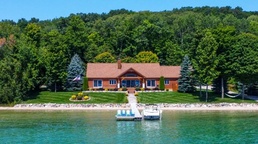
Summer Hot Spot: Median Sale Price for Area Homes Up 88 Percent Since 2019
Summer has long been the most active season for buying and selling real estate in northern Michigan. So, how was summer 2026… Read More >>
Donating Ahead of Cold Weather
Hard to believe, but winter is not that far away. Jubilee House, Traverse City’s only drop-in day shelter for adults e… Read More >>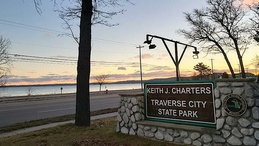
TC State Park Reopening in October
Construction work on the Keith J. Charters State Park in Traverse City is wrapping up early, according to the Michigan DNR, … Read More >>