Dressed for Success
Costume Designers Play Critical Role in Theatrical Productions
Oct. 9, 2014
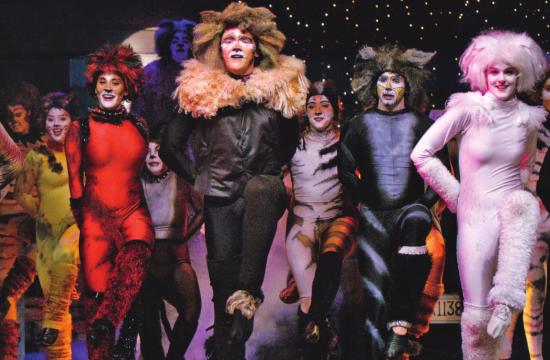
In order to immerse an audience in an imaginary world, it’s not enough to simply build the perfect set. If you want to truly transport theatergoers to another place–whether it’s northern Italy, the plains of Oklahoma, or Shrek’s swamp–when the house lights dim, the actors must be convincingly costumed.
A COMMON THREAD
When creating the look for a play, two things are essential: a vision and a sewing machine.
"My grandmothers taught me how to sew," says Susan Bernard, costumer with the Manistee Civic Players. Susan has been working with theatre, film and television productions, as well as area high schools, for 27 years.
Kathy Verstrate, a costumer designer at Old Town Playhouse, has likewise been sewing for years. Candace Hughes, lead costume designer at Interlochen Center for the Arts for 25 years, took a college course in sewing to complement her other design interests. Mica Harrison, costume designer with Parallel 45 theatre in Traverse City, actually earned her college degree in fiber arts.
Whatever their background, costumers say the ability to see the finished product in their minds is crucial. To achieve this goal, the first step is reading the play itself.
"I read it two or three times. You see who the characters are, where the action takes place, whether they’re rich or poor, if it’s hot or cold, the time period," says Hughes.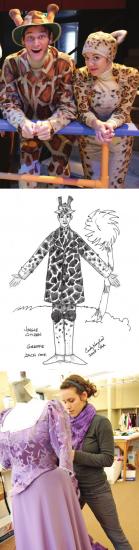
Verstrate, who boasts more than 35 years of costuming experience, agrees. "You see what the script references–pockets, colors," she says.
Often, they turn to sources beyond the text for further inspiration: books, films and the Internet. "You have a research component, especially with period pieces," says Hughes, who keeps her own library of books on hand.
For the Cadillac Footliters’ production of "Disney’s The Little Mermaid," costumer Jean Nicholas looked for suggestions in the animated film. "We got ideas from the movie. This has a lot of specialty characters," she explains.
STITCH IN TIME
Hughes often creates sketches for her designs. She then meets with the other design artists working on the production. It’s a collaborative process, not only between the director and costumer designer, but with the set designer and lighting designer, as well.
"We make sure the colors of the set and costumes work together," says Hughes.
If the colors are too close, the actors can disappear into the set; if the colors clash, it makes it hard for the audience to watch the show. And if the lighting doesn’t work with the clothing, it can undo all the effort that went into the design process.
Once the design is agreed upon, it’s time to break out the needle and thread. That may mean creating entirely new costumes or modifying something already in the costume shop for a new set and a new cast.
Designers often rely on friends and volunteers, as well as fellow staffers, to create costumes. They not only have to work with the demands of the play, but also fit the pieces to the actors, who come in all shapes and sizes.
For many costumers, their best friends are the local secondhand stores.
"I haunt the resale shops," says Verstrate. Nicholas says they often go to Goodwill and look for ways to use donated materials.
"We do a lot of repurposing," she says.
SEWING THE SEEDS OF SUCCESS
Budgets, time, and the artistic vision of the director are among the boundaries within which costume designers must work.
"Each show has a budget and there are always things I have to buy," says Verstrate. "Sometimes it’s easy. Sometimes it tests the limits of creativity. I’m a stickler for accuracy for the time period."
Sometimes, it can be a relief to work on a piece set in fairly modern times. "Dramas are more regular clothing," says Nicholas. "We do a lot of repurposing."
Harrison says her costuming of Parallel 45’s "The Shrew" offered an opportunity both for both period and modern dress–as the time periods in the play toggled back and forth–as well as something even more creative. "It has a lot of historical basis, but there’s some freedom in some details where [the lead] Katherina has a break in her reality," she says.
On occasion, the timeline or the specificity of the production is such that renting costumes makes more sense than making them. Bernard says that for her costuming of Shrek and young Shrek, she rented costumes for the sake of continuity between the two characters.
At Interlochen, Hughes will likely rent costumes for an upcoming production. "Our spring musical is "˜The King and I’," says Hughes. "The costumes are so ethnically specific we’ll never use them again, so we will probably rent them."
Whatever the challenge, the designers are up for it. Harrison says costume design is her artistic release after spending the day working in an office. They all agree that creating something from a shared vision is worth the effort.
"It’s fun to see what you can come up with," says Bernard.


Trending

Summer Hot Spot: Median Sale Price for Area Homes Up 88 Percent Since 2019
Summer has long been the most active season for buying and selling real estate in northern Michigan. So, how was summer 2026… Read More >>
Donating Ahead of Cold Weather
Hard to believe, but winter is not that far away. Jubilee House, Traverse City’s only drop-in day shelter for adults e… Read More >>
TC State Park Reopening in October
Construction work on the Keith J. Charters State Park in Traverse City is wrapping up early, according to the Michigan DNR, … Read More >>