
Should You Join?
Feb. 1, 2015
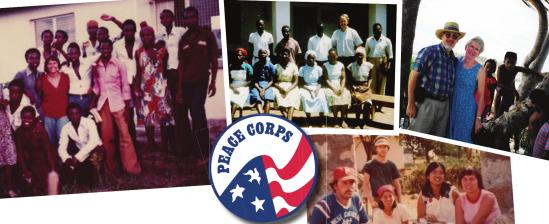
Locals share their youthful and far-flung adventures, advice
Not everyone earns a degree in English literature, joins the Peace Corps, helps rid the world of small pox, then goes on to run prestigious research hospitals. But that’s what happened to Elk Rapids resident Ken Bloem.
Peace Corps volunteers come from all walks of life. Some of them enter the organization straight out of college, while others celebrate their 70th birthdays on their first assignment. What is typical, however, is the belief that the experience enriched and changed their lives forever.
MIDDLE CLASS KID FROM MICHIGAN
In 1968, after graduating from Calvin College, Bloem received a public health assignment in Malawi.
"It was mind-blowing. I was just a middle class Michigan kid who hitchhiked through Europe with a friend one summer. That was the extent of my international experience," Bloem said. "It was a very transformative experience and a fantastic one."
Bloem would spend two years teaching health and nutrition to mothers with small children. He followed that stint with two years in Congo, known then as Zaire. Despite his lack of formal medical training, the two years in Malawi qualified Bloem to manage a small pox eradication program for part of Congo.
It was a remarkable and dangerous assignment. Elsewhere in the world, in places that weren’t torn apart by civil war, that job was assigned to doctors.
"There are volunteers that don’t have, for one reason or the other, the best experience, but I had two extraordinary professional and living experiences," he said.
NOT AS FREEWHEELING TODAY
Bloem said the Peace Corps is more regimented today and he doesn’t think what happened to him would happen to a current volunteer.
"I think the Peace Corps was a little more freewheeling and a little less structured," he said. "In the early years of the Peace Corps, the world was a different place and the American government was in a different position."
Bloem was a Peace Corps employee for several years after completing his two volunteer assignments, which is how he met his wife.
Next, he took a position with the World Health Organization. The couple moved to Bangladesh and continued the fight in the last days of small pox.
"At that moment, every public health worker wanted to see the last small pox case in history, so you had a sense of history looking over your shoulder as you worked," he said.
Bloem would continue his career managing research hospitals across the U.S. He ran the University of Chicago Medical Center and was CEO of the Stanford University Medical Center.
Bloem and his wife bought a home in Elk Rapids in 1989. They moved there permanently in 2003, except for the year Bloem spent working on a public health project for the royal family of Qatar.
"I wanted to show my wife and daughters what living in northern Michigan was like," he said.
MACHISMO IN LATIN
AMERICA Kama Ross was a female forester in Paraguay in the early 1980s.
That made for an interesting and, at times, uncomfortable Peace Corps assignment.
"I graduated from college all pumped up – "˜Yes, a woman can do this job just as well as a man!’ – and then I got put into this Latin American culture," Ross said.
In Paraguay, she found a culture of machismo so severe that landowners were unwilling to listen to the opinion of a woman.
Today a conservation district forester for Benzie, Grand Traverse and Leelanau counties, Ross said it took her a year to adapt and resign herself to the fact that this was not a battle she could win.
"In the end, I pretty much realized I wasn’t going to change the culture," she said. "I couldn’t do the women’s lib for the whole country."
Ross went into the Peace Corps with her then-husband, just out of college. Graduating with a forestry degree from Michigan State University, Ross discovered there were no jobs available. She said joining the Peace Corps was one of the best things she ever did.
"I’ve always loved to travel and I truly believe in the idea of giving back and sharing," she said.
SLEEPING ON A DIRT FLOOR
Ross and her husband were tasked with convincing landowners to adopt sustainable agricultural practices. At the time, many farmers were sacrificing long-term stability for short-term gain by clear-cutting forests to plant cotton or soybeans.
It took a year, but Ross realized she could have the biggest impact by educating children about the environment. She traveled the red clay roads of the hilly countryside on a motorcycle, splitting time between five one-room schoolhouses.
Meanwhile, the couple built themselves a wood home with a concrete floor and two windows. They’d been living in a dirt-floored hut, so this represented a tremendous jump in their standard of living.
Despite the struggle, Ross is nothing but an enthusiastic Peace Corps promoter.
"It’s just a wonderful stepping stone. It doesn’t matter what your degree is in – having that time to evaluate what those years of college meant to you. The Peace Corps is a perfect place to evaluate your strengths and challenges," she said.
A PEACE CORPS POST DELAYED
Josephine Polk-Matthews celebrated her 70th birthday as a Peace Corps Volunteer in Namibia, where she served from 1999 to 2001.
Why did she wait so long to join the Peace Corps? Polk-Matthews said she had wanted to enlist in the 1970s, but was too busy with career and family. "L ater, I couldn’t go because I was working on my doctoral degree."
While working on a dissertation about policy for special needs education in South Africa, she realized the Peace Corps might finally fit into her life.
"I looked at the Peace Corps as a way to return to that part of the world and get direct information about what was happening," she said.
There were no openings in South Africa, but there were some in Namibia, a country facing many of the same challenges as post- Apartheid South Africa.
In Namibia, Polk-Matthews worked with the ministry of education in a teachers resource center, where she instructed teachers, set up a library and computer system, and facilitated AIDS education and awareness.
"It impacted my life and I believe I had an impact on the lives of the people I met," said Polk-Matthews, who now lives in Elk Rapids. "One of the things I enjoyed doing most of all was talking with the women. It was a male-dominated society and I enjoyed talking with them about some of the things women in America had done, things African American women had done."
REMOTE TROPICAL ISLAND
Nurse practitioner Arlene Morton sought Peace Corps work after her husband decided to retire early in order to have an adventure. The couple certainly found it when, in 1998, they moved from South Bend, Indiana to Kiribati, a hardscrabble Pacific island nation where drinking water is scarce and poverty is abundant.
"My husband decided he wanted to do something really different, so that’s how we wound up there," she said.
Morton became a Peace Corps employee, rather than a volunteer, and was responsible for the health of volunteers spread across 17 islands.
Her husband Dan originally planned not to work, but the retired electrical engineer visited the country’s telecommunications company when he couldn’t get online and ended up with the job of getting Kiribati connected to the Internet.
After their adventure, the couple settled in northern Michigan, first in Fife Lake, then Traverse City.
While happy to now be close to hot showers and their three children and five grandchildren, Morton said she values her Peace Corps experience.
"At my age, I wouldn’t go again, but it was a very fulfilling situation and I think my husband would probably say the same thing."
FELT SOMETHING WAS MISSING
Robb Astor took a serious job post-college, working in an IT department in Ludington, but by his late 20s, he wanted more out of life.
"I felt something was missing and wanted something different. I basically quit my job, applied for the Peace Corps and started traveling for like a year," Astor said.
The year spent traveling around the U.S., sleeping on couches or camping, whet Astor’s appetite for adventure.
"People that knew me were trying to pin me down and say, "˜What you need to do is settle down and buy a house and get married,’" he said. "For me, at the time, I realized that that wasn’t something I wanted to do."
Astor ended up in Tanzania, where he taught high school physics between 1993 and 1995.
"We got off the plane in Nairobi and they took us into Tanzania and they quickly paired us up with host families," he said.
He said he got used to not having electricity or indoor plumbing.
The Peace Corps is supposed to change people and it truly altered the course of Astor’s life. It was there that he met his wife Stella, a Tanzanian. Today, the couple lives in Traverse City with their 18-year-old daughter and middle school-aged son.
Those two years loom large in his memory. "It’s sort of interesting looking back on the time in terms of thinking about things in the past," Astor said. "It occupies such a large portion of my memory, especially when I think of the next 20 years."
ALUMNI GROUP ORGANIZER
Sandy Seppala is a Traverse City resident responsible for bringing many of the area’s Peace Corps veterans together throughout the year. Retired after a career in technology that took her around the country, Seppala organized the Peace Corps alumni group because of the impact her volunteer experience had on her life.
In 1977, Seppala was in her mid-30s, divorced and looking for a fresh start when she wound up in the Peace Corps in Kenya.
In Kenya, she taught school in a remote village without modern comforts. It wasn’t her first time overseas; she’d also been an exchange student in Finland. In both places, she said she found the quality of life was different, but not necessarily better or worse.
"We’re raised to think we’re the best there is and we’re the highest level of civilization," she said.
Seppala said that her children, who stayed with her ex-husband while she was in Kenya, noticed she was changed when she returned.
Recently, her son told her, "You know, Mom, had you gone away and come back the same person, it would not have been OK, but you didn’t do that."
SHOULD I JOIN?Robb Astor, Tanzania, 1993-1995
"When you’re younger, I think people are open to different experiences and seeing things in quite a different way."
Ken Bloem, Malawi, 1968-1970; Congo (Zaire), 1970-1971
Bloem said that a young person needs "a tolerance for ambiguity, a desire for adventure and a willingness to take risks. A person needs to be flexible. They also need to find a good program that fits them well."
Josephine Polk-Matthews, Namibia, 1998-2000
"This is addressed to seniors, because I actually did senior recruiting when I was living in Arizona. Do it."
Arlene Morton, Kiribati, 1998-2000
"Be clear about where your comfort zone is up front. I think that would be one of the most important things, so you end up in some place where you feel like you can function."
Kama Ross, Paraguay, 1981-1983
Ross believes the best time to go into the Peace Corps is straight out of college because, if you wait, it may never happen because of the responsibilities you accumulate in life.


Trending

Summer Hot Spot: Median Sale Price for Area Homes Up 88 Percent Since 2019
Summer has long been the most active season for buying and selling real estate in northern Michigan. So, how was summer 2026… Read More >>
Donating Ahead of Cold Weather
Hard to believe, but winter is not that far away. Jubilee House, Traverse City’s only drop-in day shelter for adults e… Read More >>
TC State Park Reopening in October
Construction work on the Keith J. Charters State Park in Traverse City is wrapping up early, according to the Michigan DNR, … Read More >>