Michigan’s Craft Beer Explosion Leads To New University Programs
March 8, 2015

Small breweries have exploded across northwest lower Michigan in recent years. Where once there was only a handful of craft brewing establishments, today they can be found around every corner, in almost all our region’s cities and villages.
This boom means something exciting where career paths are concerned: more people are needed to brew beer. Previously, would-be brewers in the Midwest were limited to opportunities at the Siebel Institute of Technology in Chicago and the Master Brewers Association of the Americas in Madison, Wisconsin.
Now, a number of our state’s universities have responded to this market demand by developing fermentation science programs that will offer certificates in craft brewing right here in Michigan. They are scheduled to launch in the fall semester.
Students will be able to choose between programs at Central Michigan University, Ferris State University and Western Michigan University, with Western offering the nation’s first sustainable brewing program.
The Express chatted with Central Michigan program director Professor Cordell De- Mattei about the future of brewing and the art and science of beer.
Northern Express: Is brewing an art or a science?
Professor Cordell DeMattei: It’s a combination of both. There’s definitely a lot of science behind it, but there are some things that certainly science doesn’t know and it takes the brewer’s experience and touch to be able to work out. It’s a combination of both art and science. We’re pushing the science side because that’s what we teach here.
Express: Where did this program come from? What was the impetus?
DeMattei: It originated just because of the explosion of craft brewing, and the educational opportunities for brewers really haven’t kept up. Since this is the College of Science and Technology, we just really wanted to push the science behind it. And that’s one of the things that’s kind of lagging behind in the brewing industry; there isn’t a lot of quality control lab work and analysis being done. So that’s what we’re really going to try to focus our work on, being a good balance between doing the science, the analytical work, and getting some hands-on experience of brewing in the breweries.
Express: How much interest has there been in the program? How big will the class be next year?
DeMattei: We’re limited in the class size that we can take because we have limited lab space and we can only bring so many students into the breweries at one time to brew the beer. So we’re only taking a cohort of 24 students. I’ve gotten a lot of email inquiries and calls about the program, but I’m not sure how many are actually going to follow up with applications.
Express: Do students have to be 21?
DeMattei: We are currently limiting it to students who are 21. Others can apply. There’s going to be some tastings that we do off campus that they wouldn’t be able to do, and it would be a strike against them on the application if they’re not 21. I would prefer, for liability reasons, to only have students who are over 21, and we are listing it as a requirement. Though, legally, there are ways around it because there are exemptions written into the state law.
Express: What’s your background? Have you ever worked at a brewery?
DeMattei: I haven’t brewed at a brewery. I earned my Ph.D. at a yeast lab at Stony Brook University. Most recently, before coming to CMU, I was working at Working Bugs in East Lansing, which does fermentation to produce chemicals, and we were co-located with MSU’s distilling program, so we did a lot of beverage alcohol work also.
Express: How much demand is there for workers in brewery jobs?
DeMattei: I was led to believe, when I talked to the breweries, that there is demand for it. I mean, there’s a lot of people who want to go into it, so getting a certification isn’t a guarantee that you will get a job because I think there are a lot of people applying for jobs who want to get into the brewing industry. But, what I hope is it will let the breweries know that these people really are interested, went out of their way to really learn the trade, and hopefully give them the opportunity to show their skills.
Express: A lot of people today start out as home brewers and then apprentice at a small brewery. They sort of learn on the job. Is that going to be a thing of the past?
DeMattei: I’m not sure if it will be a thing of the past. I think there’s still a lot to be said for experience and learning under somebody, but when I talk to the people out at Oregon State, this question came up, because that is the way that things are in Michigan – where people go in as an apprentice and work their way up. In Oregon, where they’ve had a program for a while, they’ve actually had breweries coming in and asking them for brewers or analytical people to come in to work in their breweries. I don’t think the apprenticeship will be a thing of the past, but I think there will be a good balance, just depending on what kind of people the brewery needs – whether they need people with a certification or more qualifications or whether they need someone to come in and wash kegs and scrub the floors and work the apprentice way up.
Express: How important is a home brewing background for prospective students?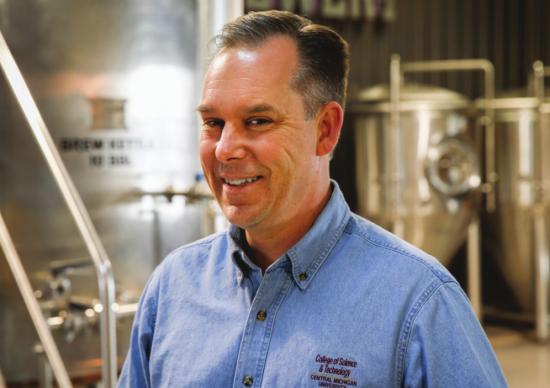
DeMattei: It’s probably a little bit of an advantage, but definitely not a requirement. I mean, home brewing is similar to brewing in the brewery, but there’s enough differences, even just the scale brings in a lot of differences. Yeah, it’s an advantage, because you do know some of the processes, but it is quite different than brewing in the brewery.
Express: Are you planning on establishing separate certificates for distillation or winemaking? DeMattei: Those are dreams in the future. We’re trying to just crawl before we run. Sometime in the future we would be very interested in pursuing those, and even fermentations in food – just a more general fermentation program – but right now we’re focusing on craft brewing. Right now I’m not even looking into wine and distillation. That would be some way down the road.
Express: How much room is there for experimentation in brewing? Do brewers need to become experts in the fundamentals before they experiment?
DeMattei: I think there’s vast room for experimentation. That’s what the craft brewing industry is about – trying different things. It’s always good to know the traditional methods and have a solid background in the styles. You can brew those and go to contests and win, and it will help you get exposure, but there’s always going to be room for experimentation, trying something new, coming up with something bizarre and tasty.
Express: What is your favorite kind of beer?
DeMattei: I started brewing when I went to graduate school, back when there weren’t many flavorful options. I experimented with hops and I like the hoppy IPAs really quite a bit. Michigan water is very good for making a nice, hoppy IPA, so they’ve really hit big here with the style, but I like a lot of other styles. I like a nice malty Scotch ale or a stout.


Trending

Summer Hot Spot: Median Sale Price for Area Homes Up 88 Percent Since 2019
Summer has long been the most active season for buying and selling real estate in northern Michigan. So, how was summer 2026… Read More >>
Donating Ahead of Cold Weather
Hard to believe, but winter is not that far away. Jubilee House, Traverse City’s only drop-in day shelter for adults e… Read More >>
TC State Park Reopening in October
Construction work on the Keith J. Charters State Park in Traverse City is wrapping up early, according to the Michigan DNR, … Read More >>