
Helping one of The Earth’s Oldest Species
April 26, 2015
Black River Sturgeon Get Second Chance
Lake sturgeons are a truly unique species.
Roughly 200 million years old,they are among the most ancient of fish. They can live for up to 100 years, weigh more than 200 pounds -- and Michigan’s Black Lake sturgeon are considered a threatened species.
Instead of roaming the Great Lakes, Black Lake sturgeon are now confined to their namesake lake behind the Alverno Dam, limiting their gene pool even further with only a small number left in that body of water. Fish can go downstream to Lake Huron and Lake Michigan, but can’t come back up. The DNR has found that very few sturgeon try to go over the dam. They are self contained. That limitation, along with loss of spawning areas and overfishing, led researchers in the 1990s to predict the fish would be extinct within 50 years, or sooner, if something wasn’t done to help them.
Great Lakes sturgeons were being killed en masse in the late 1800s and into the 1900s. They were considered a nuisance species because of the damage they caused to fishing nets. Most recently, poachers killed the spawning fish for its roe, destined to become gourmet caviar, making them – pound for pound – one of the most valuable of all harvested fish.
Brenda Archambo lives near Black Lake and, when she heard reports that the prehistoric fish, unique to the lake, would likely be gone in a few years, she became alarmed and decided to do something about it.
"I first looked into a sturgeon’s eyes when I was six years old and fell in love with it," she recalls. "I’ve been fascinated with them ever since. It was like looking at a gentle dinosaur. You can reach into the river and pet them as they slowly swim by. It was a life-changing experience for me."
Fifteen years ago Archambo organized a grass roots effort that continues today: Sturgeon for Tomorrow. Volunteers spend nearly two months, from mid-April to early June, patrolling the banks of the Black River, protecting the fish from predatory human poachers that could easily take them as they swim into the river to lay their eggs. The effort has been highly successful and has proved critical to the sturgeon’s long-term success.
"Last year we had close to 400 people show up to help patrol the river and they put in over 3,800 volunteer hours protecting the sturgeon during the time that they are most vulnerable," she states proudly.
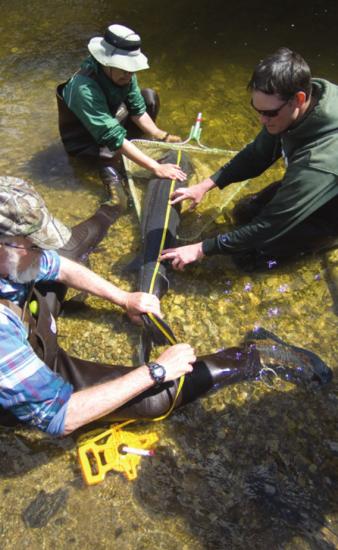
"We have a Boy Scout "˜camporee’ the third weekend of May. Several scout troops will be camping along the river to help patrol and to observe the DNR and Michigan State University researchers who also attend the annual spawning run to tag sturgeon adults, check their age and collect eggs for a hatchery.The young fish are raised to help stock Black, Burt and Mullet lakes with sturgeon," she continues.
George Warner, a 65-year-old Cheboygan resident, is planning to spend his sixth summer along the river helping to patrol and enjoying the experience.
"I love it. What’s not to like? I’m providing a valuable service and it’s a chance to spend time outdoors with some great people," the retired Vietnam War veteran enthuses. "I’ve made some nice friends over the years and look forward to spending time with them while doing this."
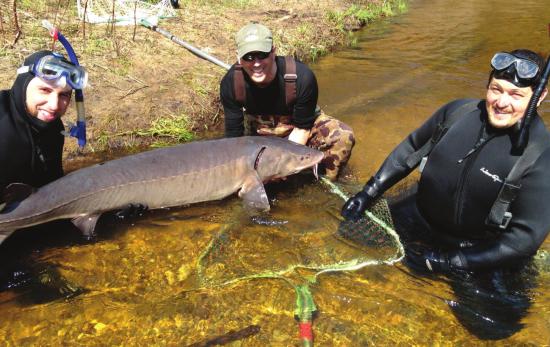
"Seeing the giant sturgeon up close is an incredible sight. It’s always a thrill watching the Michigan State students net them for tagging. They lift them out of the river and volunteers flock over to see how large they really are," he laughs.
Carp Lake residents Ralph Williams and his wife Hazel have been part of the effort for several years.
"We stay for a week and look forward to it every year," he exclaims. "Our daughter comes up from Ohio to join us. It’s a great way to connect with nature and you’re doing some good at the same time. Some of these people will bring a fifth wheel and stay for a month and some are just there for a day or two.’ Bryan Schram has brought his Harrison, Michigan Boy Scout troop to help patrol the river on Mother’s Day weekend for the past 14 years.
""¦it’s something the troop has embraced and looks forward to doing every year," says the longtime scout leader. "It’s for a good cause in a beautiful outdoor environment. It’s a great service project for our troop and the kids can earn merit badges for their participation. We have past troop members who still come back to camp out with us and enjoy the participation."
Despite the many volunteers that return annually, more are still needed each year. Volunteers can work for an afternoon or for several days. Spawning begins when water temperatures reach 60 degrees. Volunteer sturgeon guards are issued identifying hats and are assigned shifts on specific sites along the river.
"If you are in the area and don’t have a hat on, you will be stopped and questioned," Archambo adds.
If any suspicious activity occurs, volunteers use cellular phones provided by Sturgeon for Tomorrow to contact DNR conservation officers actively patrolling the area.
Ann Feldhauser, a DNR retiree from the Upper Peninsula, coordinates the volunteer program and interested individuals and groups can contact her for more information at 906-201-2484 or 906-346-9511. Volunteers can also register online at www.sturgeonfortomorrow.org/guarding-program.php.
"There’s plenty of opportunity available for those who wish to help over the six-week spawning season. There’s seven miles of river that needs to be monitored. Coordinators will also be on site at the river to assist and answer questions," Feldhauser says.
For those interested in seeing these giant, docile fish, but who can’t commit time to the guarding program, there is a guided sturgeon viewing tour slated for Saturday, May 9, from 11am to 2pm. Participants should meet at Lorenzo’s Restaurant and Lounge on Black River Road in Onoway at 10:45am to carpool to the river. The tour will go rain or shine. Polarized sunglasses are recommended for best fish-viewing opportunities.
Participants will watch research teams net the large fish and learn about the collaborative program to restore and rehabilitate the iconic species. The tour will also stop at a nearby hatchery to view the young sturgeon in various growth stages from one year to two years of age.
"They are so cute at that age," Archambo shares. "You just want to hold them."


Trending

Summer Hot Spot: Median Sale Price for Area Homes Up 88 Percent Since 2019
Summer has long been the most active season for buying and selling real estate in northern Michigan. So, how was summer 2026… Read More >>
Donating Ahead of Cold Weather
Hard to believe, but winter is not that far away. Jubilee House, Traverse City’s only drop-in day shelter for adults e… Read More >>
TC State Park Reopening in October
Construction work on the Keith J. Charters State Park in Traverse City is wrapping up early, according to the Michigan DNR, … Read More >>