
TCFF’s Special Guests: Inspire, Entertain, Educate
July 24, 2015
This week’s Traverse City Film Festival (July 28-August 2) brings a constellation of directors, writers, producers and characters – both fictional and real – to northern Michigan. Of the countless larger-than-life guests slated to appear, Northern Express shines the spotlight on three whose diverse stories are guaranteed to entertain and inspire audiences.
BOB MANKOFF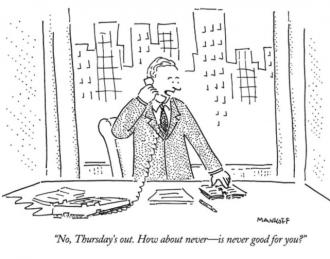
Bob Mankoff submitted 2,000 cartoons to The New Yorker before his first drawing was accepted in 1977. But his persistence paid off: In addition to selling close to 1,000 cartoons to the magazine since then, he became its cartoon editor in 1997, founded the successful licensing company Cartoon Bank and is responsible for the publication’s most reprinted cartoon ever (an executive on the phone: "No, Thursday’s out. How about never – is never good for you?").
At the TCFF, Mankoff will appear to promote Very Semi-Serious, a funny, poignant documentary by director Leal Wolchok about Mankoff and the other colorful characters that populate the New Yorker’s cartoon department. Mankoff spoke with us from New York about the film and his career.
Express: At the beginning of your career, as you kept receiving rejection letters from The New Yorker, did you begin to develop a sense of what was and wasn’t working in your cartoons? How did you get to that breakthrough moment?
Mankoff: I was doing the cartoons I wanted to, but I wasn’t slanting them for The New Yorker. I remember (the magazine) was at a particular stage where there were a number of cartoons without captions"¦that was the first one I sold. It was a guy at a very oldfashioned printing press, and he was sitting at the end of that, and as the newspaper was coming off the press he was reading it with a cup of coffee, like he’s at breakfast. It was a very detailed drawing, idiosyncratic. In retrospect, that unique sensibility was what they were looking for, and so maybe I intuitively incorporated that.
Express: Does getting published once make it more likely you’ll be published again?
Mankoff: It puts you on a track to joy and misery, both combined. There’s no guarantee, no matter who you are, that anything will be accepted. Once you get a contract, as I did in 1980, there’s a commitment to look at your work. But it’s true of everything – the articles, the writers, not just the cartoonists – that you have to continue to meet their standards.
Express: How do you decide what’s funny? You’ve mentioned there’s a balance or tension required in humor.
Mankoff: Cartoons never deal with things that are good. There are no cartoons about good marriage or sex. Bad is funny. The more I look at the structure of humor, it’s based on surprise. If there’s a scene we’re familiar with – a desert island, a married couple in bed – we’re going to switch the script. That’s what I’m looking for; a switch from a normal doctor, for example, to something a little more insane.
Express: Are there topics that are acceptable to joke about now that you couldn’t touch starting out?
Mankoff: It’s become acceptable to talk about sexual matters; you can talk about same-sex issues, which you couldn’t in the 1970s. But on the other hand, there is more political correctness now. During a period of heightened sensitivity, there are some issues where nothing is going to be perceived as funny. We’re not going to have any jokes about guns or Marines in the wake of the (Chattanooga) shootings, for example.
Humor is actually more complex now in terms of how you handle than it ever was. 40 years ago it was clear you can talk about this, you can’t talk about that. You had guys on the Ed Sullivan show, but you didn’t have Louis C.K. on Saturday Night Live talking about his neighborhood child molester.
Where the edge is – that’s not as clear now.
Express: How did Very Semi-Serious come about?
Mankoff: Leah (Wolchok) is very persistent. Many people have wanted to do something about The New Yorker, but she just kept coming back and eventually we gave in (laughs).
We’re opening up the inner sanctums"¦she had a real sensitivity to the cartoonists and their lives. It’s not gong to be what you expect; it’s a very touching, very emotional film. It touches on a lot of personal issues.
Very-Semi Serious will screen Saturday, August 1 at 9pm at the City Opera House and Sunday, August 2 at 6pm at Bijou by the Bay.
ROGER CORMAN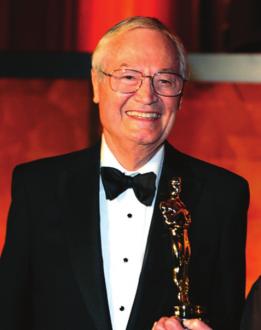
It’s difficult to overestimate the impact Detroit native Roger Corman has had on filmmaking. "The B-Movie King" – known for a prolific output of more than 400 films in his career, including low-budget camp classics like Little Shop of Horrors, Swamp Women and A Bucket of Blood – also introduced American audiences to Ingmar Bergman, Federico Fellini and Akira Kurosawa through his production studio New World Pictures in the 1970s.
A dizzying who’s who list of Hollywood heavyweights also got their start working for Corman: he helped launched the careers of Francis Ford Coppola, Ron Howard, Martin Scorsese, James Cameron, Peter Fonda and Jack Nicholson.
Yet the 89-year-old shows no signs of slowing down. Before returning to Michigan this week to accept TCFF’s Michigan Filmmaker Award, he discussed his legacy from his Los Angeles office, where he still heads to work every day.
Express: It was surprising to learn you’re still working on the job every day. What kinds of projects do you have underway?
Corman: We had the latest of our creature features last night on the Syfy channel, Sharktopus vs. Whalewolf. It’s about this insane creature, half-shark, half-octopus (chuckles). I questioned a couple of years ago if that was going too far into insanity, but the first Sharktopus film got the highest ratings in a year. We’re now figuring out who Sharktopus will be against next year. The best idea we’ve come up with so far is Sharktopus versus Donald Trump.
Express: What do you enjoy about doing campy films like that for Syfy? Do you consider them art, along with your more serious films?
Corman: No, I would not call them art films. Well I could, but I’d hesitate to actually do so. These are just fun to make. I have always liked them. And I like more speculative science fiction.
Express: You’re at the point in your career where you have enough clout to do higher budget films. Why keep going low-budget?
Corman: For one thing, I back all of my films with my own money. I don’t have that much money, so I’m not about to make a new Superman movie. At my age, I have to be careful that I don’t blow a lifetime of earnings on one mistake. So I tend to stick with what’s comfortable for my finances.
Express: How have you developed your Midas touch when it comes to finding and nurturing talent?
Corman: I think generally of three things. The first is intelligence. I’ve never met a writer, director or producer who’s had a long, continued, successful career who hasn’t been intelligent. Then there’s an ability and willingness to work hard. It’s partially true film is glamorous, but it’s also very hard work. The third is creativity. So many people who’ve started with me have started as an editor or cameraman, and I’ve been able to judge their creativity on that basis.
Express: Did it ever bother you to be the launching point for these directors and stars who’d then go on to bigger studios?
Corman: I think it’s inevitable. When someone comes out of film school, or is a good writer or director and they come to work with me, I anticipate that after a few years they will go on to greater careers. But then new people come in. It’s a revolving door"¦it still is today.
Express: This may be choosing amongst your children, but what are 2-3 of your favorite films you’ve done?
Corman: I might go back to the Edgar Allen Poe (adaptations). With The Masque of the Red Death, I was able to work with a somewhat bigger budget. Then I did a picture with a new young actor out of New York called Bill (William) Shatner called The Intruder, about the racial integration of schools in the South. It got great reviews. It was the first film I ever made that lost money, but these things happen.
Express: With all the great films you’ve helped make and distribute, do you mind your reputation as "the King of B films?" Is that an unfair legacy?
Corman: You know, the critics and commentators have been fair to me. I recognize I do make B films. Some are good, some maybe not so good – but hey, that’s how it goes.
The Intruder will air Wednesday, July 29 at 9pm at Bijou by the Bay; The Masque of the Red Death will air Thursday, July 30 at noon at the State Theatre. Corman will also appear in a one-on-one panel with Michael Moore on Sunday, August 2 at 9:30am at the City Opera House.

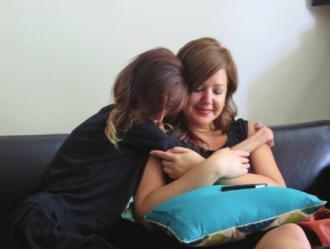
LIZZIE VELASQUEZ
When she was 17 years old, Austin native Lizzie Velasquez came across a YouTube video called "The World’s Ugliest Woman." The video had already racked up four million views. When Velasquez clinked on the link, she was horrified to discover the video was about her.
Rather than retreat, however, Velasquez – who at 63 pounds, suffers from a rare congenital disease that prevents her from gaining weight and has left her blind in one eye – decided to fight back.
Velasquez began posting her own YouTube videos sharing her story, and gave a TED talk on bullying and self-worth that went viral. Now a motivational speaker and anti-bullying advocate, Velasquez will appear in person at the TCFF with a new documentary about her journey, A Brave Heart: The Lizzie Velasquez Story.
Express: How did you become aware of the YouTube video that started you down this path? Do you know or why how the poster was able to get footage of you and upload it?
Velasquez: I accidentally found that video when I was 17. I was procrastinating doing my homework and saw a picture online that looked familiar. I have no clue who posted it or how he got the footage. It was only eight seconds long. I had no idea it would end up being something that changed my life.
Express: Obviously, a video like that would be devastating for anyone to see, but particularly a teenager. But it sounds like it was also the impetus for you to begin sharing your story.
Velasquez: Absolutely. When I found it, there was a mixture of not knowing how to handle it, being shocked and being angry some one would say such horrible things. It was a catalyst for me. I was trying to figure out if I could forgive them"¦when people bully other people, it’s not to make them feel bad, it’s because they’re coming from a place of hurt. It was a process for me to figure out if I could turn things around and use this to make the Internet a better place not only for myself, but anyone who uses it.
Express: It was only recently that your condition was finally medically diagnosed (as Marfan syndrome and lipodystrophy), correct?
Velasquez: Yes, I actually found out during filming. That’s what’s really special for me personally. That was a really big moment in my life. I’m grateful every part of it was documented, and that people get to see not only my perspective but my parents’ perspective. I have a new team of doctors and people who are surrounding me"¦I feel a lot more reassured now that we have a game plan in place.
Express: Talk about the trust involved in making this documentary and why you wanted to be a part of it.
Velasquez: To be completely honest, I’ve been asked many times by many people to do a documentary. It never felt like the right time or the right people. When I feel in my gut something is right, I run with it. Sara (Hirsh Brodo) called me last February and said she had a crazy idea to do this, and that she’s never done anything like before but was it something I wanted to do? Right away I said, "I’m in." I feel like (the film) is the missing piece of my puzzle I’ve been waiting for. It’s made it easy for me to open up and share things I’ve never shared publicly before.
Express: Becoming high-profile – with a film, with motivational speaking – exposes your message to a wider audience, but it also opens you up to further bullying. Were you concerned about making yourself vulnerable in that way?
Velasquez: Anytime you put yourself out there in any sort of public way, it’s really scary. I remind people, "This is my life." There are some days where the comments really get to me and I question if this is what I want to do. But if I’m going to put myself out there, I’ve always had the mindset I have to be able to handle the bad with the good. I have sad days where I allow myself to close the blinds, listen to sad music and cry and let it out of my system. But when the sun comes up the next day, that’s it – no more feeling sorry for myself. It’s time to look at the positive side.
Express: You’ve lobbied Congress to pass anti-bullying laws. What do you think still needs to be done to address bullying?
Velasquez: We were absolutely shocked when we found out there weren’t any (federal) bills in place (for student bullying).
We took a trip to Capitol Hill to have different meetings with Congressmen and women about the Safe Schools Improvement Act. One of the biggest things I’ve learned is they want to support it, but they were not aware of the bill. The reality of the situation is one day we have to stop talking about this and actually start doing something about it. I told (Congress) I’m not going away until something is done, so they’re going to have to keep seeing me.
A Brave Heart: The Lizzie Velasquez Story will screen Saturday, August 1 at 12pm at Milliken Auditorium and Sunday, August 2 at 3:30pm at Lars Hockstad Auditorium.


Trending

Summer Hot Spot: Median Sale Price for Area Homes Up 88 Percent Since 2019
Summer has long been the most active season for buying and selling real estate in northern Michigan. So, how was summer 2026… Read More >>
Donating Ahead of Cold Weather
Hard to believe, but winter is not that far away. Jubilee House, Traverse City’s only drop-in day shelter for adults e… Read More >>
TC State Park Reopening in October
Construction work on the Keith J. Charters State Park in Traverse City is wrapping up early, according to the Michigan DNR, … Read More >>