
Robot Battle!
Jan. 29, 2016
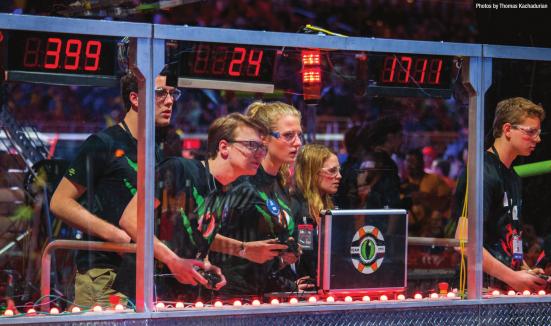 Students Across Northern Michigan Build Robots For Sport
 One might think schools from northern Michigan wouldn’t stand a chance in robot competitions against Detroit-area teams sponsored by General Motors or Delphi that have some of the world’s best engineers on speed dial. One might think that, but one would be wrong.
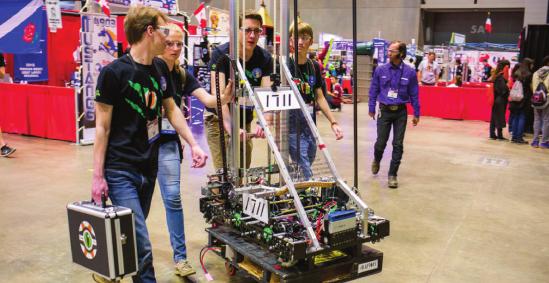
Last year, Traverse City Central High School’s team was among several teams from northern Michigan that qualified to take part in a world finals competition in St. Louis, and the Trojans — or, as they are known, the 1711 Raptors — bested hundreds of teams to reach the semifinals.
Nearly 400 teams around the state are now hard at work designing robots, getting ready to battle other schools. Students design and build robots that cost thousands of dollars, with help from mentors and funding from sponsors.
A MEDIEVAL CHALLENGE
Each year, teams design a new robot according to that year’s theme and rules. This year’s challenge requires robots capable of somehow hurling volleyball–sized foam balls at towers.
How that will work, teams have to decide — maybe use a mechanical arm, maybe design some kind of canon.
“We don’t know yet,” said TC Central sophomore Abigail Fox at an early January meeting.
The robot games are organized by FIRST, a New Hampshire-based nonprofit founded by Dean Kamen, inventor of the Segway.
Northern Michigan teams attended this season’s kickoff Jan. 9 in Boyne City. It was one of more than a hundred places around the country where the unveiling of the theme was simulcast.
This year’s game combines the modern with the medieval. Robots must scale moats and open gates in order to hurl “boulders” at their opponents’ castles. At the end of a match, robots can attempt to scale and capture their opponents’ tower.
“I think, this year, it’s almost a more complicated game than it’s been in previous years, but it kind of boils down to a capture-the-flag theme,” said Tess Mello, a sophomore who is the team’s mechanical lead, in charge of designing the robot. “I think that’s going to be both really fun to play and really fun for people to watch.”
41 OUT OF 41
When the 2015 season started, it didn’t look like TC Central’s team was very good. Their first competition, at Flint’s Kettering University, was almost a disaster.
“We were dead last for most of our first competition,” Mello said.
Teams have six weeks to design a robot from the day of the kickoff event and then they must seal it in a bag; they can only practice with it for six hours between the end of the build period and their first tournament. Teams compete in two tournaments each year in the hopes they will finish well enough to win an invitation to the state finals.
“We were having all kinds of problems,” Mello said. “We had our robot just straight up brownout. We just lost communications and everything. Everything just stopped working.”
That wasn’t their only problem. At FIRST tournaments, each two-and-a-half-minute match features two opposing groups of three teams. Each team competes in a dozen matches and hopes to do well enough to get into the tournament playoffs.
That means teams must collaborate with teams from other schools. Deciding who to partner with is a big part of the game’s strategy and can have as much impact on the outcome as robot design.
“We had problems with the other teams, our alliances, not showing up,” Mello said. “We got partnered with a lot of rookie teams. It was just a whole bunch of worse and worse things that kept happening. We ended up 41 out of 41.”
A DAY TWO COMEBACK
Things turned around the second day. “The team was very resilient and they were able to make changes,” said John Failor, a math teacher who brought FIRST to Central High School 11 years ago.
“That’s another great thing: between matches you can work on your robots and fix things. So, day two at Kettering we did a lot better; we moved into the top 20 and then we got picked for an alliance for the playoffs, so we made it to the semifinals.”
FIRST is designed to teach students how to overcome adversity, which is what happened for the Central team.
“I mean, these kids are learning lots of cool skills about engineering, but they’re also learning how to be leaders and to work with each other,” Failor said.
Fox said the team learned from their mistakes and successes last year.
“We were really, really good at one specific thing, and that’s not something we thought we’d be good at, but because we had a robot that we could change, even during state competition, that’s really how we moved ahead,” Fox said.
The team was able to make themselves attractive to other good teams in alliances and that’s how they advanced so far, to state finals and then to world finals, where they won their division and their alliance made it into the final rounds. “Traverse City did phenomenal,” said Tom Ochs, FIRST coach at Petoskey High School, which also made it to world finals.
He said northern Michigan teams must overcome adversity to make it that far.
“There are a lot of teams that do have great advantages. They’ve got great engineers working with them; they’ve got a lot of great resources,” Ochs said. On the other hand, “look at Suttons Bay, look at Pellston [both of which also made it to worlds]. In Pellston, there’s basically two engineering guys that are running the whole team.”
GETTING READY FOR THIS YEAR
Soon after the 2016 theme and rules were unveiled, team members had already given a lot of thought to what this year’s robot should look like.
“There’s so many people on the team and so many people who are just so excited about science and designing robots specifically, that you end up with a ton of ideas and the problem isn’t coming up with ideas; the problem becomes narrowing it down,” Mello said.
Mello’s father, Daniel Mello, is the team’s mechanical advisor. He’s proud that his daughter is a leader on the team. He said perhaps a few years ago it would have been unusual for a female to take a leadership position in an engineering activity, but not so much today.
Mello said he’s glad the program sends the message that it is welcoming to girls. He said now that she’s gotten into a management position, however, she will actually be less involved in the actual mechanics.
“The position that she’s in has a lot more to do with personnel management than handson engineering,” Daniel Mello said.
One thing the group agrees on is that they would like to design and build their robot in five weeks. That would give them a week to practice with it before Feb. 23, aka “Stop Build Day.”
“After our robot is built, hopefully we’ll have like a week to do drive tryouts,” said junior Liam Tank. “Probably not.”
Tank said he was drawn to FIRST from a young age when he watched a competition.
“When I was a lot younger, like 10 years old, I actually saw the competition and — just right then and there — I was super interested,” said Tank, this year’s media lead.
A STRICT SET OF COMPLICATED RULES
FIRST teams are not allowed to spend more than $4,000 on their robot.
Team members laughed when asked if they were worried about the limit. TC Central works within a much smaller budget. The spending limit exists so teams from wealthy areas who are sponsored by large corporations don’t get too much of an advantage.
“Technically, FIRST gives us a limit on how much we’re allowed to spend and how much we’re allowed to spend on each part, and so then at the end of the season, you have to submit to them a bill of materials and you have to list for them every single part that you use on your robot — ” Fox said, “every single sheet of metal that you cut something out of, all the rods, all of the electronics. I think, to some extent, if you have any special wiring, you have to list all of it, and how much it costs and how many you have.”
The rules are strict. If a team can’t account for its robot or if its specifications fall outside of what’s allowed, a team is disqualified and all of that work was for nothing.
“When you’re at a competition, FIRST inspects the robot, with the bill of materials, but also, it can only weigh a certain amount and be a certain size and, if you don’t pass inspection, you don’t play,” Failor said. “They are really strict about it. The kids really have to stay up on the rules.”
WHAT KIDS GET OUT OF IT
Winning is contagious, so lots of Central High School students signed up for FIRST this year.
“Our roster fluctuates between 30 and 50 as of right now,” said Kierra Pendill, a junior who is the team’s communications lead, responsible for getting the word out about the program. “A large amount of people came because we won our division in worlds.”
Even though only four students will be out on the field during a match, a team of 40 is a good size to begin with, partly because of how much work is required and partly because some people will drop out as the season goes on.
Fox said that, despite the dozens of people who show up to the first few meetings, far fewer people are willing to stay late on a Saturday to finish some important task.
And the list of tasks that must be completed is bewildering. In addition to design and construction, some must write computer code so the robot can operate autonomously, teammates have to learn how to drive the robot, someone has to train to be the human element on the field during games — that person will funnel foam balls into the play area this year — and others have to scout teams during tournaments and form alliances.
Off the field, each team needs someone in charge of media — developing the team’s brand through logos and T-shirts — someone to promote FIRST in the community, and people to tackle fundraising, signing up sponsors and raising the thousands of dollars the team needs. Failor said the team needed to raise $40,000 last year to cover added expenses. Someone also needs to keep track of what’s spent and what materials are used.
“It’s like a small business really, and everyone has a role they are involved in,” Failor said.
“I’m completely useless mechanically, but I can help to raise money.”
The way the teams collaborate with each other even while they are in competition with each other is another great dynamic, Failor said, because it teaches students how to have professional relationships.
“In those preliminary rounds, I may be competing against you in one round, but the next round you may be one of our partners, so there’s really a spirit of helping each other,” Failor said.
He said many of the seniors from last year’s TC team are in prestigious engineering programs today.
“Most of those kids now are studying engineering at Michigan and Kettering and USC, like these really amazing universities all over the country,” he said.
Traverse City Central High School hosts a FIRST Robotics district competition the weekend of Apr. 9, a chance for the public to see what high school students can do with robots.


Trending

Summer Hot Spot: Median Sale Price for Area Homes Up 88 Percent Since 2019
Summer has long been the most active season for buying and selling real estate in northern Michigan. So, how was summer 2026… Read More >>
Donating Ahead of Cold Weather
Hard to believe, but winter is not that far away. Jubilee House, Traverse City’s only drop-in day shelter for adults e… Read More >>
TC State Park Reopening in October
Construction work on the Keith J. Charters State Park in Traverse City is wrapping up early, according to the Michigan DNR, … Read More >>