
The North’s New Powerhouse
July 8, 2016
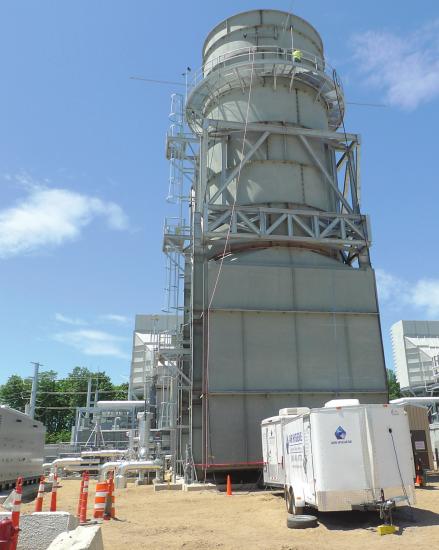 Alpine “Peaker Plant” Goes Live This Month
 Northern Michigan’s newest power plant, a massive twin-tower complex tucked into the woods between Elmira and Gaylord, goes online this month. It will be northern Michigan’s largest power plant, generating over 400 megawatts. The hope of officials at Wolverine Power Cooperative: that it will satiate their customers’ energy appetite for years to come.
The Alpine Power Plant is a natural gas peaking plant — aka a “peaker plant” — meaning it can be fired up quickly to provide electricity for surges in demand. Its opening has drawn little resistance from environmentalists, who strongly opposed a Wolverine coal plant project a few years back.
LARGEST IN THE NORTH
Alpine, which will provide electricity to the members of Cherryland Electric Cooperative, Great Lakes Energy, and Presque Isle Electric and Gas Cooperative, dwarfs any other natural gas plant in Wolverine’s portfolio. Initial estimates projected its cost at $100 million; at completion, its cost totaled over $150 million.
“This one is our largest output. This is the largest generator north of the Saginaw-Ludington area,” said Wolverine spokesman Kenneth Bradstreet.
The plant also represents a step in the evolution of how people get electricity. Natural gas plants are called peaking plants because they can provide power on demand and are easily turned on or off. That’s an advantage over coal plants, which can take a day or two to fire up and so, must run around the clock.
In northern lower Michigan, peak times tend to be the hottest and muggiest days in the middle of the week, when air conditioners are fired up in homes, offices and factories.
Bradstreet said the scale of the plant is designed to accommodate those occasional surges in demand.
“It’s kind of like, you go into a Walmart store right now — they’ll have 25 check-out lanes, but only 10 of them are operating,” Bradstreet said. “The reason they have 25 is because they know that, once in a while, they’ll need 25.”
Another key strategy in Alpine’s design?
Its location. While it might appear as though the plant was dropped into the middle of the woods, it’s actually located at an optimal place: the intersection of the TransCanada transmission line that carries natural gas across the state and a Wolverine electrical transmission artery.
AN ALTERNATIVE TO COAL
So how did this monstrous natural gas peaker come to be? Credit the failure of Wolverine’s pitch to erect a coal plant in Rogers City. Environmental groups fiercely opposed the proposal, citing air and water quality and climate change concerns. When regulators denied approval for the 600-megawatt plant in 2013, Wolverine scrapped its proposal and looked for a Plan B.
The cooperative’s experience mirrors a shift in the utility industry across the country: Coal plants are out and natural gas plants are in.
“I think it’s fair to say that if we had built the Rogers City plant, we wouldn’t have built this one,” Bradstreet said. “It’s a different kind of product really. Rogers City was a base-load plant that would have operated around the clock. This one operates on an as-needed basis.”
That as-needed basis opens up additional opportunity for environmentally friendly power, allowing the utility to easily add more renewable energy sources in the future, keeping the peaking plant as backup, Bradstreet said.
Despite many positives, Bradstreet said Alpine still generated some concern, especially from neighbors who were worried about noise generated from the plant, but the local approval process ultimately proved uneventful.
“We had a lot of questions,” Bradstreet said. “We added a couple million dollars to the design just to make sure it was as quiet as it could possibly be, because we do want to be good neighbors.”
Likewise, securing permits from state and federal regulators was equally smooth — a large departure from what Wolverine faced with its coal plant proposal.
“I think it’s accurate to say it’s impossible to build a coal plant right now, impossible to get the permitting that you need from everybody, or to avoid the risk that seems to be there from the federal side,” Bradstreet said.
ENVIRONMENTALISTS ARE CAUTIOUS
Regardless of the fluidity of the process that brought Alpine to fruition, not everyone agrees the natural gas plant is a good idea.
Stanley “Skip” Pruss is one. Principal and co-founder of 5 Lakes Energy, a clean-energypolicy consulting firm, and the director of the Michigan Department of Energy, Labor and Economic Growth under former Governor Jennifer Granholm, Pruss said Wolverine makes a lot of smart moves, but he doesn’t believe the construction of the Alpine plant was among them.
“There’s a lot of things I think Wolverine Power is doing correctly now,” he said. “They are really ahead of the curve.”
For example, the cooperative has invested heavily in wind power — so much that wind could soon make up 30 percent of its energy portfolio. Its member electrical cooperatives also are investing in solar. Pruss believes moves like that will give customers long-term rate stability.
But he said that he also believes spending millions on a massive natural gas plant could threaten that stability, noting that some energy experts believe natural gas plants are doomed to become obsolete — and soon. Pruss predicts no natural gas plants will be constructed after 2020.
“Any natural gas plant built today won’t operate during its entire operational service life,” Pruss said. “It will be shut down and will be a stranded investment.”
Why? Advances in battery storage and other technology, developing rapidly because of demand for electric vehicles, are transforming the way people get electricity, he said. Pruss points to experiments in Germany, where electric car batteries that ended their lives powering drivetrains are being repurposed to be grouped into battery arrays that can be called upon to instantly provide power on a large scale.
SOMETHING NEEDED NOW
Bradstreet, a former member of the Michigan House of Representatives, agrees that energy technology is changing rapidly but said he is not impressed with the state of battery storage — and doesn’t believe it’s an option that’s even on the horizon.
“The battery technology on a small scale is great, you know, if you’re driving a car or you’ve got windmills or solar panels on your house, and you’re storing up electricity in a battery bank for the time when you use it,” he said. “But on a large scale, when you’re talking about tens and hundreds of megawatts, that technology just isn’t there yet.”
It’s difficult to store electricity because it does not like to stay in one place, Bradstreet said.
He points to a pseudo-battery project in Ludington that was constructed in the late ’60s and early ’70s, in Consumers Energy’s pumped storage plant.
At night, excess power is used to pump Lake Michigan water into an enormous reservoir. During the day, when demand for power peaks, water is let out of the reservoir back into Lake Michigan through turbines that generate electricity.
“The reason why that was originally built was because you had a couple of nuclear power plants along the lakeshore that have to run 24 hours, and they don’t have a demand at night, so they run those pumps when you have very low-cost electricity,” he said.
That plant, however, only returns 70 percent of the power that it takes to run, he said.
“There aren’t batteries per se where you can store large amounts of power yet. That technology is not developed yet on a commercial scale,” Bradstreet said. “There’s a lot of different technologies that they’re working on. I hope some day that they’re able to make them efficient enough for large-scale commercial use.”
Pruss believes there are smaller-scale technologies that are on the verge of viability that will revolutionize the energy infrastructure and store energy on a large scale.
Even as battery storage improves, technology for controlling energy demand is rapidly developing. Pruss sees a world where consumers cede control of energy used by appliances in exchange for rate cuts so that electricity use is stabilized, eliminating the need for a peaking plant like Alpine. “The aggregation of household appliances, doing that throughout the service area is very, very large,” Pruss said. “People — utility executives included — don’t fully understand how fast the technology is changing. It’s explosive growth, and it’s just starting.”
QUESTIONS AND LIMITED OPTIONS
Wolverine is not alone in switching to natural gas. In 2015, natural gas surpassed coal as the No. 1 source of energy in the United States, making up 31 percent of supply, as compared to coal’s 30 percent, according to the U.S. Energy Information Administration.
(Five years earlier, coal accounted for 44 percent and natural gas just 22.)
It’s a seismic shift that’s made for a tough debate within communities of environmentalists. The burning of natural gas produces less carbon monoxide than coal, meaning it causes less pollution and short-term climate change, but extraction of natural gas can lead to methane release, which poses a more serious climate threat.
Pruss said he believes that natural gas poses an even greater threat to the environment than coal if you take into account the way it is developed, extracted, stored and transported.
“The literature is becoming clearer and clearer that natural gas is worse than coal when you take the full life cycle into account,” Pruss said.
Pruss believes we are only on the cusp of understanding the effect the shift to natural gas could have on the climate.
“If you were to pose this conversation five years from now, the public conversation about natural gas will be much different,” Pruss said.
Bradstreet said something like a natural gas peaking plant is necessary as a utility expands into producing more renewable energy because the nature of renewables requires backup.
“The fact of the matter is, wind and solar are not commissionable,” he said. “You can’t say, ‘Okay, tomorrow I’m going to have X number of megawatts from my windmills,’ because you don’t know if the wind is going to produce that kind of output. So you have to have a reliable, commissionable source, in order to make sure that your members have adequate power.”
He said he doesn’t understand what an opponent to a natural gas plant would propose as an alternative.
“I guess if I’m trying to build a power plant and someone objects to one thing, I guess a fair question is, What are you for?” Bradstreet said. “I mean, you’re probably going to be one of the first people to call me if your power goes out, so how do you want me to do that? And there’s not a lot of options. There’s nuclear. There’s solid fuel. And there’s natural gas.”


Trending

Summer Hot Spot: Median Sale Price for Area Homes Up 88 Percent Since 2019
Summer has long been the most active season for buying and selling real estate in northern Michigan. So, how was summer 2026… Read More >>
Donating Ahead of Cold Weather
Hard to believe, but winter is not that far away. Jubilee House, Traverse City’s only drop-in day shelter for adults e… Read More >>
TC State Park Reopening in October
Construction work on the Keith J. Charters State Park in Traverse City is wrapping up early, according to the Michigan DNR, … Read More >>