
Who’s The Carpetbagger?
The race for the 1st District congressional seat is proving to be a knock-down, drag-out fight.
Oct. 7, 2016

Airwaves have been inundated with ads from the National Republican Congressional Committee that claim the Democrat running in the 1st District congressional race doesn’t live in northern Michigan, but rather, in a Detroit penthouse. The ads end: "For Lon Johnson, it’s all an act."
Johnson’s campaign retorts with questions about its Republican rival’s insistence that he is a full-time resident of the Upper Peninsula. In a press release, the campaign pointed to evidence that shows Jack Bergman lives primarily in Louisiana. It ends: "Bergman is not from northern Michigan, and it’s clear he is not for northern Michiganders."
The race for the 1st District – the second largest congressional district east of the Mississippi and one that encompasses the entire Upper Peninsula and the norther portion of lower Michigan – is one of the most competitive in the country. If you watch television, listen to radio or visit election-related web pages, brace yourself for an onslaught.
SORTING THROUGH THE DUELING CLAIMS
A panel of journalists at Bridge Magazine, a non-partisan publication of the nonprofit The Center for Michigan, fact-checked each campaign’s claims and faulted each side, though it noted that it found that Johnson’s campaign raised legitimate questions about Bergman’s assertion that he is a full-time resident of Watersmeet.
"Johnson’s attack was backed by real, first-hand evidence," said David Zeman, Bridge editor, in an email. "The attack by Republicans on Johnson was not."
Among the evidence the Johnson campaign has cited: that Bergman has owned a home in St. Francisville, La., since 2009; that he took a four-year government appointment to a Louisiana military commission in 2013, and that the retired Marine Corps lieutenant general is on record in a newspaper stating he planned to retire in the state.
"We quite honestly fell in love with New Orleans and Louisiana," Bergman told the newspaper. "And it doesn’t hurt that we don’t get 10 feet of snow here in the winter."
However, the Bridge panel found that Johnson went too far in his criticism of Bergman when he claimed that Bergman had lied on a congressional disclosure form by failing to list his Louisiana residence; the panel determined real estate ownership was not required to be listed as an asset under House rules.
On the other hand, the Bridge review called "foul" on the NRCC’s claims about Johnson’s supposed "fishing cabin" in Kalkaska.
Since 2011, Johnson has owned a home on Bass Lake in Blue Lake Township, northeast of the Village of Kalkaska, and that’s where he is registered to vote. His campaign maintains that he and his wife, Juliana Smoot, live in that home.
The Bridge found that Smoot, a former Obama administration official and a nationally known Democratic fundraiser, owns a property in Detroit where she stays on occasion, but the inquiry found that the NRCC’s "evidence" to back up its claim that that’s where the couple actually lives is weak; it depends on a photo of Johnson and Smoot outside of the Detroit building that houses Smoot’s apartment.
"That’s a pretty thin reed upon which to call Johnson’s residency in northern Michigan "˜an act,’ especially when juxtaposed with the evidence against Bergman," Zeman said.
SPOKESMAN: TIES UNQUESTIONABLE
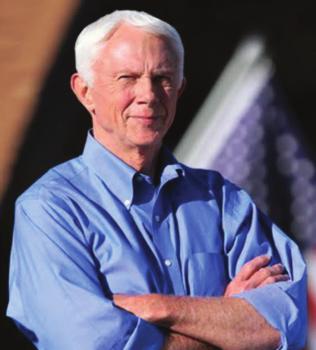
The Express wanted to hear from candidates directly.
Bergman was not available for an interview, but John Yob, a Bergman spokesman, said his candidate’s ties to the district are unquestionable.
Bergman’s grandfather was born in Ironwood and worked in the mines. His father moved to Minnesota for work, and that’s where Bergman was born and raised, but he considers the Upper Peninsula to be his "ancestral home."
Bergman bought land in the 1980s and built his home there two decades ago, Yob said.
"He moved to various places around the country, but he always considered the Upper Peninsula home," he said. "For anybody to say he’s anything other than a Yooper is bologna."
As for whether Bergman spends his winters in Michigan or in Louisiana, Yob wouldn’t answer directly. His response echoes that of Bergman, whom, when asked in September by a constituent in Hancock whether he was a snow bird, answered that he liked to snowmobile in the winter and also liked to fish in the Bayou, according to a video available on YouTube.
Yob insisted that Bergman is a "fulltime" resident of the district.
"There’s a big difference between a partisan political operative and a straight-talking Marine Corps veteran who bought property, moved there, and voted there for the last 20 years," Yob said. "Questions that are raised about (Johnson’s) true intentions in moving to Kalkaska are legitimate."
INTERVIEWED BY PHONE
The Express interviewed Johnson by phone, and he expressed frustration about having to talk about where he lives rather than the issues of his campaign. Johnson contends that Bergman wants to eliminate Social Security and slash Medicare, though the Bergman campaign has said that is not true.
Johnson said he and his wife have made their Kalkaska cabin their primary home.
"I grew up just south of Detroit, but I am the fifth generation of my family to live here in Kalkaska County – not to come up on weekends, but to live here," Johnson said.
There have been periods when he hasn’t lived in Kalkaska County – like when he became chairman of the Michigan Democratic Party, a position he left to enter this year’s race.
Johnson said he doesn’t understand why his residency has been such an issue.
"I can’t believe that we’re actually even writing about this, to be blunt," he said. "This is a distraction."
Johnson said he wishes people would focus on the policy differences between him and Bergman. Johnson said he believes Bergman’s legislative decisions would be bad for the district.
"He moved here from Louisiana, bought the nomination, and now the [Republican National Committee] has come in here and they’re trying to buy the seat," Johnson said.
AN UNANNOUNCED VISIT
Two days after the phone interview, the Express dropped by Johnson’s Kalkaska address to see if it looked like a place where someone lives year round.
Johnson was in his driveway, on a cellphone, walking toward the lake. A campaign staffer came out of the cabin, followed by Smoot, wondering what was going on.
Johnson was getting ready to take the campaign camper to an event in Petoskey, but he took the interruption in stride and gave the Express a tour of his cabin and the surrounding property.
Johnson said the place means so much to him because he loves northern Michigan and Bass Lake in particular. It is a place where his family has come for generations, and he loves to hunt in the woods nearby.
Johnson’s grandfather owned a cabin across the lake, and he’s been visiting the area all his life, he said. His brother now owns that cabin, plus acreage in the nearby woods where Johnson likes to trail run and hopes one day to build a larger home.
Johnson has completely renovated the cabin, and today it is small but comfortable, set up like a loft apartment. Johnson said he and his wife, who do not have children, have spent as much time as they’ve been able to in recent years in Kalkaska, despite their busy lives.
WHO IS MORE "OF" THE DISTRICT?
Questions surrounding this year’s candidates’ claim to the district are in stark contrast to the two most recent representatives of the 1st District.
Rep. Dan Benishek, R-Crystal Falls, who is vacating the seat after six years, was born in the U.P. and long worked as a doctor there. Rep. Bart Stupak, who was elected to represent the district in 1992 and served through 2010, graduated from Gladstone High School and lived in Menominee.
But what’s at stake in the argument between Bergman and Johnson isn’t legal standing to run for Congress. It’s more about who can make the better case that they are of the district they’re hoping to represent.
The requirements to run for are fairly straightforward: A candidate must be at least 25 years old, a U.S. citizen for at least seven years, and an inhabitant of the state – not the district – in which he or she is running.
While a candidate is required to be an "inhabitant" of the state, it’s a pretty wide open term, said John Zachman, political science professor at Northwestern Michigan College.
Zachman believes that both candidates likely have tenuous enough ties to the district that it could cost them politically, but each one’s position probably cancels out the other.
Scott Ladeur, professor of political science at North Central Michigan College, believes Bergman has the advantage in the duel over who can lay claim to the district because his military service makes it easier for people to explain away all of the time he hasn’t lived here.
"I think that that kind of thing helps to smooth the charge that he doesn’t live in the district – the military career explains his moving around," Ladeur said.
POLITICS NO LONGER LOCAL
This year’s race for the 1st District could be a sign of things to come, Zachman said.
Changes in media and campaign finance mean it’s less important than in year’s past for candidates to be from the place where they run.
Because Michigan’s 1st District is so vast and diverse, it might be only natural that native status is less important than it might be in a smaller district that has a more homogeneous, geographically tight identity – one whose voters are more likely to hold out for one of their own, Zachman said.
Another change affecting this and future races: It used to be that the local newspaper, radio station or town hall meetings were the only source of information about candidates. Today a voters doesn’t need any of those communication hubs to get informed.
Citizens United, the U.S. Supreme Court decision that permitted unlimited U.S. election donations from corporations and special interest groups not tied directly to campaigns, further eroded the advantage of being the local candidate, Bachman said.
The result? Rather than connecting with voters who came out to town hall meetings or stump speeches, a candidate today simply needs to impress a few large donors that can afford massive media buys.
"Now you have fundraisers where you shake hands with people, and it’s not for their vote, it’s for their money," Zachman said. "What it takes to get elected under Citizens United is support from interest groups and wealthy supporters."
WHERE THE MONEY COMES FROM
So where does the money come from in this year’s race?
Johnson’s campaign raised far more during the primary cycle; Bergman’s campaign relied mostly on loans from the candidate himself.
In the general election, Bergman’s campaign has ramped up fundraising, but it still relies heavily on Republican political action committees who are running attack ads against Johnson.
According to the most recent data available from the Federal Election Commission, Johnson raised nearly a million dollars from individual donors leading up to the primary. He raised an additional $283,800 from political action committee contributions.
Bergman received just over $70,000 in individual contributions leading up to the primary. He loaned his campaign an additional $270,120.
Where did the individual donations come from? From voters in the district? From voters in Michigan?
An analysis of the donations shows that roughly 20 percent of Johnson’s money came from within the district, 37 percent from outside the district but within Michigan, and 43 percent from out of state.
Money raised by Bergman’s campaign included 15 percent from within the district, 27 percent from outside of the district but within Michigan, and 57 percent from out of state.
Campaign fundraising only tells part of the story, however.
By mid-September, the candidates and groups working for them had purchased $1.6 million in ad time for the two months leading up to the election, based on a Michigan Campaign Finance Network analysis of Kantar Media tracking data. The data represents money spent on broadcast television ads and does not include cable or online media buys.
Outside interest groups spent considerably more in support of Bergman compared to Johnson: The National Republican Campaign Committee reserved $839,040 worth of time, and the House Majority Pac spent $404,390 in support of Bergman. The Democratic Congressional Campaign Committee, meanwhile, reserved just $20,205 in time. Johnson’s campaign reserved $411,658 in ad spots.
Regardless of the final outcome, Craig Mauger, MCFN’s executive director, said there’s an irony to what’s happening within this election. And it’s probably one that voters caught up in the contentious debate about the candidates’ geographical ties should keep in mind.
"It’s really funny and also sad that you have two candidates arguing about where the other one was born," said Mauger, "and the people that are making that argument happen are groups from way outside the district."
Jack Bergman and Lon Johnson has been invited to attend a candidate forum organized by the Petoskey Regional Chamber of Commerce. The event takes place Wednesday, Oct. 12, at the Iron Horse Café at North Central Michigan College in Petoskey. There will be a meet and greet at 6pm and a moderated forum at 7pm.


Trending
Summer Hot Spot: Median Sale Price for Area Homes Up 88 Percent Since 2019
Summer has long been the most active season for buying and selling real estate in northern Michigan. So, how was summer 2026… Read More >>
Donating Ahead of Cold Weather
Hard to believe, but winter is not that far away. Jubilee House, Traverse City’s only drop-in day shelter for adults e… Read More >>
TC State Park Reopening in October
Construction work on the Keith J. Charters State Park in Traverse City is wrapping up early, according to the Michigan DNR, … Read More >>