
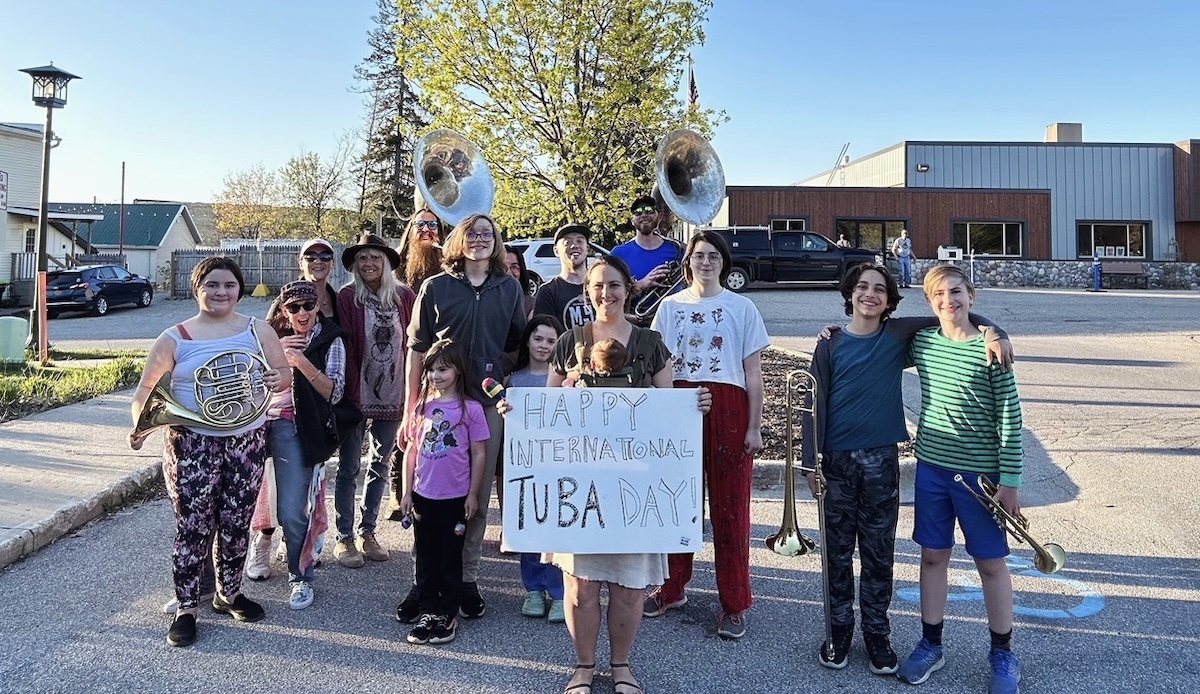
Buzzing about the Kingsley Tuba Parade
Local tubists unite for their day
By Ross Boissoneau | April 18, 2026
If it’s a holiday, there’s a parade somewhere. St. Patrick’s Day, Christmas, the Fourth of July, International Tuba Day—they all feature mirth, merriment, and parades.
Which means that it is almost time once again for the Kingsley Tuba Parade. The brainchild of Kingsley musicians Kevin and Sierra LaRose is entering its third year and will take place Friday, May 1, at 5pm in downtown Kingsley. (That’s the date of International Tuba Day for the uninformed.)
“Kingsley becomes the tuba capital of Michigan for 30 to 40 minutes,” says Sierra with a laugh.
Kingsley Village Manager Charlie Jetter says the parade is an opportunity for the community to gather and celebrate together. “Any time you can get the community involved, it’s great for the village. I’ve heard the numbers continue to go up,” he says, meaning both those participating in the parade and those watching.
Cucumbers & Therapy
Veteran low brass player Kevin LaRose was inspired by an unlikely source: Larry the Cucumber, the Veggie Tales character who played the tuba. Kevin actually started on violin, then moved to cello; his first wind instrument was trumpet, before he switched to tenor sax because of braces. But when he heard the music on the cartoon, he was immediately drawn to the big brassy sound way down low.
The Marshall native first came to northern Michigan to study at Interlochen Arts Academy before earning a Bachelor’s degree in music education and performance from Michigan State University and a Master’s in tuba performance from the Hartt School.
These days he’s well known for playing a variety of low brass instruments in Northern Michigan Brass Band, the Northern LOWER Brass Quartet, the Encore Winds, Song of the Lakes, and musical theater work for area schools and Old Town Playhouse. He and Sierra also have a folk duo, in which he plays bass and she plays ukulele while they both sing.
And while not a veteran tubist like her husband, Sierra now plays tuba as well. In fact, she’s an enthusiastic convert.
“What I like about it is tuba could be marketed as therapy,” she says. “The act of playing is incredibly therapeutic. The breath work floods the body with oxygen. The low notes resonate through the body. You focus on breathing, your body, posture—I find it to be a really healing experience.”
Celebrations & Sounds
Joel Day first came up with the idea of a holiday celebrating the tuba in 1979 while part of the Lower Merion High School Band outside Philadelphia. One of only two tuba players in his band, he and his fellow tubist didn’t believe that their instruments (and they themselves) got the respect and recognition they deserved from their fellow high school band members. So he decided to set a day aside for the instrument and gain recognition for the tuba and tuba players as reputable musicians.
Day went on to study at Millersville University in Millersville, PA, where he established International Tuba Day celebrations. Since its inception, International Tuba Day has been celebrated throughout the country and around the world, including in Kingsley, where the parade winds around the sidewalks of downtown and ends at Kingsley Local Brewing, which hosts the after-party.
As for the music the musicians play for the International Tuba Day parade? Anything they want. “Historically it’s entirely improvised, based around a B-flat dominant jam,” says Sierra.
Kevin says the B-flat scale is typically the first one students learn in band class, making it the easiest for anyone to play along with. “B-flat is familiar. They can pick the notes, add rhythmic excitement,” he says.
Participants & Spectators
Everyone is welcome to participate, whether they play tuba or not. The LaRoses lead the way on tubas, but other brass, wind, and percussion players are welcome. Even if you don’t play, you’re welcome as part of the show, carrying flags, carrying signs, or simply carrying on.
If you do want to participate but don’t have an instrument, don’t worry: You can check out instruments at the Kingsley branch of the Traverse Area District Library.
“As librarians, we encourage kids to get involved in activities like the parade,” says Amy Monette, the branch manager. “We have shakers, maracas, tambourines.” (No tubas, unfortunately.)
Monette says she hasn’t participated in past parades herself but counts herself an invested observer. “A parade needs an audience,” she says.
She says the LaRoses are among the most visible and busiest residents of the village. “What Kevin and Sierra won’t tell you is they bring musicality to the village like we haven’t seen before,” she says. “They host the weekly open mic at Kingsley Local Brewing. They manage the Kingsley Farm Market, which features live music,” alongside the offerings of fresh vegetables and produce, bread, meats, fruits, prepared foods, and more.
“The two of them are real powerhouses in Kingsley.”
Jetter says the parade is a boon for Kingsley and a way for the community to come together. “Music is so important,” he says, noting all his children participated in band for at least one semester, with two of them playing throughout their school years.
And it’s even better when it is something as prosaic as a casual parade, celebrating an instrument so unique that even a cucumber can play it. Jetter’s hope is the parade continues to grow, to the point other participants join in and the parade takes to the street from the sidewalk.
And he doesn’t want to stop there. “I want to bring back the homecoming parade and a light parade in winter,” he says.
Fun Facts about the Tuba
- Tubas come in varying sizes, weighing from a dozen pounds to 50 pounds or more
- The tuba was patented in 1835 by Wiebrecht and Moritz in Germany
- A tuba has between three and six valves
- The tuba is the largest instrument in the brass family
- The original tubas were made of wood, contained holes, and looked a bit like a snake; as a result, these unusual instruments were named serpents
- Tubas exist in a variety of keys. The smallest, an F tuba, has about 12 feet of tubing, while the largest, the Bb tuba, boasts some 18 feet of tubing
- The sousaphone is basically a circular version of the tuba, with the weight carried on the player’s shoulder. It was first created around 1893 at the direction of American bandleader John Philip Sousa
- Tubas replaced the string bass in early jazz bands of the late 1800s to early 1900s to avoid exposing the much more delicate string bass to harsh weather when performing outside
- The tuba is a member of the valved bugle family; other members are the euphonium and the flugelhorn, aka soprano tuba

Trending

Saturday Suds in Cadillac
Grab a tasty craft brew or choose from a variety of NA flavors at Cadillac’s Craft Beer Festival, overlooking Lake Cad… Read More >>
Halloween Begins on Silver Lake
If the decorations around town haven’t been a sign, then consider this your official notice: spooky season is here! Ho… Read More >>
Revisiting Memory
How does a memory change when we revisit it? This is the question that Echoes, the newest exhibit at Crooked Tree Arts Cente… Read More >>