
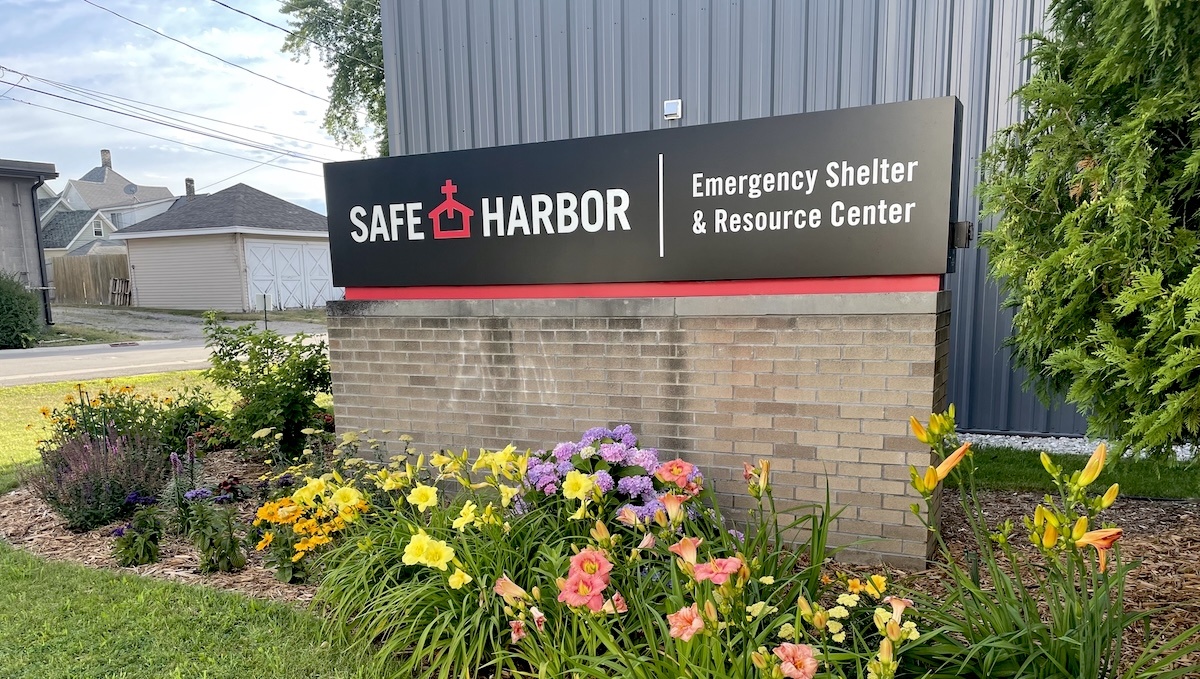
Safe Harbor’s Year in Review: What the shelter has learned since opening its doors full time
Four takeaways from the 2025-26 pilot year
By Lourin Sprenger | June 6, 2026
When Safe Harbor transitioned to a year-round emergency shelter last May, it marked a turning point in how Traverse City and northern Michigan approached homelessness. The shift was prompted by an urgent need paired with enforcement of the city’s no-camping ordinance at The Pines, the wooded encampment that had become home to many unhoused residents.
Officially though a full year cycle, Safe Harbor says the move has brought many successes and some unexpected lessons. As they head into the second year of a two-year pilot, they’re looking to continue to expand their services to not only offer shelter for the unhoused at Safe Harbor, but also more resources for their guests to help get them back on their feet and ensure long-term stability.
1. Make More Meals
One of the biggest learning curves came almost immediately: understanding what people actually need in order to stay sheltered consistently.
Joshua Brandt, Safe Harbor board member and fundraising chair, says the organization realized early on that simply offering beds wasn’t enough. If residents had to leave during the day or leave the shelter to find food, many wouldn’t return or would choose not to eat at all.
“We learned pretty quickly that we needed to provide meals,” Brandt explains. “People weren’t going to leave for meals and then come back. If you want people to stay sheltered, you have to remove as many barriers as possible.”
Previously, during seasonal operation at Safe Harbor, volunteers would provide and staff meal services for residents. However, the transition to year-round operations increased demand. Safe Harbor still relies on its army of 2,300 volunteers to staff food shifts but has now allocated part of its operating budget to cover the cost of evening meals when and where it’s needed.
As of May 1, the shelter is providing dinner for guests, a change from last summer when meals were not offered due to staffing and financial precautions.
2. Build It, But They May Not Come
Another difficult reality Safe Harbor has faced is that even with a year-round shelter available (and with the no-camping ordinance now being enforced) some people still choose not to seek shelter.
“There’s still a segment of the population that won’t seek shelter even when beds are available,” Brandt says.
He says there are a number of reasons for that, including mental health struggles, addiction, distrust of systems, or simply wanting to maintain personal freedom. “It’s a reality,” Brandt says, “that many people outside the issue don’t always fully understand.”
Safe Harbor currently operates year-round at a capacity of 74 beds, and according to Brandt, the shelter has remained full.
3. Costs Keep Rising
At the same time, the cost of operating year-round has increased significantly. Brandt says operating expenses have doubled over the past year as the organization expanded staffing, food service, utilities, and support services.
Still, he is grateful the organization is financially stable for the near future thanks to strong local support.
“We have two years of funding secured because of the community and donors stepping up,” Brandt says. “The support has been incredible.”
4. There Is No Silver Bullet or Quick Fix
The transition to year-round operations has also changed the situation at places like The Pines. While the encampment itself has become smaller and less visible since enforcement of the no-camping ordinance began, homelessness in the region has not disappeared.
“We have not seen numbers go down,” Brandt says of the unhoused population in Traverse City. “Even with the closing of The Pines and offering shelter year round.”
Instead, the issue has become more spread out and, in some cases, harder to see.
During the 2024-2025 season—when Safe Harbor was operating from the months of October through May—they hosted 361 people in need of shelter, with a total of 19,315 overnight stays.
Like many communities across northern Michigan, Traverse City continues to face increasing housing costs, affordable housing issues, and growing demand for services. Local organizations and city leaders have become increasingly focused not only on emergency shelter, but also on mental health care, addiction treatment, transitional housing, and long-term housing placement.
Brandt said no single organization can solve the issue alone.
“This really takes everybody,” he said. “Shelters are one piece of it, but affordable housing, mental health care, addiction treatment, and community support all have to work together.”
Safe Harbor is doing just that—working together—as part of the Housing and Homelessness Task Force (led by Northwest Michigan Coalition to End Homelessness), aimed at finding solutions to help the unhoused population in northern Michigan. The group of nonprofits, government entities, and services agencies is working to offer increased housing and service opportunities for those in need.
To learn more about Safe Harbor, visit gtsafeharbor.org.


Trending

Flannel Season Comedy
Michigan comic Brendon Lemon brings The Flannel Season Comedy Tour to Michigan Oct. 20-28 with eight shows, from Muskegon to… Read More >>
From Russia to Iran with NWS and IAF
Big conversations are coming to Traverse City this week. On Tuesday, Oct. 20, join the National Writers Series (in partnersh… Read More >>
Call for Winter Traditions from Readers
Hello, dear readers! We’re putting together a special story in a few months, and we need your help! As colder, shorter… Read More >>