The Making of a Community Center
Crosshatch Center Meeting Place + Mercantile underway in Bellaire
By Anna Faller | June 6, 2026
Founded in 2005, Crosshatch Center for Art and Ecology is the brainchild of co-founders and co-directors Brad and Amanda Kik, who have long shared a passion for exploring the magic that happens when agriculture and art overlap.
Now in its 21st year of operation, the nonprofit convenes a host of initiatives across a trio of programs—arts and culture, agriculture and land use, and community and connection—all with the goal of better caring for each other and the earth at the fore.
“We’ve been working against a transactional model for 20 years,” Brad Kik says, “but there’s so much more to saying, ‘What can we co-create?’”
He believes the only way to break that cycle is to start treating people like they’re producers and members of a community, and that requires space to achieve. Enter: Crosshatch Meeting Place + Mercantile in Bellaire.
Finding a Home
The concept, says Kik, arose as the result of a Community Center grant through the Michigan Department of Labor and Economic Development, which was awarded to Crosshatch alongside Grow Benzie and Commongrounds Cooperative in Traverse City.
The grant allowed each of these organizations to pursue community spaces in their respective counties, for which Crosshatch had first earmarked 50 acres near Glacial Hills Pathway and Natural Area. A pre-construction environmental assessment, however, discovered heavy metal contamination in the property’s topsoil—likely from past pesticide use, Kik says—rendering the land untenable, at least for now (though he does note that Crosshatch has plans to undertake the process of natural remediation, so stay tuned!).
“In the meantime, we had this money that was not going to wait for us to do that,” he says. So when the two-story downtown Bellaire storefront that had previously housed Uniquely North hit the market, the group set their sights on a new location.
“It was more of a last-minute pivot than we expected, but as soon as we started thinking about what it means to operate a storefront in a downtown, we realized how it connected in 100 ways to what we’d already been doing,” Kik adds.
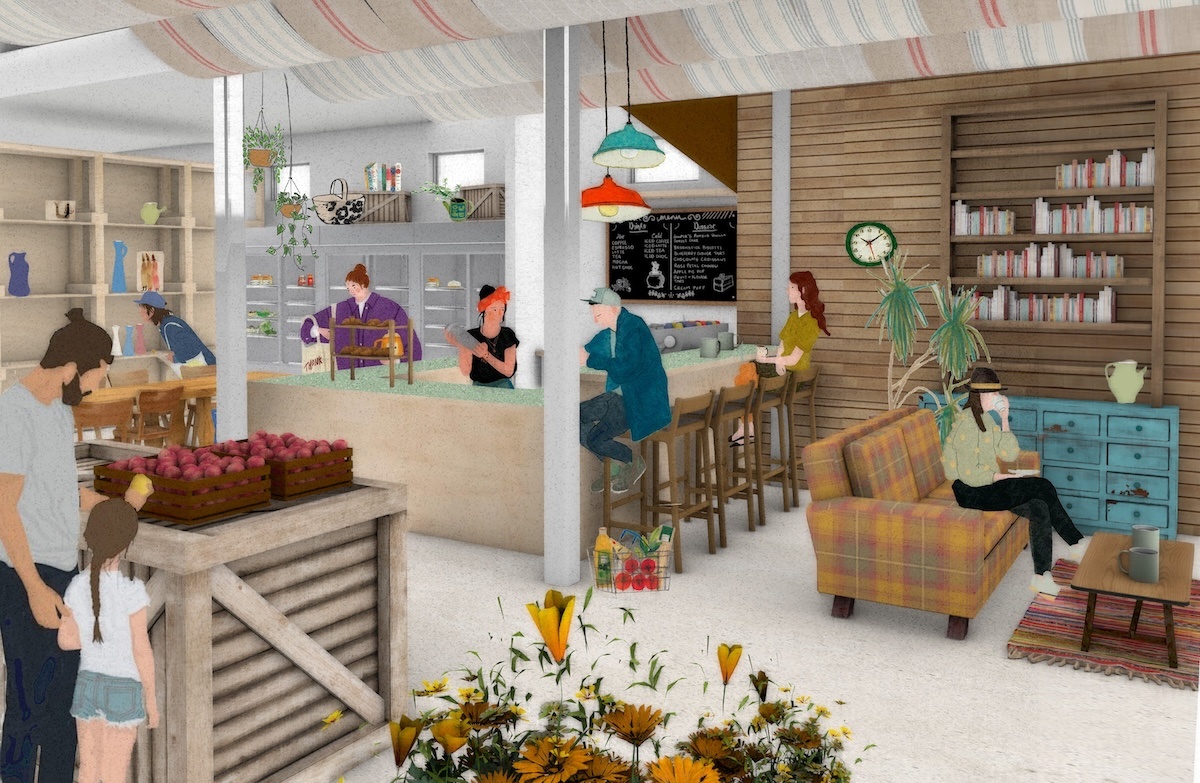
On the bottom floor, per general manager Elizabeth Manning, the space will comprise three versatile sections. For the first, the nonprofit envisions a retail area stocked with crafty goodies and artisan products (think: pottery, prints, candles, foodstuffs, etc.) in service of promoting and incubating local producers.
“That’s really exciting!” Manning notes. “It will help support the broader work that we do [as well as] build some of that infrastructure that these pockets of farmers and makers need to be supported.” Pop-ups are also on the table, she adds, as is a rotating inventory, which the nonprofit aims to curate alongside seasonality and general demand.
Behind the retail section they’ve designed a flex community space, equipped with a café and co-working area, where guests can collaborate on projects and access the internet—though Kik underscores that patrons won’t need to make a purchase to use the space—as well as an adaptable zone for workshops and classes on everything from apiculture to tree grafting to baking sourdough, and even a commercial kitchen.
There’s also an apartment upstairs, which Crosshatch has slated first for short-term rental and eventually a component of an artist-in-residence program.
“It’s really nice to now have this space that we get to call our own and shape it for all the things we want to shape it for,” Kik adds.
The Build Out
Construction-wise, the building was in its “muddy spring zone”— i.e., Crosshatch staff and volunteers were finishing demolition in May.
Moving into summer, next steps include passing the reconstruction baton as specialized trades, helmed by the folks at Team Bob’s, step in to facilitate the bulk of the buildout. Manning also highlights the recent launch of a crowdfunding campaign through Patronicity, through which the organization aims to close the project’s final funding loops.
From there, Kik adds, the plan is to turn it back over to volunteers for finishing touches. “It goes without saying that Bellaire is an amazing community full of the most incredible people,” he says. “They just keep showing up!”
Nevertheless, even ballpark budgeting for a project of this magnitude is tenuous business, especially in the face of multi-phase projects, like tearing down ceilings and walls, historic preservation, and latent code issues, Manning notes. Consequently, the space’s projected launch date, which the team had tentatively scheduled for July, has since been postponed, likely to fall 2026.
In the meantime, Crosshatch plans to adapt through community-centric initiatives, like a table at the Bellaire Farmer’s Market, as well as partnerships with local organizations, artists, and makers to offer connective programming—botanical journaling segments and nature walks, for example—both in and around Bellaire.
“We want to create a foothold in the community where people are associating those third spaces with Crosshatch and creating opportunities to deepen our relationships, both with each other and ourselves,” Manning adds.
Working with the Dreamers
As for the space’s finalized form? That’s largely up to the community to decide.
Per Kik, a good place for patrons to start is by pinpointing what they’re interested in doing, as it not only dictates what they might seek in the Meeting Place + Mercantile, but also what they could contribute. In this regard, workshop instructors are welcome, he notes, as are craftspeople and artist vendors, and cottage law cooks seeking kitchen space.
“We’re always looking for people with interesting ideas in partnership,” he says, even if it isn’t a fit in the end. “We can’t [develop] those beautiful long-term projects without [having] the 10,000 handshakes and coffees.”
Financial support, irrespective of level, is also a biggie, because it represents buy-in for the values behind projects like the meeting space.
Perhaps most importantly, though, Crosshatch needs dreamers—in particular, people willing to be vulnerable enough to voice what they need to achieve those dreams.
“We’ll keep building based on what people are drawn to, what people are asking for,” Manning adds. “I think what’s going to make this the most successful is that it’s not just about what Crosshatch wants this space to be, but what our community wants this space to be.”
To learn more about Crosshatch Center for Art and Ecology, visit crosshatch.org, and find them on patronicity.com/crosshatch to contribute to the Crosshatch Meeting Place + Mercantile campaign.
Pictured: A rendering of the cafe.

Trending
Summer Hot Spot: Median Sale Price for Area Homes Up 88 Percent Since 2019
Summer has long been the most active season for buying and selling real estate in northern Michigan. So, how was summer 2026… Read More >>
Donating Ahead of Cold Weather
Hard to believe, but winter is not that far away. Jubilee House, Traverse City’s only drop-in day shelter for adults e… Read More >>
TC State Park Reopening in October
Construction work on the Keith J. Charters State Park in Traverse City is wrapping up early, according to the Michigan DNR, … Read More >>