
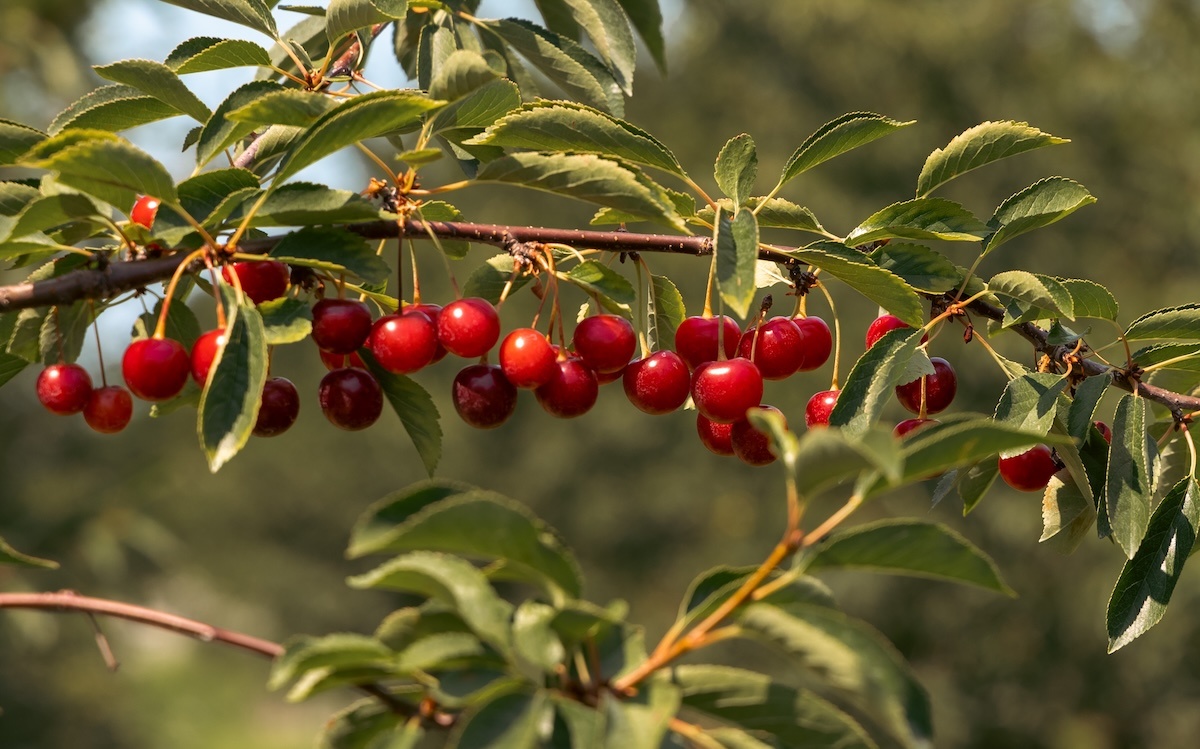
The 2026 Cherry Crop Report
Tart cherries lost, sweets in good shape
By Art Bukowski | July 18, 2026
How did this year’s cherry crop shape up?
While it depends on who you ask, what they’re growing and where they’re growing it, the answer is mostly not great for the region’s cherry farmers.
“Depending on who you talk to, the news is either bad or very bad,” says Nels Veliquette, whose family grows cherries on more than 2,200 acres in the region.
Northwest Michigan produces far more tart cherries than sweet cherries, and the region’s output is the reason why the state ranks number one in the country for tart cherry production (they’re also grown in lesser numbers downstate).
Unfortunately, a late frost event in April decimated the tart cherry crop, with regional losses estimated at 70-80 percent and even worse numbers down south. Sweets, which develop and blossom at a different time, were largely spared.
High Hopes Dashed
As coordinator of Michigan State University’s Northwest Michigan Horticultural Research Center (the “Hort Center”) in Leelanau County, Nikki Rothwell is in constant contact with dozens of cherry farmers. What she’s seeing and hearing is not good.
“The tarts look really rough,” she says. “I think we’re estimated to harvest 40 million pounds, and our carrying capacity is probably 180.”
The situation is far better for sweets, though they aren’t entirely unscathed.
“The thing about sweet cherries is it depends on what variety they have,” Rothwell says. “We’ve got some stuff that’s light and then stuff that looks great. It’s all about the variety and the stage it was in when we got that cold weather in April.”
This is especially frustrating because the weather seemed to be shaping up perfectly.
“We were really hopeful [because] it was a cool spring, which is typically good,” says Juliette King-McAvoy of King Orchards in Antrim County. “We were slow to come out of dormancy, and we didn’t really have that up, down, up, down as far as it getting hot and cold again.”
That fluctuation in temperature—particularly when it gets warm enough for the trees to blossom and then cold again, zapping and killing the blossoms, which turn into fruit—has been to blame for several major crop failures in the last quarter century.
This year was a little different. It stayed cool and got warm gradually, just as everyone hoped. And even though most of the trees hadn’t begun to blossom, the cold zapped ’em anyway.
“I thought this was gonna be a great year. We had a cold winter and kind of a slow start to spring, and I thought things were going to gradually come out of dormancy,” Rothwell says. “But it just got so cold [in April]. At Stony Point south of Suttons Bay, it was 18 degrees. So even though the blossoms weren’t out per se, the trees were far enough along that the cold caused damage.”
Pricing, Picking, and More
In an interesting and depressing twist, the other main tart cherry growing region of the country—Utah—also lost most of its crop to weather damage. This means that tarts will be in low supply across the board.
“There’s no doubt there won’t be enough cherries for everybody this year, and that includes imports,” Veliquette says. “There just won’t be enough cherries for everybody to have them.”
That does mean, however, that there is a silver lining of sorts.
“The positive side is that for those farmers that have anything over 30 percent of a crop, they’re actually going to make more money this year because the price is going to be high because of the supply and demand situation,” says Mark Santucci, who grows cherries on Old Mission Peninsula. “When you have a short supply, everybody’s scrambling to try to fill their processing plants, and that’s when the farmers get a nice return. It’s unfortunate that it takes a short crop for that to happen.”
A bad year in Michigan last year might only serve to drive prices higher for those who actually have a crop.
“We’re really low in the freezer and we don’t have a lot of stock, so I think tarts are going to be worth some money if you got ’em,” Rothwell says.
Even with high prices, though, it will be a struggle to justify harvesting a severely diminished crop.
“Those cherries will be valuable, certainly, but…are they valuable enough to shake and harvest?” King-McAvoy says. “You have to judge how many pounds do I think I can get out of a block and how much does it cost me to go in there and get them? Some farms might be bad enough that it’s not even worth trying to get those cherries off the trees.”
There’s been a lot of discussion on that front this year, Rothwell says. Decisions will have to be made on how much can actually be picked and sold.
“What’s the cutoff point? What’s that back of the napkin math that by the time you get your harvest crew in there and incur all those costs associated with harvest, are you going to make enough money?” she says. “So yeah, let’s say the price is good, how does that price have to be for you to actually get your harvest equipment, your trucks out, everything that you need and [still make a profit]?”


Trending

Flannel Season Comedy
Michigan comic Brendon Lemon brings The Flannel Season Comedy Tour to Michigan Oct. 20-28 with eight shows, from Muskegon to… Read More >>
From Russia to Iran with NWS and IAF
Big conversations are coming to Traverse City this week. On Tuesday, Oct. 20, join the National Writers Series (in partnersh… Read More >>
Call for Winter Traditions from Readers
Hello, dear readers! We’re putting together a special story in a few months, and we need your help! As colder, shorter… Read More >>