Horses on the Move
What does it take to coordinate the travel of 3,000+ horses for the Traverse City Horse Shows?
By Anna Faller | July 18, 2026
It’s that time of year again, folks, that season from June to September when the population of Williamsburg grows by thousands of residents, many with hooves, for the Traverse City Horse Shows (TCHS).
“There are equestrian communities throughout the country,” TCHS Event Director Matt Morrissey says, “and I think we have the next equestrian community developing right here on the showgrounds.”
With entrants arriving from around the globe and small armies of horses, their riders, barn staff, and scads of equipment to finagle, what does it take to transport the whole production to Flintfields Horse Park every year?
The answer is plenty of—pardon the pun—horsepower.
By the Numbers
Though final numbers for the 2026 TCHS season are still developing—per Morrissey, the show is sold out in July, but they’re still taking entries for August and September—the team anticipates a full-tilt turnout similar to the 2025 season, which saw more than 3,100 horses compete with 2,600 riders, and demographics representing a whopping 27 countries and 48 U.S. states (though, this year’s FEI World Championship in Germany might make for a slightly smaller swell).
That’s some serious ground for competitors to cover, and as you might have guessed, horseback isn’t an option!
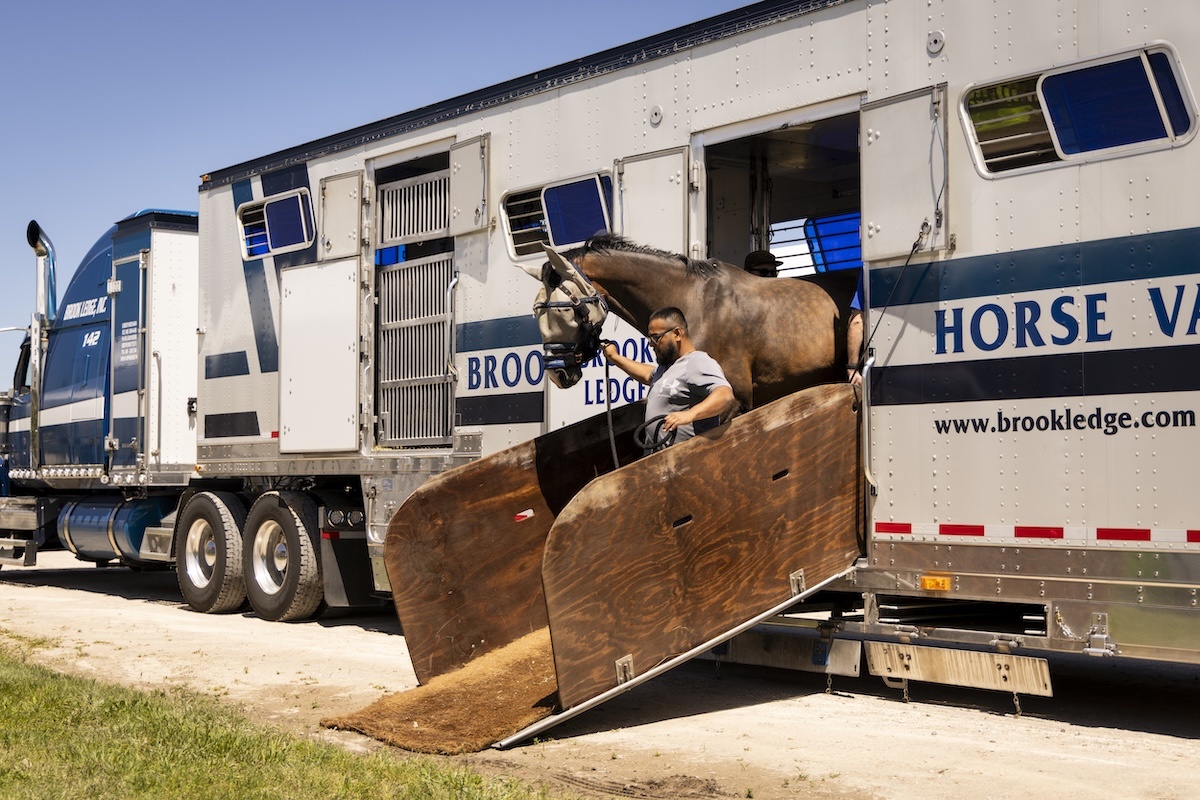
Instead, says Morrissey, about 95 percent of TCHS participants arrive via ground transportation, nearly half of whom opt for private shipping—i.e., a trailer system or semi they own, which the park has dedicated several acres to housing. The other half, he estimates, leave the travel to the professionals through services like Brook Ledge Horse Transportation, which is the largest of its kind in the country and the official transport outfit for the show.
“We try to make it a first-class ride for these horses,” says horse show operations representative Christina Sappington. “We want it to be as direct, safe, and comfortable as possible.”
A Barn Full of Stuff
Like any other road trip, the process of putting horses on wheels actually begins days or even weeks before by laying out a blueprint of needed equipment.
For smaller businesses or more prestigious events where fewer horses qualify, this might entail a minimal load, aka a “carrier convenience” ride, where one truck hauls horses from multiple barns. Or, for equestrians like Jacob Pope, a professional rider and nine-year veteran of the Traverse City Horse Shows, it could mean multiple semis move an entire business—from stables to gear and even office equipment—to Michigan for the season duration.
“We’re really a competition barn, so we tend to pack and move wherever the best shows are,” he explains. “Traverse City is so wonderful, so everything comes up here for the summer!”
The co-owner of prestigious barn Hickory Ridge, Pope estimates that his contingent typically rolls 20-30 horses deep, all of which are accompanied by students, riders, grooms, and stable staff.
Each rider in the company can expect to travel with their own tack trunk, a coffee-table-sized chest packed to the brim with all of their riding essentials from helmets to bridles, brushes, horse treats, and beyond. “That’s [already] 10-15 trunks, which of itself, is a lot to move!” Pope notes.
Then there are the equipment lockers that outfit frequent flyer horses, as well as saddles and show goodies like jumps, favorite furniture, tools for stall maintenance, and even smaller vehicles, like golf carts and dirt bikes for navigating the park’s many rings.
Last but not least, there are the horses themselves, each tucked snugly in their own travel stall (which come in several sizes, and for longer tips, might even let them lay down), along with plenty of water and feed for the ride. Per Sappington, the Brook Ledge fleet of more than 60 semis and “goosenecks,” or smaller rigs, also feature shock-absorbing air-ride suspension, as well as in-cabin fans and meticulously-oriented windows for the comfort of each vehicle’s four-legged passengers.
“Even after long trips, the horses get off the truck looking healthy and ready to go,” she says.
There are, however, protocols if a horse’s health does take a turn en route, including at least two drivers per truck, both of whom are experienced equine handlers, a live camera system, and a nationwide network of veterinary clinics for emergency stops. As Sappington explains, all traveling horses must also present a clean bill of health (complete with a Coggins test to rule out Equine Infectious Anemia), while some with specific health conditions or medications might even come with a groom or stable member.
“We really care for these horses,” adds Pope. “We want to make their lives and the travel as easy as possible. We’re there for them every step of the way.”
When Horses Fly
Air travel is a common method of equine transport for international riders, though an overall less-frequent choice for most TCHS participants.
Flying is often much more expensive and requires more specialized gear than ground transportation. Consequently, one-way air tickets for horses can easily run in the four-to-five figure range; meanwhile Morrissey estimates commercial travel rates, though situation-dependent, at a few thousand dollars per horse.
The key for many equestrians, he explains, often comes down to striking a balance between distance and cost.
“When you’re coming from [hubs like] Florida or California,” the latter of which could easily equate to multiple days of highway travel, he says, “there’s a point where the benefit of flying, for timing, really is the key decision.”
There are, however, certain transatlantic shows and qualifiers—notably, global championships, and if it’s the right year, the Olympics—as well as riders whose far-flung locations make flying non-negotiable. Airport access is also a factor, as only a handful of U.S. air hubs are properly equipped to handle equine passengers, among them, Louisville (KY), JFK (NY), Indianapolis, and Chicago. Morrissey says that TCHS has discussed the possibility of collaborating with Detroit Metro Airport, though the machinery there is yet unavailable.
There’s also additional paperwork, like equipment manifests, vet assessments, and in the case of especially well-traveled steeds, horse passports, involved in crossing borders; though this is also true of ground travel. Transnational quarantines are also a factor to consider (which are often compulsory to manage disease and invasive species, like the recent plague of the New World screwworm), as are hours- or days-long rest periods for animals making longer trips.
“There’s not really one way to do it,” Pope adds. “Every year looks a little different.”
Fuel Prices & Housing
Similarly, TCHS’s new crop of riders and classes each year makes for an increasingly-dynamic operation. There is, however, one trend in particular that continues to remain consistent: it’s getting bigger.
“People love to spend time [in Traverse City],” Morrissey says. “They hear how great the town is, how great the show is—it’s the total package.”
Even with climbing diesel prices (which, per the Bureau of Transportation Statistics, have spiked by about 50 percent since 2025), the group agrees that equestrian travel remains a bustling industry, with only the occasional small barn or solo rider thus far reducing their typical schedules.
Instead, says Morrissey, the more pressing issue is cost of local accommodation, which has proven a very real deterrent for show participants without their own barn setup.
“It’s shortening people’s stays for sure,” he says. “Some competitors can afford it, but the trainers paying for themselves and their staff to be here are absorbing that high cost of housing.”
To help mitigate this dilemma, and by extension, maintain the show’s accessibility, Morrissey highlights upcoming plans to implement TCHS-backed housing options—“that’s something we’re working on internally,” he says. There’s also a growing investment among riders vying to approach the season the same way Pope does: rent, or if possible, purchase farm property and make it a summer-long affair!
“[TCHS] is one of the nicest shows in the country,” adds Pope. “That’s what I look forward to—just enjoying our summer and knowing our horses are happy here.”
Find the Traverse Horse Shows at Flintfields Horse Park in Williamsburg (6535 Bates Rd.). For more information, including ticket purchases and event schedules, visit traversecityhorseshows.com.
Photo provided by Traverse City Horse Shows

Trending

75 Years of the Little Traverse Bay Humane Society
At the Little Traverse Bay Humane Society (LTBHS) in Harbor Springs, their answer, whenever possible, is yes: yes to adoptio… Read More >>
Compost Crawl Across Michigan
Sept. 13-26, the entire state is going to the worms with the Great Michigan Compost Crawl. Put on by Landscape for the Lakes… Read More >>
“Frame the Theme” Call for Art
Traverse City-based nonprofit The Folded Leaf Foundation (sister organization to the bookstore founded in Cedar) is issuing … Read More >>