
To Flock or Not to Flock?
Flock cameras swarm northern Michigan, stirring debate over safety or surveillance
By Mitchell Ryan Distin | Aug. 8, 2026
You have likely driven past one without noticing. But they’ve noticed you.
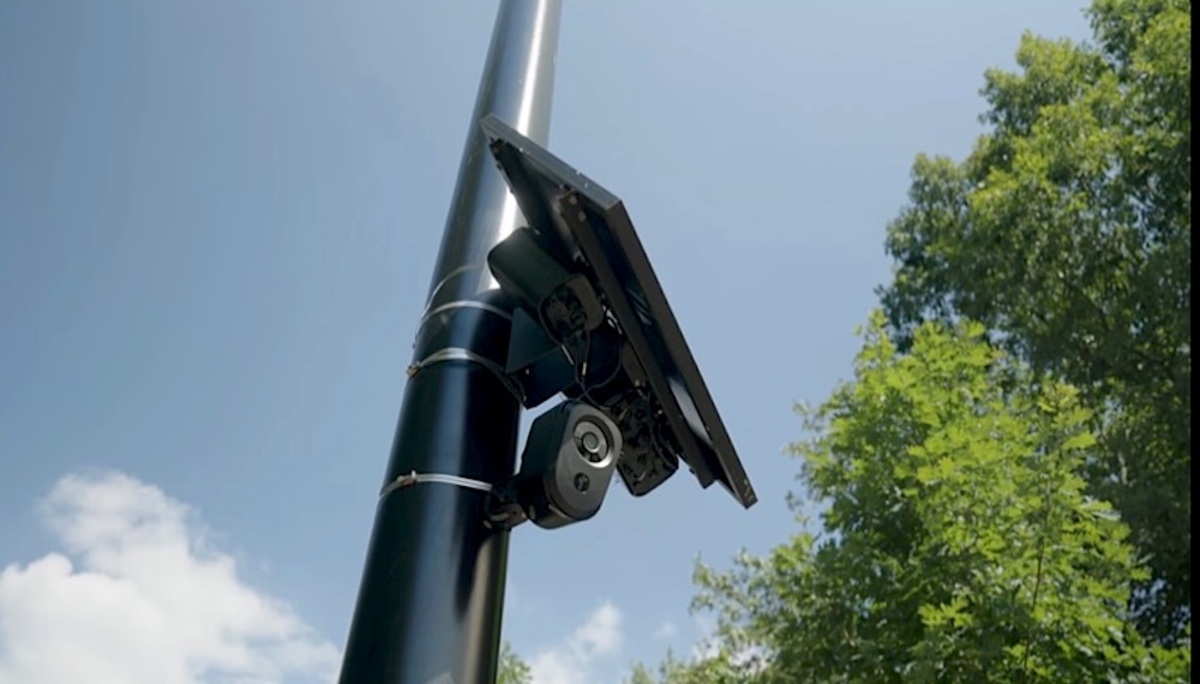
Across northern Michigan, automated license plate readers (ALPRs) made by Flock Safety—a private corporation valued at $7.5 billion—are popping up at high-traffic intersections, highway entrances, and busy township roads.
In Grand Traverse County alone, officials have reported 27 cameras across Garfield, East Bay, and Peninsula Townships, scanning more than 150,000 vehicles in a 30-day period. Similar Flock cameras have surfaced in Elk Rapids, Torch Lake, East Jordan, Kingsley, Petoskey, Gaylord, Cadillac, Manistee, and all the way up to Sault. Ste. Marie.
Flock’s system uses AI-enabled cameras to photograph every passing vehicle, recording not only license plate numbers but also characteristics such as make, model, color, decals, bumper stickers, roof racks, and other identifying features. That information is then uploaded to a database that can be accessed by dozens of law enforcement agencies outside of a local area without a warrant—including out-of-state police departments, federal agencies, and perhaps even private corporations or foreign hackers.
The result is what Flock and law enforcement agencies often describe as a searchable “vehicle fingerprint.” Law enforcement says the network is especially helpful for solving certain crimes, including auto theft, burglaries, and kidnappings.
The Pros
Supporters point to real, on-the-ground success stories. Grand Traverse County Undersheriff Randy Fewless told Interlochen Public Radio that the cameras have helped solve crimes that otherwise would have gone cold, including missing persons cases and break-ins. “If it helps us catch a criminal,” Fewless said on IPR, “it’s saving some of our other citizens and businesses from being victimized.”
According to data provided by the Antrim County Sheriff’s Office, Flock cameras have assisted deputies in seizing significant quantities of narcotics and resolving serious cases since its deployment. In 2025 alone, Flock-assisted stops yielded 1,186.8 grams of methamphetamine, 86.9 grams of cocaine, 76.2 grams of fentanyl, 37.5 grams of heroin, and 26.9 grams of crack cocaine.
The department also credits Flock with locating nine fugitives, intervening in two child abductions, recovering two missing elderly adults, and assisting in one murder investigation.
“The primary concern of the Antrim County Sheriff's Office is to preserve and protect life, property, [and] maintain public safety while respecting the rights of all people,” the department stated.
The Cons
Yet the paradox of Flock cameras is that, while supporters often describe them as a powerful crime-fighting tool capable of cleaning up our streets, critics see something far more ominous: the quiet expansion of a privately-operated surveillance network capable of tracking Americans’ movements at an unprecedented scale.
Grassroots opposition to Flock cameras, called the “DeFlock movement,” is picking up steam across Michigan and other parts of the country.
As of June 2026, the DeFlock mapping project has catalogued nearly 90,000 ALPR cameras across the United States. Flock dominates the market, with cameras deployed in more than 5,000 communities. Their network now scans billions of plates per year and shares data across jurisdictions without warrants, without oversight, and in many cases without the knowledge of the people being tracked.
In Kalkaska County, Commissioner Jeff Seiting noted that “when a proposal came across our desk to install Flock cameras about nine months ago, we immediately shut it down. We know what these are ultimately for. They’re for surveillance of Americans. Plain and simple.”
Seiting acknowledges the appeal of the technology. “Listen, the positives of Flock cameras—catching the bad guys—that’s a good thing,” he says. “I support that.”
But, he adds, the public should look beyond the typical Flock sales pitch with added scrutiny. “You need to look at the company itself, and who their primary investors are,” he says. “These are people we cannot trust to have our best interests at heart.”
Among those investors is Peter Thiel, the billionaire technology investor who was an early backer of Flock Safety and is also a co-founder of Palantir, the data-mining and surveillance company with deep ties to U.S. intelligence agencies and the military (who recently made world headlines for his secret society called “Dialog”).
For critics like Seiting, that connection is no mere coincidence. It is part and parcel of what makes Flock feel less like a crime-fighting tool and more like a surveillance weapon aimed at common Americans such as himself.
When Surveillance Goes Wrong
The DeFlock movement is burgeoning here in Michigan, too. Bay City rejected a new Flock contract after residents packed a public meeting. Milford’s township board recently voted unanimously to end its contract. And three Oakland County cities—Rochester, Ferndale, and Clawson—have all canceled theirs.
“Flock has proven time and again to be a bad actor by violating contracts, relying on aggressive sales tactics, and fear mongering,” said one Detroit-area activist known online as DebateHerOfficial, who has been organizing protests against Flock downstate. “Whether it’s misuse or misread plates, innocent people are put at risk. Flock also maintains the rights to all data collected in perpetuity. So that should worry all Americans.”
Ferndale township, for example, canceled their Flock contracts last year after an internal audit by one of their councilpeople revealed that the Ferndale Police Department accounted for less than 1 percent of all total searches made using their cameras—the rest were made by out-of-state and federal agencies like the ATF, border patrol, and homeland security. According to data discovered during the audit, there were hundreds of searches using terms related to immigration, graffiti, anti-Trump protests, and littering.
Such concerns extend well beyond Michigan. The Electronic Frontier Foundation (EFF) analyzed more than 12 million searches logged by more than 3,900 law enforcement agencies across the county and found hundreds tied to constitutionally protected political demonstrations, including the Hands Off and No Kings protests. Nineteen agencies conducted dozens of searches specifically tied to No Kings protests alone.
Civil liberties organizations, such as the ACLU, call the technology a direct assault against the Fourth Amendment—which protects citizens from warrantless, unreasonable searches and seizures by the government. In a 2023 report, the ACLU warned that Flock Safety is building a “sweeping and powerful mass-surveillance tool” that could be misused by authorities for a variety of purposes.
In Texas, for example, the EFF obtained court records showing a deputy used Flock’s system to search more than 83,000 cameras for a woman suspected of self-managing an abortion. The search note read: “had an abortion, search for female.” Flock and the sheriff’s office publicly claimed the search was a missing persons inquiry. Court records told a different story.
The Institute for Justice found that police have used ALPR systems to stalk romantic partners at least 20 times in recent years. In Wisconsin, officers from three separate departments were accused of doing exactly that—a scandal that contributed to seven communities recently terminating their Flock contracts.
Other Flock Concerns
The cybersecurity record of Flock isn’t perfect either. 404 Media, a leading watchdog on AI surveillance, reported that Flock left at least 60 cameras exposed to the open internet with no authentication required, allowing journalists to watch live feeds and manipulate cameras remotely.
A separate report by 404 Media found Flock login credentials in malware infection logs—valid usernames and passwords for Flock’s national surveillance system—being sold on a Russian cybercrime forum. Lawmakers subsequently called on the FTC to investigate.
Then there is the general concern of where these cameras are pointed. Flock has come under added fire after cameras were found aimed at pools, playgrounds, and schools. In one documented case, Yahoo News reported that Flock employees watched live feeds of a children’s gymnastics room to pitch their surveillance technology to prospective police clients.
Whatever side of this debate you land on, what is certain is that this debate is only in its infancy. Critics of the technology recommend that Michigan township approached by a Flock sales representative should be asking the same questions: Who controls the data? Who can access it? How long is it stored? What constitutes misuse—and what happens when it occurs?


Trending

Summer Hot Spot: Median Sale Price for Area Homes Up 88 Percent Since 2019
Summer has long been the most active season for buying and selling real estate in northern Michigan. So, how was summer 2026… Read More >>
Donating Ahead of Cold Weather
Hard to believe, but winter is not that far away. Jubilee House, Traverse City’s only drop-in day shelter for adults e… Read More >>
TC State Park Reopening in October
Construction work on the Keith J. Charters State Park in Traverse City is wrapping up early, according to the Michigan DNR, … Read More >>