
Crossed: A Local Pastor and a Local Atheist Debate Moral Authority – The Word of God or Legal Statute?
Aug. 26, 2016
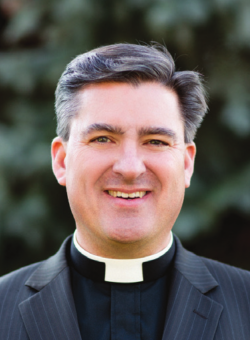
Rev. Dr. William C. Myers
Senior Pastor at Presbyterian Church of Traverse City
"There are six seats in a lifeboat"¦" If you grew up in the 1970s, you know what comes next: "and seven people." Situational ethics! I hated it! No "right" answer. The point? Everything is relative.
The traditionalist reserves the lifeboat for women and children first (a thought that would chafe my daughter). The evolutionist chooses the strongest. Survival of the fittest! The pragmatist searches for flotsam for the odd person out. The egalitarian has everyone take a turn swimming beside the boat.
Who’s right? Whose way is best? Any of them or none, depending on the situation. In a world where there’s no absolute authority, everything is relative. In a world where there is no God, "I" becomes god.
Thankfully, we don’t live is such a world. We live in a world created by the God of Abraham, who defines what is true, good, and beautiful, and whose nature is revealed in the world by Jesus Christ. Through divine revelation, God’s identity and will -- God’s goodness, truth, and beauty -- become the standard by which our actions are measured. The love of Jesus Christ, not the relativity of a situation, is the ethical standard by which we are to live.
Christians don’t always get it right. "We see in a glass darkly"¦" But at least we see the difference between a Muslim American who sacrifices his life for his country, and a radical Jihadist. We see the difference between an immigrant, working to provide a better life for her family, and a drug mule. How do we make such distinctions, if everything is relative? Sadly, if our political rhetoric is the measure, we don’t.
GARY’S RESPONSE
Bill, you live in a world created by the God of Abraham. Your religion remains a minority, and a shrinking one at that, in developed nations. Separation between church and state in the U.S. demands that we comply with the law, period.
The traditionalist, evolutionist, pragmatist, and egalitarian are like the religious – they have differing points of view with different sources of reasoning. But, they tacitly agree to follow the law of the land. They must occasionally reject their "gut feeling" for the common good.
Those of us with no religion have only to follow the law. If we disagree with it, we work to make change. When you get right down to it, life without religion is quite a bit simpler, don’t you think?
Gary Singer
Gary helps businesses with their Internet marketing. He was raised a Catholic.
A persistent issue with established religious practices and governmental regulations is how to resolve recurring clashes between the two. I empathize with those who must occasionally choose one over the other. They either violate civil law or incur the wrath of their god and fellow believers.
With more than 4,200 active religions worshipping more than 2,500 gods – each of which, followers believe is the one, true version – not only are there constant conflicts between each of them, they also run up against competing government statutes. If "god" is the source of moral authority, which one are we supposed to choose?
My Christian friend Bill stipulates that all moral authority comes from the Christian God. I imagine Muslims and Buddhists would disagree. I am certain that nontheists disagree. In fact, since all religious practice originated with humans – I defy anyone to disprove that – it is up to us collectively to resolve conflicts between civil and religious commands.
Laws are the collective will of the people and represent a compilation of acceptable behavior. Essentially, they encapsulate our morals. If we don’t like a specific law, we are free to work to change it. A recent example is the quantum leap forward our government has taken with LGBT rights. In the past, it has been equal rights for women and people of color. This is called progress, and most religions are painfully slow to evolve. But they do, and have done so because of the sacrifices of people like Mahatma Gandhi and Martin Luther King, Jr.
Like them, those who insist upon choosing religious authority that conflicts with established government law must be prepared to accept the legal consequences.
BILL’S RESPONSE
Gary’s right. It’s difficult living one’s faith in a culture where our choice is to ignore important beliefs or be a conscientious objector. Americans proclaim religious freedom, but humanism is the established faith.
Where Gary seems mistaken is in suggesting the conflict lies primarily between people of different faiths. The highest calling of most world religions is similar: Love God and neighbor. Apart from religious extremists who, like their secular counterparts, are motivated more by politics than faith, most people of faith strive to find common ground. Our experience of divine revelation is subjective, but we know there’s one God and seek to share God’s love with all people. Mahatma Gandhi and Dr. King, people of faith, moved the world forward, not just their own religions.
Bill and Gary agree that there will always be conflicts between individual beliefs and legal statutes. It is up to each of us to resolve those differences peacefully and seek guidance from religious and secular leaders we trust.

Trending

Summer Hot Spot: Median Sale Price for Area Homes Up 88 Percent Since 2019
Summer has long been the most active season for buying and selling real estate in northern Michigan. So, how was summer 2026… Read More >>
Donating Ahead of Cold Weather
Hard to believe, but winter is not that far away. Jubilee House, Traverse City’s only drop-in day shelter for adults e… Read More >>
TC State Park Reopening in October
Construction work on the Keith J. Charters State Park in Traverse City is wrapping up early, according to the Michigan DNR, … Read More >>