A Mirror, a Myth, and a Lifetime of Art
Rufus Snoddy on the chapters of his career
By Anna Faller | July 25, 2026
For award-winning multi-media artist and former Traverse City resident Rufus Snoddy, a canvas is more of a mirror for what’s going on in the world than a blank space that needs filling.
“I’m just trying to mirror things that are going on around me,” he notes. “Artists have always done that. All I can hope for is that people will appreciate the process and understand what I’m trying to say.”
Much like his art and the societal nuance it reflects, Snoddy is still evolving, and with multiple decades, countless interests, and dozens of exhibitions under his belt, he rarely says the same thing twice. In fact, he was the subject of Northern Express coverage in both 2006 and 2016, so it only made sense to check in for 2026.
Life Is a Book
To get a feel for his newest observations, though, we have to go back to the beginning.
As Snoddy explains, he views his career as an artist like chapters in a book, the first of which began in childhood as doodles in comic books and napkin stacks. Then, when he was a teenager, Snoddy developed an interest in cars—specifically hot rods and their engines, which a friend of his father’s taught him to deconstruct, paint, and even weld back together.
It’s here that the assembly element of his eventual artwork first took root.
“Even as a kid, I was always attracted to shiny objects,” Snoddy says with a laugh. “I’m looking down all the time, [picking up] interesting things. Cars were the epitome of that to me.”
From there, he entered college as an athlete and almost graduated as a PE major before falling in love with an elective art class and ultimately changing his concentration. Since then, Snoddy’s also earned a master’s degree in Fine Art with a sculpture emphasis, which he employed in his more than 10 years at NMC teaching studio art and design.
Locally, Snoddy’s work has been featured at numerous galleries and exhibitions, including at the Dennos Museum Center (like his Disappearing Man series in 2021), as well as Higher Art Gallery, The Alluvion, and in the form of several Traverse-based murals, including the Boardman Serenade, which he curated alongside Glenn Wolff in 2022.
Last year, Snoddy made the move to Kalamazoo and has reentered the teaching space as an instructor at both Kalamazoo Valley Community College and the Kalamazoo Institute of the Arts.
Inside the Art
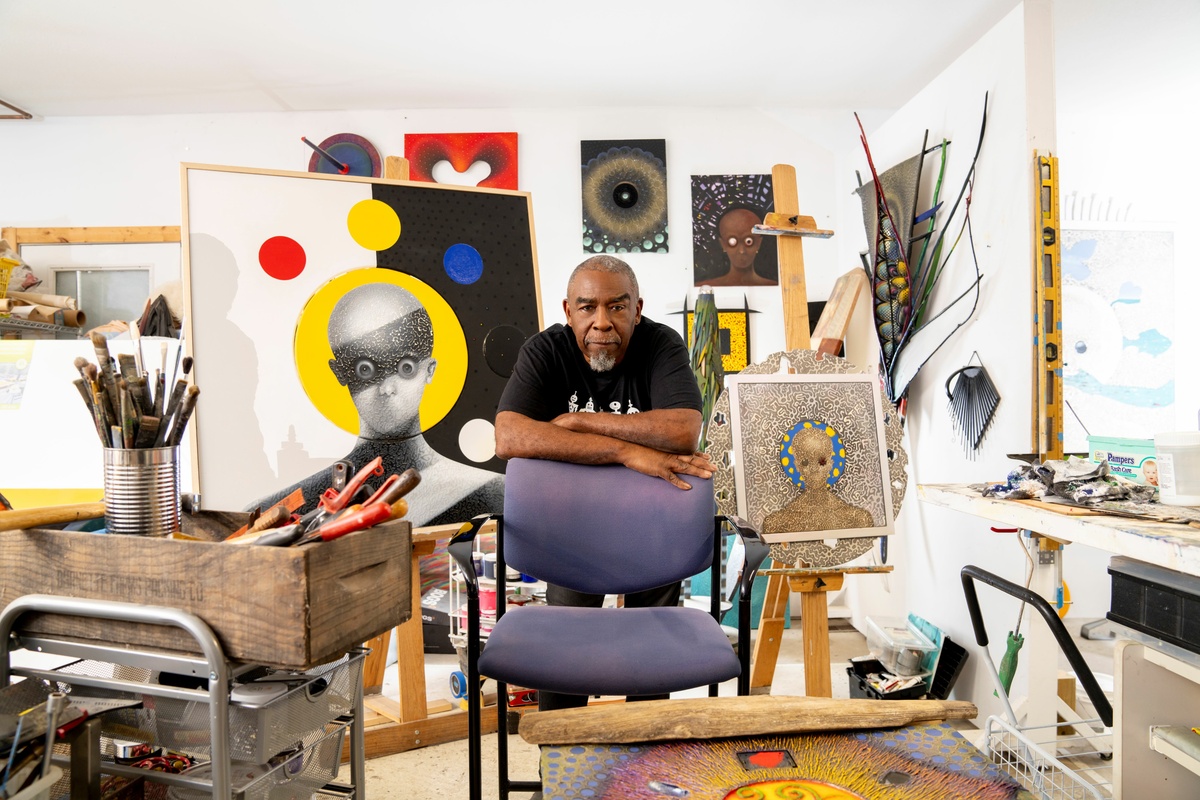
Unlike a monodisciplinary artist, Snoddy’s creations utilize multiple media to create what he calls “construction paintings,” or three-dimensional, and often free-standing, pieces that combine principles of both painting and sculpture.
“[My pieces] are objects,” he explains. “They have a lot of dimensions to them, and they’re made to occupy space in the environment rather than hanging on a wall.”
Per Snoddy, each new piece begins by crafting his own canvas base—“I’m not interested in the rectangle,” he notes—which he then manipulates further by adding texture through fabricated materials (think: string-gel, plastic, and wood), 3D optical illusions (aka trompe-l’oeil), and items he’s foraged.
With this endless assemblage at his disposal, Snoddy is free to experiment as he pleases. As for what inspires the bulk of his work? The answer is just about anything, though he notes that what’s going on in his life geographically, professionally, and personally is always an influence.
Snoddy’s Shields collection, for instance, which reflects the visual and cultural interest of his experiences in the American Southwest, explores the literal and symbolic blocks we use to protect our personal space. Meanwhile, his Windows series, curated during his time in Los Angeles, represents an observational period of his life and the effects of viewing the world from the outside-in.
Then, there’s Snoddy’s Mythology series, whose wing-centric theme harkens back to a show he did in the early 1990s surrounding the classical lore of Leda and the Swan (in which swan is Zeus, who’s assumed bird-form to seduce Leda). The resultant piece, “Seduction and Deceit,” a creation complete with a real-life audio loop, led him to the notorious legend of Dedalus and Icarus, which has since become a recurrent theme in his work as a conceit for the precariousness of modern society.
As the story goes, Icarus falls to his death after flying too close to the sun and melting his wax wings, and if you ask Snoddy, we as a society are coming mighty close to a similar plunge.
“I think we’re pretty frivolous about how we live in the world, and we’re doing a lot of damage,” Snoddy says. “We’re so intoxicated by our power and abilities, that we [make decisions] without thinking about what the consequences are going to be.
This concept of flight comes to the fore in his Wings of Icarus exhibition, a 45-piece show at the Dennos Museum, whose 2013 installation featured materials and themes specific to northern Michigan.
The collection touched on the legend of Icarus as a cultural metaphor, but this time, used flight as a symbolic escape from burdensome societal issues. “Like the shields, I wanted [the wings] to be personifications. What would I do? What would my wings look like?” Snoddy asks.
In contrast to his more urban works, which often employ the detritus of city-living (i.e., scraps of canvas, metal hardware, plastic, wood, etc.), much of Snoddy’s Michigan art features the region’s distinctive natural materials. “Spirit of Season’s Changes,” a dual-sided piece inspired by Midwest weather, features a frame of foraged tree limbs, while others incorporate items like hockey sticks, and even an elusive Faygo logo or two.
A Clarion Call
This brings us to Snoddy’s most recent “chapter,” which highlights a range of fresh conceptual art.
For starters, there’s the series entitled The Disappearing Man (a central human form dissolving into a busy background) which Snoddy says is representative of humanity’s abiding ignorance as it pertains to becoming agents of our own destruction.
Per Snoddy, foci here include the widespread debasement of climate science—“We haven’t been very good caretakers of the earth,” he laments—as well as the social construct of racism, both of which he describes as “forms of insanity.”
“These pieces are about man acting naively, being greedy and devaluing facts, and how all of that will catch up to us if we continue on that path,” he adds. “It’s a clarion call.”
Other recent projects include a series of Black consciousness pieces, headlined by a Black women portrait collection (of which “She – Not Disposable” is a standout), as well as several abstract works, many with a defining crow theme. Per Snoddy, these newer collections not only represent subjects he loves, but also allow him to amplify and reinterpret global concepts like misogyny, cultural stereotypes, and systemic racism through a modern lens.
Creating Change
When it comes to connecting with art, Snoddy points to a gap in art education, both locally and on a national scale, as an impetus to making more art accessible to wider audiences.
“It takes a certain amount of education and exposure for people to get excited [about art],” Snoddy says. “I’m starting to think differently about that, because it’s not that people don’t appreciate the work, but many of them don’t understand.”
Luckily, Snoddy reports that even Traverse City’s small-scale art community has become noticeably more open-minded and abstract since he arrived in the early 2000s. This is largely attributable to a recent influx in younger artists and leaders, he believes, who are less focused on producing art for sales than taking chances with more avant garde inventory. Increased inclusion across regional showrooms, including Higher Art Gallery, Twisted Fish, and larger spaces like The Alluvion, also continue to amplify that progress.
From there, Snoddy says, deinstitutionalizing viewership is the next big step; in other words, making art accessible outside of museum and gallery spaces. He feels this not only increases general exposure and makes consumption feel less intimidating, but also creates a wider space for artists to be more supportive of each other.
“Art is for the people,” Snoddy says. “It’s not a zero-sum game. We’re all in this together, and the more supportive of each other we are, the better off society will be.”
To see more of Rufus Snoddy’s work, visit rufussnoddy.com.
Trending
The 2026 Vineyard Recap: The Harvest, The Bottle, and The Experience
Blizzards, floods, wildfire smoke, and changing drinking habits have made 2026 another year of adaptation for northern Michi… Read More >>
Fall Festival in Elk Rapids
Just a few days after the autumnal equinox—Sept. 22, for those who observe—Elk Rapids will host its Fall Festiva… Read More >>
Revisiting Memory
How does a memory change when we revisit it? This is the question that Echoes, the newest exhibit at Crooked Tree Arts Cente… Read More >>