Being Human in a Wild World
Artist Kim Diment advocates for animals, the environment, and reconnecting with nature
By Anna Faller | June 20, 2026
If you ask award-winning wildlife artist Kim Diment, humans have far more in common with the world of animals than many of us realize.
“We came from animals,” she notes. “If you’re open to it, we can learn so much from them, [because they] teach us about us.”
A resident of the mighty Au Sable River, Diment is a decorated artist, an avid traveler, and an expert at finding the beauty in all animals, even the slimy ones; in fact, it’s that familiarity that comes from recognizing another living thing that defines much of her work.
Of her countless accolades, recent additions include the 2026 Montana Migratory Stamp and induction into her hometown’s roster of distinguished alumni. And as of October, 2025, she became the first Michigan artist to become a Master Signature Member of the Society of Animal Artists (SAA).
Top of Her Field
Master status within the SAA is a really big deal. In fact, Diment joins only 11 other active society members worldwide (18 in total) who have achieved the title.
“I’m still a little bit flummoxed!” she says. “It’s a life goal, a lifetime achievement. I still can’t believe I’ve attained it.”
Founded in 1960, the Society of Animal Artists was born in New York from a successful gallery exhibition highlighting species in the Bronx Zoo. Since then, the organization has grown to encompass several hundred members, and ultimately highlights the most distinguished animal artists around the globe.
To get there, says Diment, the process, which spanned multiple years, required two tries to crack even the guild’s introductory “associate” level, before her inclusion in the SAA’s prestigious Annual Exhibition eventually earned her five independently-juried Awards of Excellence.
In other words, Diment’s at the tippy-top of the global wildlife artistry game, joining such icon-status artists as the late Bob Kuhn and Morten Solberg; the insanely-knowledgeable Carel P. Brest van Kempen; and Diment’s friend, Rachelle Siegrist (UT), who also achieved master status this year.
Now, says Diment, the trick is to continue making art to keep up with that status. For her, that means more animal subjects—“I’ll always paint animals, because that’s just what I love,” she notes—though she also highlights environmental impact pieces as newer additions to her repertoire.
A Wild Path
Ever a nature girl—you know, the sort that could be counted on to bring creatures of every breed home from school—Diment notes that her lifelong love of art and animals developed simultaneously, making the pipeline from curious kid to serious wildlife artist, well, downright natural.
Diment was raised in an artistic family, where rainy day painting, nature walks, and crafting with materials of all kinds were par for the course. From there, the support of several early-elementary teachers was instrumental to her realization that making art could be special (not to mention her 13 subsequent years as a secondary art instructor!), before an art education from Michigan State University and the influence of such wildlife artists as Robert Bateman (also an SAA Master), John Seerey-Lester, and Rod Lawrence really sealed the deal.
Much of Diment’s work is done primarily using acrylics, as well as watercolor, charcoal, and occasionally even sculptural clay.
“I’ve had a lot of different paths, but my passions were always wildlife and art,” she says. “Whether I’m teaching, or [doing] gallery [work], I’m always still interested. Those are my driving factors.”
Decades and a blossoming art career later, those factors (combined with a healthy dose of Mutual of Omaha’s Wild Kingdom in her youth) have driven Diment all over the world in pursuit of far-flung creatures, tall and small.
“I wanted to see every animal I possibly could!” she says.
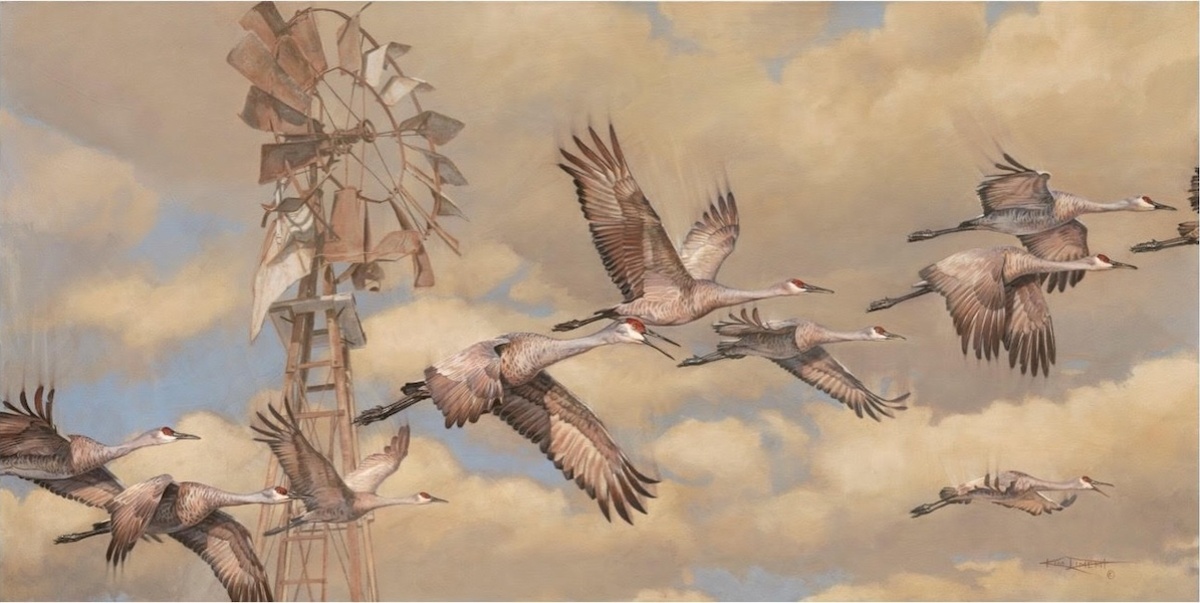
To date, Diment’s travels include locations throughout the U.S. and Canada, as well as Ecuador, Belize, New Zealand, and notably, much of Africa, which she’s visited more than 15 times (though global issues, like the onset of disease and international tensions have made future trips uncertain). In fact, several of Diment’s big cat pieces rank amongst her personal favorites, as does a giant rendering of Wisconsin sandhill cranes in flight (“The Drifters,” 2016), both of which, she notes, likely contributed to her master title.
“The inspiration is just the beauty in animals or nature itself,” she says. “I try to find things that are a little different and bring [them] out of the woodwork.”
Consequently, Diment’s latest work includes a growing series on common “pests” (possums, porcupines, skunks, the ever-contested cormorant, etc.), which she’s rendering on a massive scale in vivid color and sprinkling with personality. “I try to take the cutest parts, so people will want to know more about them,” she says.
She is also working on an annual conservation series in partnership with the Anglers of the Au Sable and book cover art for the recently released The New Au Sable by Dave Jankowski and Thomas Buhr.
Ups and Downs of the Industry (and the Environment)
While Diment is no starving artist, she’s excited that lately she’s noticed wildlife art has begun to gain widespread recognition and appeal.
“That makes me tremendously happy,” says Diment, not only from a professional perspective, but also because it suggests that audiences are viewing animals on a more complex, and maybe even more comparable, scale.
“I think art is always a reflection on society. If society is [embracing] the animals, then it starts to show up in the artwork, too,” she adds.
Conversely, Diment has also noticed a decline in environment-based initiatives, especially those concerning the preservation of public lands and wildlife habitats. This, she says, is likely tied, at least in part, to the rise of tech that keeps us tethered to the digital world instead of exploring and appreciating the great outdoors.
Though Diment remains optimistic that the pendulum will eventually rebound, she also underscores the importance of connecting with others, and then using those connections to advocate for greener, more sustainable systems.
“It’s bothersome to me that people think they can survive without forests, clean water, and clean air,” she says. “If animals and [their habitats] are dying, we’re on the menu next!”
For her part, Diment points to art as a tool for environmental advocacy, which she wields through documentative paintings, like her Tahquamenon Falls and Au Sable River series—“I would like part of my memory to be [preserving] the history of these places,” she notes. She also does work with wildlife-centric nonprofits, including the Lewa Wildlife Conservancy (Kenya), Trout Unlimited, and the Ruffed Grouse Society, among many others, and even creates pieces directly illustrating the dangers of ongoing climate change, headlined by a favorite work-in-progress depicting an owl in a forest fire.
As for the rest of us? The first step is substituting the usual doom-scroll with time spent outside.
“It’s getting back outside and getting involved with the animals and the environment,” Diment concludes. “That also allows people to communicate, because when you’re out in the wild world, we become human again.”
Check out Kim Diment’s work at kimdiment.com. Pictured: "The Drifters"

Trending
Summer Hot Spot: Median Sale Price for Area Homes Up 88 Percent Since 2019
Summer has long been the most active season for buying and selling real estate in northern Michigan. So, how was summer 2026… Read More >>
Donating Ahead of Cold Weather
Hard to believe, but winter is not that far away. Jubilee House, Traverse City’s only drop-in day shelter for adults e… Read More >>
TC State Park Reopening in October
Construction work on the Keith J. Charters State Park in Traverse City is wrapping up early, according to the Michigan DNR, … Read More >>