Controlled Chaos in the Classroom
Inspired by 27 years of teaching, Cheboygan teacher Eric Hall pens new book
By Kierstin Gunsberg | Aug. 29, 2026
He may not have a magic, teleporting school bus or be able to shrink students down to molecular levels for an up-close look at cellular respiration, but in spirit, Eric Hall is something of a Ms. Frizzle to kids in Cheboygan, where he taught elementary for more than two decades until his retirement at the end of the 2025 school year.
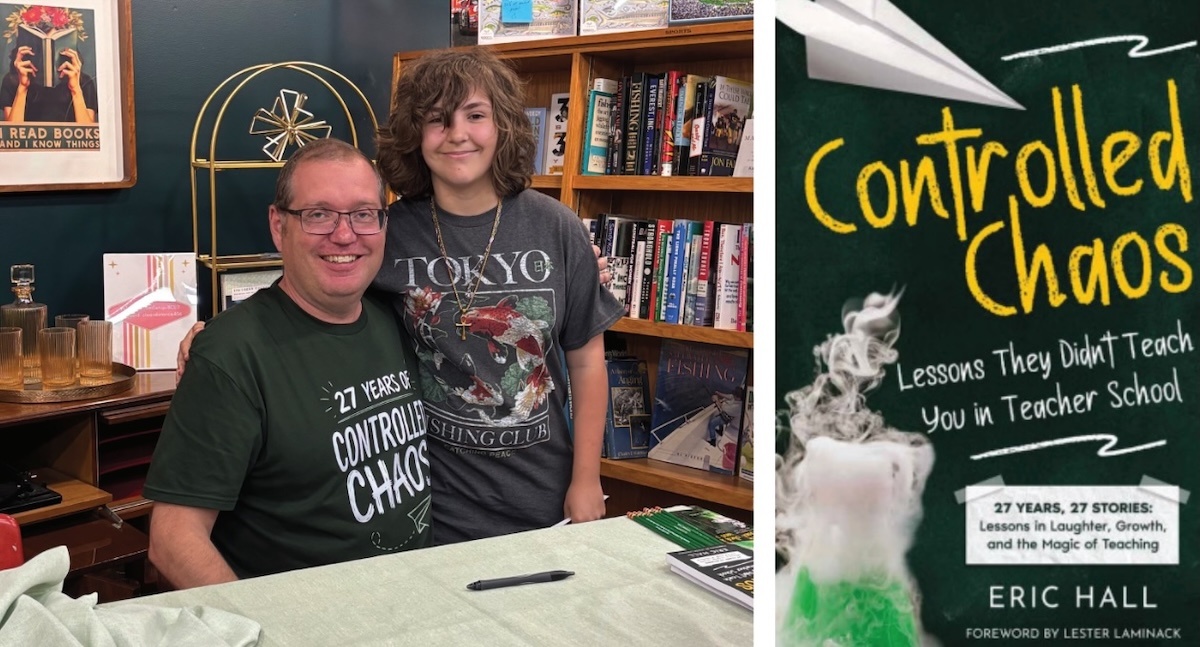
Like The Frizz herself, Hall is a bit of a rebel against rote academics, living out his career by the principle that learning should be fun and hands-on, both things he reflects on in Controlled Chaos: Lessons They Didn’t Teach You in Teacher School, a primer for teachers-to-be which hit bookstores in July.
Over 27 chapters—well, lessons—Hall recounts the ways he made math an adventure (like Lesson Five, where he set his third grade cohort loose in a race to solve equations at local businesses) and doused the monotony of language arts with comedic performance as fictional Chef Henry (that’s in Lesson 17), asking students to quickly come up with adjectives to describe his less-than-original Oreo, cheesepuff, and Skittle “recipes.” Afterward, he writes in the book, he left behind “a room full of students who just spent an entire lesson fully engaged, laughing, and – without even realizing it – learning.”
Why a Book?
As much as Hall revels in memories of his years in the classroom, including successfully getting his class on the first season of The Ellen DeGeneres Show, writing about those years wasn’t even his idea.
When asked by his students what his retirement plans were, “I told them I planned to do nothing,” says Hall. That wasn’t going to fly with the grade schoolers who had a very different vision for Hall’s post-teaching lifestyle. “They suggested I write a book about some of the classroom adventures I had.”
Writing the book took Hall a year, and edits took another four months. In some ways, the project is just a continuation of the only career Hall ever saw himself in starting back in his own elementary school days when he first met his fourth grade teacher, Gregory Driscoll, as a student in Connecticut. Mr. Driscoll, as Hall referred to him back then, was unpredictable in the best ways.
“You never knew what he was going to do next,” recalls Hall. And that’s what made learning so fun. Instead of just working through the curriculum, Mr. Driscoll showed his students how to dive in with curiosity. “It was the first time I wanted to go to school and [didn’t experience] the dread of having to go…”
And though Mr. Driscoll was prone to misadventure, like stinking up the classroom slow-cooking a peanut butter soup recipe he and the class had found in a book they’d read the day before, it was that kind of out-of-the-box teaching that inspired Hall to become a teacher himself.
“He was my idol and, ever since the day I first walked into his classroom, I wanted to be a teacher,” says Hall. “I never once thought differently.”
Crash Course
Hall first kicked off his career in 1999 as a fifth grade teacher in Franklinton, North Carolina before moving to Cheboygan Area Schools in summer of 2000, where he taught second, third, fourth, and fifth graders until last year.
Now, with several teacher-of-the-year awards racked up and Controlled Chaos earning accolades with readers, here’s a few more lessons Hall shared with us.
Children are learning all the time—for better or worse. Because, says Hall, they’re in a constant state of observation, from what kinds of conversations teachers are having with each other on the playground to how teachers are reacting to student behavior.
“My job was to always remember that I had to model not only what I said but also what I didn’t say,” says Hall. “My facial expressions, my engagement by walking around the room and giving kids a fist bump,” was just as important as the standards he had to teach that day.
There’s a lot to be learned from risking (and owning) failure. It shows kids that it’s okay to admit when something you’ve tried doesn’t work, so you can try again, says Hall, recalling the time he walked his class through a math problem that the students couldn’t get, no matter how hard he tried. Later, he realized he was actually the one who’d missed a step, not the other way around. “I told them it was my mistake, and let’s go through it again.”
As a teacher, it’s your job to find out what works best for each student. “You can’t expect them to all learn the same way,” says Hall. “Some kids need time to think before an idea comes to mind. Some need a different way to solve a problem.”
Connection is the foundation of a curriculum. That’s something Hall’s first supervisor/principal taught him early on, after Hall was placed as a permanent teacher halfway through the school year following a rotation of substitutes that had left the kids feeling a little whiplashed.
“Being young, I wanted to start teaching right away,” says Hall. Instead, the principal advised him to pause academics to get to know the students first. “Learn everything you can about them,” Hall remembers being told. “Get to know their interests and show that you care. If you do that, the trust comes and the curriculum is much easier to teach.”
Though that’s easier said than done these days. The last decade’s K-12 reading and math scores are down across most of the country, and school districts are tightening up their curriculums in response. Just in the year since Hall’s retirement, a lot has changed, including stricter daily schedules across some Michigan schools. When he was teaching, he could take his class for a meandering walk with plenty of stops to answer their myriad questions about trees, leaves, and the world around them, then head back to read books about the topic together.
“You had time for that,” says Hall, who thinks teachers are now under a lot more pressure and time constraints that leave little room for student-led learning and exploration. “The wonder of a child asking a question is gone.”

Trending

Halloween on the Farm with Wilderness Valley
Don your Halloween costume and take advantage of Wilderness Valley Farms’ final Saturday of the season, Oct. 31, from … Read More >>
Share Your Favorite Michigan Mysteries
We’ve been diving into all kinds of spooky stories this week, and that got us thinking about our 2027 Histories & … Read More >>
Interlochen’s Community Art Trail Underway
This fall, Interlochen began work on the Interlochen Community Art Trail, a 3.5-mile “non-motorized trail connecting p… Read More >>