
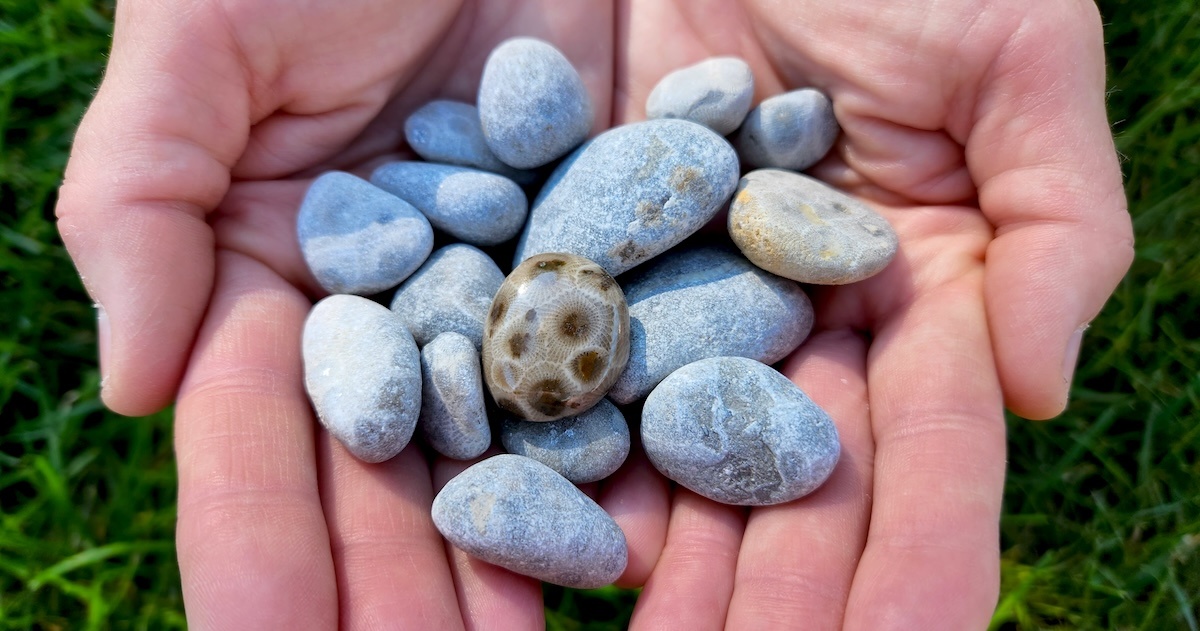
What Lies Beneath the Surface: The Ever-changing Landscape of Rock Hunting
Michigan Rockhounds founder shares stone stories and hunting tips
By Rachel Soulliere | July 11, 2026
Rock hunting is a quiet hobby, but one that puts northern Michigan on the map. From the famed Petoskey stone to Frankfort greens and Leland blues, rockhounds from around the world flock to local shores annually for the thrill of the hunt.
“This hobby is something that overshadows other types of seasonal Michigan hobbies, like deer hunting, because people come to our state specifically to do this,” says Cody Wiedenbein, Michigan Rockhounds founder and community lead. “For some, rock hunting is a bonding experience; for others, it’s about collecting; and for some, it’s a career. It’s accessible for all ages and is the perfect souvenir of our region for visitors who want to see if they have what it takes to find a Petoskey stone of their own.”
From late May to August, beachgoers are as likely to be looking at the horizon as they are to be head down, searching sandy shores for Michigan’s most famed rocks. From Petoskey stones to Lake Superior Agates, we dive into the history and locations you’re most likely to find some of Michigan’s naturally created and man-made stones.
The Petoskey Stone
The Petoskey stone we have come to know today made its appearance on Michigan shorelines a few million years ago after being churned up by massive ancient glaciers. These glaciers broke apart Michigan’s bedrock, including massive coral formations, and distributed Petoskey stones and other rocks, such as Michigan river rock, across the state.
The epitome of a Michigan treasure hunt, it’s no wonder these elusive history-filled stones became Michigan’s state stone in 1965. Featuring a honeycomb pattern created by the calcification of coral, sediments, and clay, you truly can’t find this specific type of stone anywhere else in the world.
“While there are around 10 types of Hexagonaria that exist, Michigan is the only place you can find the Hexagonaria percarinata,” says Wiedenbein. “This specific structure is like a beehive with each organism living in a tube. When one dies, it gets filled with sediments and clay, and this is what makes each eye on a Petoskey stone. This is also why the eyes of the stone tend to wear down quicker than the coral, which has a calcium carbonate structure. Ultimately, this unique structure is what brings rockhounds to Michigan.”
You can find Petoskey stones across the state, most often on beaches in the upper lower peninsula. Due to glacial activity, Wiedenbein has also found them in mid-Michigan and even, most notably, in a fast-food restaurant parking lot. However, Wiedenbein’s favorite Petoskey stone hunting spots are on the shores of Lake Huron.
“There’s an abandoned quarry in Alpena that the DNR turned into Rockport State Recreation Area. At this park, you can take your own hammer and chisel and mine for your very own Petoskey stone out of the actual 350-million-year-old Devonian coral that these stones are formed from. You can collect ones the size of your head and it’s such a unique experience because people aren’t used to seeing the actual coral that Petoskey stones are formed from,” Wiedenbein says.
Frankfort Green & Leland Blue
Years ago, Wiedenbein was having a difficult time finding information on Frankfort green and Leland blue stones, so he spent three years doing the research himself. What he found led him to a deeper historical appreciation of the stones and teaching others how to correctly attribute the stones names to the region they were formed.
“Both Leland blues and Frankfort greens are glass slag material leftover from iron melting in the 1800s. This means wherever there was an iron industry, you’ll find slag. This is why it’s important to keep the name focused on the region the slag was created, as each iron smelting operation produced different colored slag depending on the trace elements, impurities, and how fast it hydrates and cools,” Wiedenbein explains.
He then notes Elk Rapids and Cadillac both had a smelter who produced blue glass slag, but they shouldn’t be called Leland blues, rather Elk Rapids blue or Cadillac blue. Since these were the towns these specific blue stones were created in, utilizing the town name pays respect to the specific operations and iron industry in that city.
From sky blue to indigo or purple to green, these man-made glass stones are great rock hunting treasures but have had more practical uses historically, including railroads and house foundations.
Lake Superior Agates, Yooperlites & Puddingstones
Agates, Yooperlites, and Puddingstones are all most likely to be found in Michigan’s Upper Peninsula, particularly near Lakes Superior and Huron.
Agates: Cold-water agates feature blue to white tint and laces that form at the center where fossils used to be. Lake Superior agates were specifically formed in areas like the Keweenaw Peninsula or Isle Royale from amygdaloidal basalt, which has pockets like Swiss cheese that make it easy for other minerals to invade to create its coloring. They are usually as big as a quarter, and you can find people regularly hunting for them in Marquette in the mornings or after a big storm has come through.
Yooperlites: These glowing rocks were carried down to the Upper Peninsula by glaciers in Canada and dispersed along Michigan’s shoreline. While the name suggests they can only be found in the Upper Peninsula, Wiedenbein and his team like to refer to them as “Glowdalites,” as you can find them along shores across the state… as long as you have a high-quality ultraviolet light. You can find a majority of rockhounds searching for the largest concentration of these rocks between Grand Marais to Whitefish Point at night with their strongest UV lights.
Puddingstones: Dropped parallel to Drummond Island by glaciers, Puddingstones have a cookie-like appearance that features pebbles, including red jasper, against a white or gray quartzite base. The Michigan Rockhounds map features eight different locations to find Puddingstones, all along Lake Huron.
Where to Hunt
Explore the Michigan Rockhounds Map to view the best hunting grounds for each individual rock mentioned above and more: michiganrockhounds.com/map.
Welcoming more than 268,300 members to their Facebook group, Michigan Rockhounds is setting the standard for rock hunting locations, rules, and history.
Wiedenbein shares rock hunting spots on the Michigan Rockhounds map, but he always adds the disclaimer of there never being a guarantee of finding the exact rock you are looking for. He encourages rockhounds, from novice to expert, to experience the joy of the hunt and to take in the full history of each town’s rocks instead of focusing on finding a certain rock.
Even with this disclaimer and limitations in place, including a 25-pound yearly limit and it being illegal to remove rocks from national lakeshores such as Sleeping Bear Dunes, Wiedenbein still hears words of concern regarding difficulty of finding stones.
In fact, a few years ago, a local politician came to him concerned that they couldn’t find a Petoskey stone. They wanted to take steps to protect this elusive stone, as they believed rockhounds may be scooping up too many of them and not leaving enough for everyone else.
“One thing this politician didn’t realize is that there are thousands of metric miles of Petoskey stone in formation underneath Michigan. Every single day these formations are breaking apart on the shoreline and bringing more stones to the surface to be found by all. There truly is enough for everyone,” Wiedenbein says.
(Turns out, a combination of location, seasonality, and the politician’s eye not being particularly rock hunting trained were what contributed to their inability to find a Petoskey stone during their summer trip to the lakeshore.)
Rock hunters often have good luck after big, windy storms, during which waves churn up plenty of new finds from the depths. But one of the greatest times of year is not summer but early spring. (We recommend you invest in waders.)
Through the comforting, timeless cadence of waves pushing and pulling through the harsh northern Michigan winters, sediment is churned up and new rocks are brought to the surface. Locals understand the importance of resetting in winter just as much as our lakes do. As the first trillium, ramps, and morels appear, so do a new collection of our local stones.
The earlier you can get out to hunt, seasonally and time-of-the-day wise, the luckier you might be. Turns out, the early bird gets the stone.
Want to contribute to or join the local rockhounding community in Michigan? Submit your rock findings, locations, tips or learn more about Michigan Rockhounds at michiganrockhounds.com or join the Facebook group at facebook.com/groups/michiganrockhounds. Photo courtesy of Michigan Rockhounds.


Trending

Meet the Candidates: Hear from candidates for Washington & Lansing seats
Nov. 3 will be a busy day for Michigan politics, as we elect leaders to our state legislature, the governor’s office, … Read More >>
OBrien Vineyards’ Ard Ri Pinot Noir
There’s something about fall in northern Michigan that has us feeling like royalty. So, we’re pairing the majest… Read More >>
Four Frightful Halloween Events
Ghosts and ghouls are starting to emerge, and we have four fab ways to celebrate this week. Friday, Oct. 23, head to Seven H… Read More >>