The Top Threats to the Great Lakes, and Ways to Combat Them
Seven orgs, government entities, and businesses weigh in
By Ren Brabenec | July 11, 2026
There’s nothing we Michiganders are more proud of than our Great Lakes. And while we’re in the high season of swimming, paddling, and boating, it seems like life couldn’t get any better out on the water.
But behind the scenes, our lakes face rising challenges—from pollutants to quagga mussels to climate change—so we checked in with seven organizations dedicated to protecting our favorite natural resource.
LOCAL
The Little Traverse Conservancy
Though it is easy to assume the Great Lakes will always be there and remain healthy and natural, Anne Fleming at the Little Traverse Conservancy emphasizes the importance of not taking the Great Lakes for granted. Fleming is the director of community outreach and communications at LTC, where she focuses on preserving land and scenic areas in northern Michigan.
To Fleming, one of the first steps in encouraging the public to advocate for the Great Lakes is ensuring they can access them, which means preserving the land where the lake meets the shore. “When people can access the Great Lakes via public lands, they develop a relationship with the water and become an advocate for it,” Fleming says.
“We are pleased to say that some of the few places the public can get to a Great Lake in our service area is thanks to the work the conservancy has been able to do in partnership with landowners and supporters. For example, between Harbor Springs and Mackinac City, almost all of the most popular access points to Lake Michigan were conservancy projects, including the beloved Sturgeon Bay Dunes, a protection effort coordinated by LTC’s first executive director, Kathy Bricker, that is now part of Wilderness State Park.”
The Watershed Center of Grand Traverse Bay
The Watershed Center of Grand Traverse Bay combines scientific expertise with policy work to examine and advocate for the health of the Great Lakes watershed system as a whole, i.e., not just by examining the bodies of water themselves, but by examining the entire watershed system that surrounds the Great Lakes.
“We approach our work in three core ways,” says Christine Crissman, executive director of the Watershed Center. “We protect water through science-based planning and advocacy, restore waterways through on-the-ground projects, and connect people to clean water through education and community engagement. From leading watershed protection strategies to implementing nature-based stormwater solutions and naturalizing shorelines, we serve as both a trusted resource and a strong voice for clean water.”
Crissman lists off some of the organization’s recent accomplishments, highlighting their successful efforts to hold a polluter accountable for long-term water quality violations, their work to guide shared stewardship of a newly restored, free-flowing river system in the Boardman-Ottaway River Network, and their efforts to give Kids Creek new life through habitat restoration, stormwater improvements, and reconnection of natural systems.
But their work is far from finished. As a watershed expert, Crissman directed our attention to the role that non-Great Lake water systems play in Great Lakes water quality.
“Wetlands, rivers, and natural shorelines that once filtered pollution and supported diverse ecosystems are increasingly altered or disconnected, reducing their ability to protect water quality and sustain native species in the Great Lakes,” she says.
“Runoff from urban and agricultural areas remains a significant stressor, carrying nutrients, sediment, and contaminants into rivers and lakes,” Crissman adds. “Habitat loss and fragmentation, especially in wetlands, rivers, and along shorelines, continue to strain native species that depend on connected, complex ecosystems to survive and thrive.
“At the same time, emerging pollutants that aren’t yet fully understood, including microplastics and other toxic compounds, are a growing concern as they are increasingly running off the land and becoming present in the Great Lakes.”
Wave Lumina
Pollution is not a new concern, but the types of pollution threatening the Great Lakes are changing. Wave Lumina is a Traverse City-based tech company that’s building one of the first field-deployable screening tools for PFAS, aka forever chemicals. Across the state, the Department of Environment, Great Lakes, and Energy maintains a public map of confirmed sites.
“Michigan has identified more PFAS-impacted sites than nearly any other state,” Wave Lumina founder and CEO Vernon LaLone says. “Once these compounds enter surface water or groundwater, they don’t break down. Environmental consultants working on Great Lakes-adjacent sites—landfills, airports with firefighting foam history, legacy manufacturing—currently fly blind between lab turnarounds. Our tool gives them eyes on contamination in real time, which translates to faster cleanups and better sampling decisions.”
LaLone has spent years working on technology to combat PFAS. He says the work of protecting the Great Lakes and Michigan waters, both above ground and below, can’t just be left to private companies, nonprofits, and the government.
“Everyone needs to play a role, however they can, starting with testing your water,” LaLone says. “If you’re on a private well, get it tested for PFAS at least once, and check whether your township or county has a known PFAS site within your groundwater capture zone,” he recommends.
LaLone adds that “If you’re on municipal water, ask your utility for their most recent PFAS testing results; under the new federal drinking water standards, they’re required to share them. It sounds small, but PFAS contamination is essentially invisible—no taste, no smell, no color change—and the only way to know what you’re drinking is to measure it. Every household that tests adds a data point to a picture we badly need to fill in.”
REGIONAL
The Great Lakes Coalition
Ron Watson is board president of the Michigan-based Great Lakes Coalition, a “non-profit organization whose membership consists of individual coastal property owners throughout the Great Lakes Basin,” per their website. He tells us what he thinks the public isn’t focusing on enough regarding the Great Lakes.
“The hidden danger no one’s talking about is not the water itself, but that critical habitat and ecosystem where the water meets the land,” says Watson. “The Great Lakes Coalition focuses attention and action on water levels, natural sand supply to beaches, dunes, and bluffs, shoreline protection and resiliency, and coastal management. Our goal is a simple one: to ensure the Great Lakes and their coastal regions remain healthy, natural, accessible, and usable forever.”
According to Watson, much of the shoreline erosion along Lake Michigan is caused by human activities, such as piers, jetties, harbors, and dredging. He explained that piers and jetties interrupt the natural flow of sand (called littoral drift) by trapping massive amounts of sand on the up-drift side of the obstruction while starving the down-drift side, leading to beach erosion and accelerated risk for structure collapse.
“We want to provide solutions to some of these erosion issues caused by man-made devices, to bring the shoreline back to its natural state, one that’s better for residents and the plants and animals that live on or near the shoreline,” Watson says.
He adds that The Great Lakes Coalition is “currently advocating for HR 5304 that was introduced by Rep John Roth. That bill would modernize Michigan dredging policies, as it requires that if the dredged material is suitable, it should be placed on the down drift beach or on the nearshore. There’s also a federal bill we’re supporting that would provide funding for beach nourishment and other shoreline and wetland area restorations.”
The Alliance for the Great Lakes
Based in Chicago, the Alliance for the Great Lakes is a nonpartisan, nonprofit organization working to protect the fresh, clean, and natural waters of the Great Lakes. Funded by individual donors and foundations, the organization focuses on invasive species, plastic pollution, water infrastructure, excessive water use by industries like agriculture and data centers, and toxic algal blooms.
“We successfully made the case that federal cuts to Great Lakes research would be harmful to the Great Lakes and the communities that depend on them,” Media Director Don Carr says when asked about the organization’s recent accomplishments. “We’ve also raised the issue of data center proliferation into a top of mind topic.”
Carr indicates that there are many challenges facing the Great Lakes today, each of which needs to be at the forefront, not just for nonprofits, but for every resident of the region.
“Climate change is making algal blooms worse, creating better habitat for invasive species to push cold water species out, and producing weather events that overwhelm already crumbling water and sewage infrastructure,” Carr says. “We need everyone who loves these waters to band together and support them. They can volunteer for one of our Adopt-a-Beach cleanups to make an individual impact, and use that as a springboard into other advocacy roles.”
NATIONAL
NOAA’s Fisheries Office of Habitat Conservation
Many of the threats facing Great Lakes ecosystems stem from habitat loss and degradation resulting from human coastal development, agricultural expansion, invasive species, and climate change. Andrea Gomez, Public Affairs Officer at NOAA’s Fisheries Office of Habitat Conservation, says her office is tasked with restoring habitat for Great Lakes fisheries.
“Our office has funded more than 130 habitat restoration projects in the Great Lakes region,” Gomez says. “The Office of Habitat Conservation provides funding and technical guidance to local partners, who implement restoration projects throughout the Great Lakes basin. We support projects that improve areas that have experienced environmental degradation, known as Areas of Concern, and that restore priority habitat for Great Lakes fisheries.”
Gomez listed a few examples of recent projects her office played a central role in, touching on the restoration of habitat for Great Lakes fish at the Historic Edsel and Eleanor Ford Estate, the cleaning up of Muskegon Lake to the point of it being removed from the List of Most Degraded Great Lakes Sites, and the revitalizing of the Detroit River Ecosystem.
“The Great Lakes serve as important economic resources, supporting industry, transportation, commercial and recreational fishing, and tourism,” Gomez says. “NOAA’s habitat restoration work in the Great Lakes region helps support the fish, communities, and economies that rely on them.”
EPA’s Great Lakes National Program
Todd Nettesheim, deputy director of the Environmental Protection Agency’s Great Lakes National Program Office, brought us up to speed on what the EPA is doing to protect the health of the Great Lakes via the Great Lakes Restoration Initiative (GLRI).
According to Nettesheim, the greatest threats to the Great Lakes include legacy pollutants that affect water quality, invasive species such as zebra and quagga mussels that alter ecosystems, and harmful algal blooms.
“In the last two years, EPA delisted the Rochester Embayment Areas of Concern,” Nettesheim says when asked about projects the EPA has been working on. This and the Muskegon Lake Area of Concern mentioned earlier were two regions in the basin that had experienced significant environmental degradation.
“Thanks to the GLRI and the work of numerous partners, both have been removed from the list of Areas of Concern, and are no longer considered two of the Great Lakes’ most environmentally degraded areas,” Nettesheim adds.
“Additionally, EPA has made major progress to help native species recover in the Great Lakes,” Nettesheim continues. “Each season, GLRI supports work to locate and identify each critically endangered piping plover pair and nest, put protections around nests, and monitor each for the full breeding season. In 2025, a record 85 nesting pairs were discovered and protected in the basin, the largest number noted since the species was listed as federally endangered in 1986.”
Nettesheim tells us that GLRI funding has also supported the restoration of lake trout populations, which are now considered fully recovered in Lake Superior.
“Other successes include restoring more than 27,000 acres of coastal wetland habitat in FY 2024, to benefit native fish, bird, and amphibian species, reopening more than 840 miles of stream in FY 2024 of Great Lakes tributaries, increasing the aquatic connectivity for numerous fish species, and preventing more than 83 million gallons of stormwater from entering the Great Lakes through various green infrastructure projects in FY 2024,” Nettesheim says.
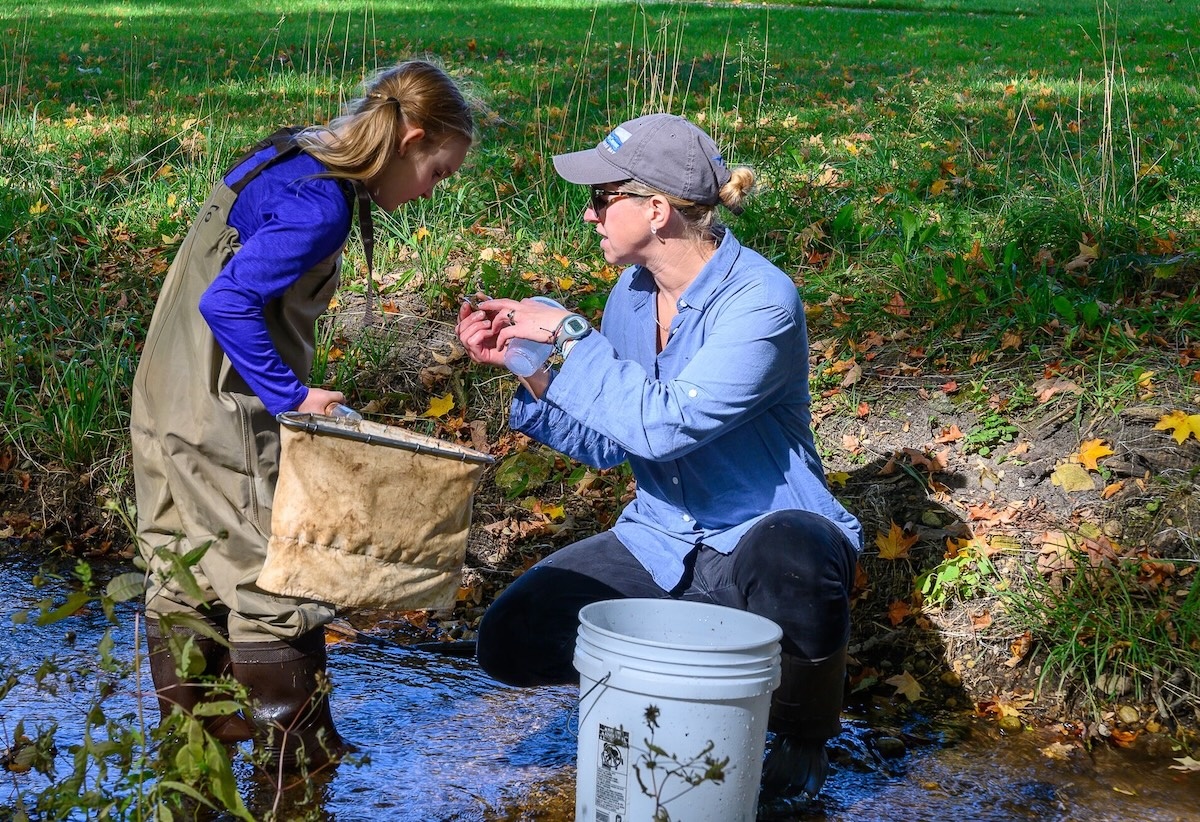
Photo courtesy of the Watershed Center Grand Traverse Bay


Trending

Saturday Suds in Cadillac
Grab a tasty craft brew or choose from a variety of NA flavors at Cadillac’s Craft Beer Festival, overlooking Lake Cad… Read More >>
Halloween Begins on Silver Lake
If the decorations around town haven’t been a sign, then consider this your official notice: spooky season is here! Ho… Read More >>
Revisiting Memory
How does a memory change when we revisit it? This is the question that Echoes, the newest exhibit at Crooked Tree Arts Cente… Read More >>