
Kalkaska Public Schools: Then & Now
In 1993, a budget crisis in Kalkaska schools changed Michigan school funding forever. Three decades later, how is KPS doing today?
By Beth Milligan | Aug. 29, 2026
In March 1993, the Kalkaska school district made a decision stunning enough to attract national attention. Faced with a budget shortfall, the district decided to end school 10 weeks early rather than cut more programming.
At that point, Kalkaska had already slashed its art, sports, and library budgets and repeatedly sought voter approval to increase taxes—to no avail. Rather than gut anything else, the school board decided to cut back its school year.
The move generated considerable debate. Critics said the district chose to make a political point at the expense of its students, while defenders said the closure was the natural outcome of an inequitable funding system legislators refused to address. The slogan “No More Kalkaskas” eventually led to the state’s passing of Proposal A, which “promised a minimum per pupil foundation allowance, more equity among local school districts, lower property taxes, and more school accountability,” according to a 2002 report on Proposal A from the Michigan Department of Treasury.
Before Proposal A, Michigan’s property tax burden “was more than 33 percent above the natural average,” with the top 10 spending districts outspending the lowest 10 districts “by almost a 3:1 ratio,” according to the report.
A decade later, that ratio had dropped to less than 2:1 and Michigan’s property tax burden was near the national average, the report states. So how did Proposal A affect Kalkaska schools, which helped usher in the pivotal change?
“It’s a really complicated question,” says Kalkaska Public Schools (KPS) Superintendent Rick Heitmeyer. “Prop A was huge for schools that had trouble getting community support for operating millages. It definitely had a great impact. But there have been so many tweaks and changes to it throughout the years that it’s lost what it initially set out to do. It’s so tied to property taxes that we now see many schools going out of formula,” he adds, referring to when districts collect more than their per-pupil allowance in local taxes and stop receiving state baseline foundation aid.
“I think there needs to be something done at the state level, and there are possible solutions,” Heitmeyer says. “But it’s a complicated maneuver to get to the next spot.”
In the meantime, KPS today is pursuing the same path as many rural school districts in Michigan: embracing creative—sometimes bold—solutions to challenges that include high transportation costs, staffing shortages, and declining enrollment.
Transportation & Staffing
Heitmeyer, who became KPS superintendent in 2021, says one of the district’s biggest challenges is its size. “We cover 444 square miles, so we are huge,” he says. “We are most of Kalkaska County.”
While Michigan school districts received a 2.5 percent increase in their per-pupil foundation allowances this year—to $10,300 per pupil, up $250 from last year—that increase isn’t enough to keep up with inflation, much less automatic staff wage increases or rising insurance and fuel costs, says Heitmeyer.
Faced with such a sprawling rural area to cover and a shortage of bus drivers, KPS has a cooperative agreement with Kalkaska Area Transit [KAT] to help provide student transportation. The agreement means public transit covers about half of the district’s bus routes.
“I think since I’ve been here, we’ve had a constant sign out for hiring bus drivers,” explains Heitmeyer. “It’s a unique job. It’s a couple hours in the morning and afternoon and then some field trips. It’s an important job, but it doesn’t necessarily appeal to everybody. If we didn’t have that (KAT) partnership, I don’t know what we would do. That’s one of our biggest challenges: getting everybody to school.”
The lack of bus drivers is part of a bigger overall issue facing school districts across the country: staffing shortages. In 2025, more than 400,000 U.S. teacher positions were unfilled or filled by those with inadequate teacher certification, according to the Learning Policy Institute. The American College of Education cites several factors for the teacher shortage, including a “mix of low pay, high stress, inconsistent leadership, and declining interest in the profession.”
KPS has just under 100 teachers and about 200 staff members overall, Heitmeyer says. Many of those employees are eligible or close to being eligible for retirement. “If they all decided to retire at once, it would be wild, because the folks aren’t out there to replace them,” the superintendent warns. That’s led to a complete reversal in school staffing trends, he notes.
“If this was 1996 instead of 2026, we would’ve probably encouraged retirement so we could get the next generation of teachers in place,” Heitmeyer says, explaining that such an approach helped curb costs since veteran teachers are typically on the higher end of the pay scale.
“That’s one major change over the last 30 years. We need to keep our veterans now. We try to keep great relationships with our people to keep them here. We were able to fill our positions this year, but it’s usually not without taking somebody from our neighbors. It’s a free agent market for teachers, which is great for teachers but hard for districts. The number of teachers available does not meet the demand throughout the state of Michigan.”
Enrollment
Declining enrollment is another challenge, not just for KPS but school districts across Michigan.
According to the Michigan Center for Data and Analytics, about 80 percent of Michigan’s school districts have experienced enrollment deductions since 2009. That’s largely due to a decline in births overall, with the 5- to 17-year-old population decreasing from 1.92 million in 2000 to about 1.57 million in 2022, according to the state. That 18 percent decline in just two decades is likely to be repeated, with the state projecting another 18 percent loss by 2050.
At KPS, the district had close to 2,000 students in its heyday but is now down to about 1,350, Heitmeyer says. “We’re much smaller than we were in the ’80s and ’90s,” he says. “We probably get 30-50 fewer students every year. In the last five years, we’re probably down a couple hundred students.”
He points to surrounding school districts, like Forest Area, Bellaire, and Elk Rapids—“we call it the 131 corridor,” he says—and notes that along with Kalkaska those districts have collectively lost roughly 1,200 students in the last decade. “That’s a reasonably-sized school district in and of itself,” he says.
Rightsizing & Reimagining
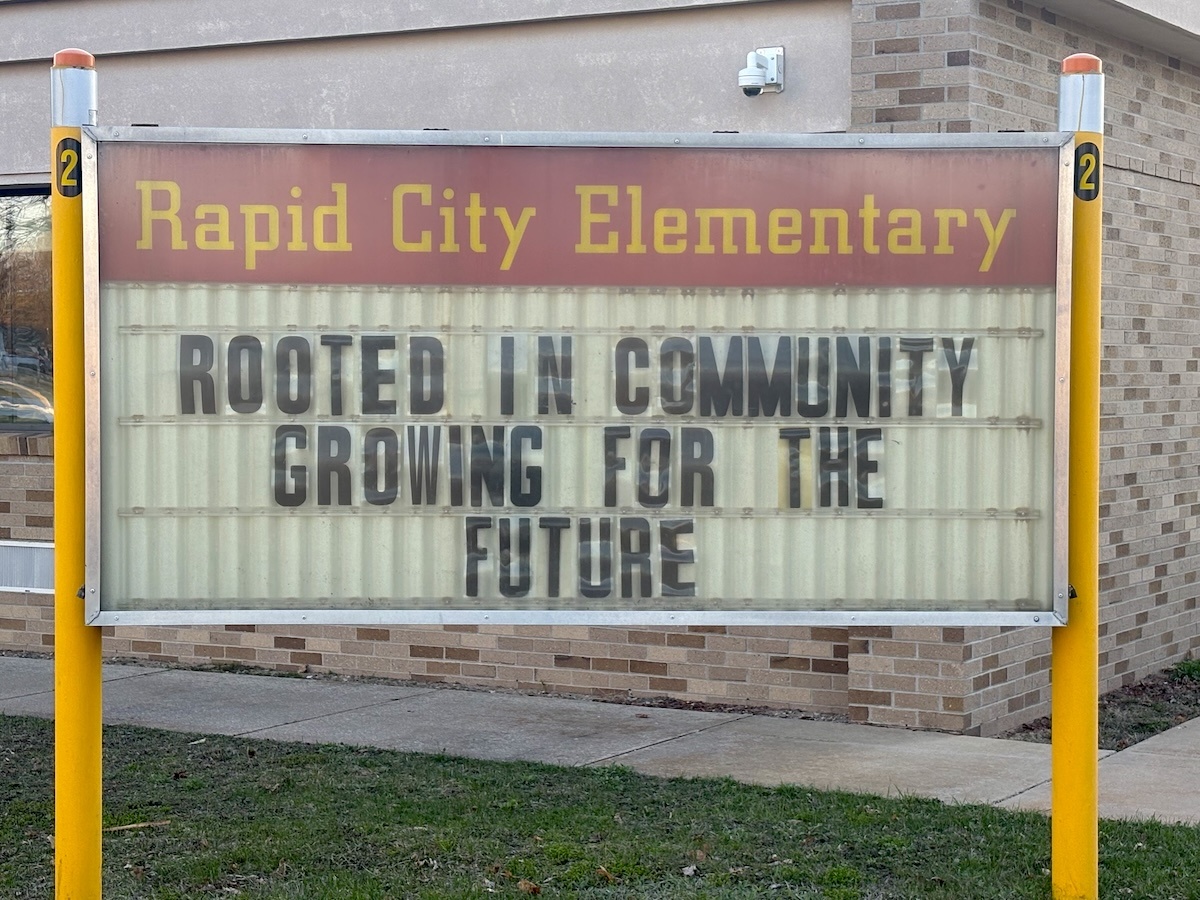
Declining enrollment not only means reduced funding for districts but tough conversations about rightsizing schools. That happened at KPS this spring when school board members considered closing Rapid City Elementary School.
“Our original thought was that the building’s enrollment has declined in the last five years, so what if we made the 2025-26 school year a celebration [farewell] year?” says Heitmeyer, citing the school’s student population drop from the low nineties to the low fifties in recent years.
But then another idea emerged, particularly as the community expressed alarm about losing a beloved campus. “What if we did something completely different?” says Heitmeyer. Officials began a year-long process to envision a new model for Rapid City. After researching and meeting with other districts, a new “place-based model” that embraces the school’s natural resources—its on-site garden and extensive acreage hosting forested terrain and the Rapid River—rose as the frontrunner option.
School board members approved that approach this spring, voting to keep the school open.
Rapid City Elementary School Dean of Students Kevin Malbouef says the new “stewardship campus,” as the model is called, teaches students to “understand they’re part of something bigger than themselves.” Core subjects like math, reading, science, and social studies are still taught but incorporated into an immersive, hands-on curriculum that emphasizes outdoor and community time as much as indoor classroom space.
The curriculum, called Project Learning Tree, is an award-winning, multi-disciplinary environmental education program used in classrooms PreK-12 across the country. Staff trained with the Grand Traverse Conservation District to help learn the program, Malbouef says. The model switch, which incorporates multi-aged, family-style classrooms, is already meeting with enthusiasm. Enrollment for this fall is “hovering right around 70,” says Malbouef.
The school is also introducing a new middle school component, adding a self-contained classroom for grades 6-8. “We have veteran staff here; all of us have about 20 years of experience in education,” Malbouef says. “We have some of those new, nervous feelings about this, but we also have extremely dedicated educators who are excited about expanding the traditional classroom and about learning through application.”
The innovative approach is an example of how KPS continues to evolve to meet challenges, much as it did in the nineties, when daring decisions were sometimes necessary to secure the district’s future. KPS still has strong community support, with voters overwhelmingly backing a 2021 bond that allowed the district to renovate Birch Street Elementary and add a new early childhood learning center.
While Heitmeyer is mindful of the financial “cliff” that always looms for rural school districts, he’s confident in his team’s ability to face whatever comes next.
“We’re doing a lot of great things, and we get [as] creative as possible,” he says. “I feel great about navigating the challenges to come.” He adds, chuckling: “If we didn’t have challenges every day, it wouldn’t be any fun.”

Trending

Water Weekend in Petoskey
The annual Water Is Life Festival—part of the 2026 Water Weekend Sept. 4-7—heads to Bayfront Park West in Petosk… Read More >>
Can Leelanau Housing Become Affordable?
That’s the question the Leelanau County Housing Collaborative and Sleeping Bear Gateways Council are trying to answer … Read More >>
The Fall Herd
Did you know that Gaylord is home to a herd of 60 elk, the official mascot of Otsego County? And that there are places aroun… Read More >>