
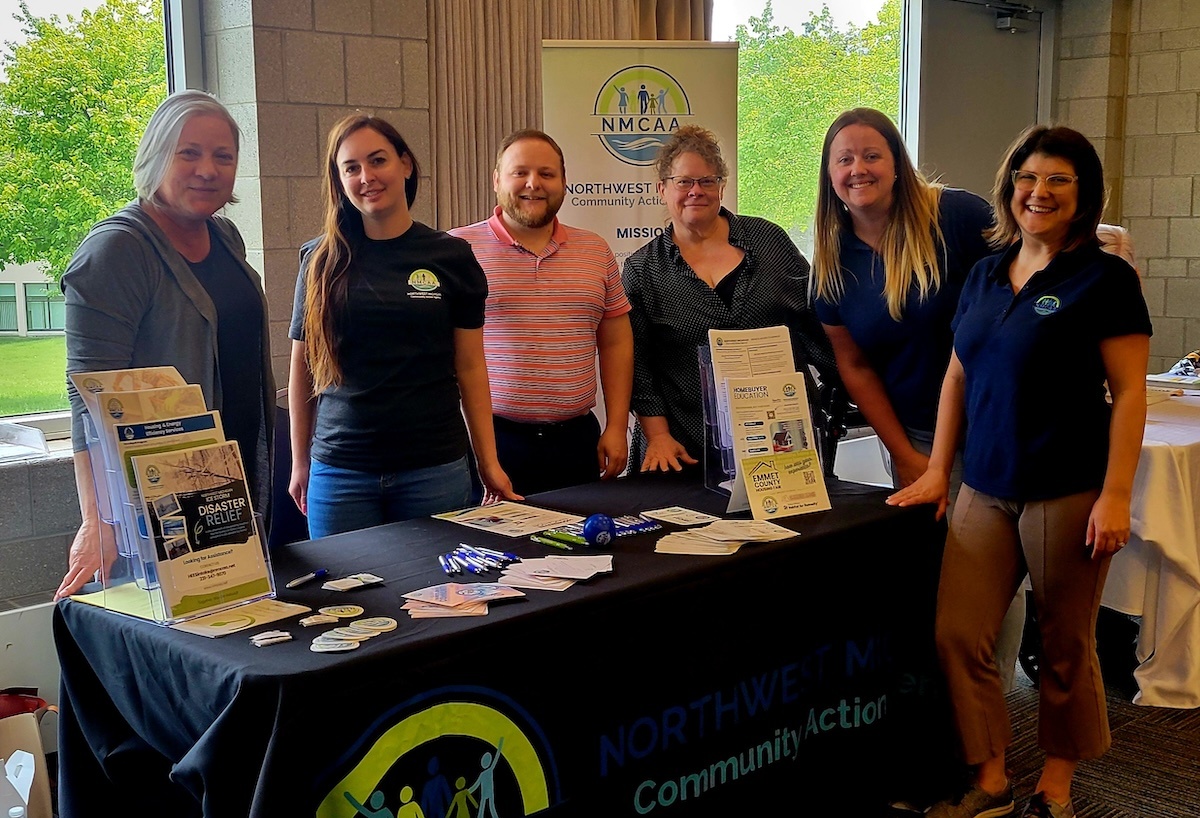
NMCAA Working to Build Communities that Thrive
Northwest Michigan Community Action Agency on housing, childcare, food insecurity, and more
By Anna Faller | Jan. 31, 2026
We’re all familiar with the adage that says “it takes a village” to reach a long-term goal. For the team at Northwest Michigan Community Action Agency (NMCAA), that goal is eliminating poverty and empowering local families, and their growing network of community-focused programs is the verifiable village.
“Our goal is really to help people achieve stability and self-sufficiency so the communities in beautiful northwest Michigan that we live in will continue to thrive,” executive director Kerry Baughman says.
But what does a thriving community look like in the context of larger social issues? We talked with NMCAA about the housing crisis, economic instability, childcare deserts, and food insecurity.
Housing & Financial Stability
First and perhaps foremost on the NMCAA docket is the ongoing issue of housing stability.
In fact, according to the organization’s 2024 Community Needs Assessment (CNA), all but one of the 10 counties NMCAA serves reported a clear deficit in affordable housing. Several counties, including Wexford and Emmet, were in the red by more than 300 units, while Grand Traverse County was short by upwards of 1,000 units and counting.
As Housing Stability Department operations manager Grant Card notes, a big part of the problem comes from a vicious combination of steadily increasing housing prices paired with limited units and ALICE numbers (asset-limited households) holding steady between about 30 and 45 percent across the region.
“People have literally been priced out of their unit just so the market can maintain [it] as a stable source of income,” he says. “That’s been the huge piece—just sheer lack of housing and increased prices.”
In fact, the last few months alone have seen over 150 people utilize NMCAA homeless prevention programs (94 percent of whom were stably housed upon completion!).
To mitigate this growing housing chasm, NMCAA highlights a recent merge between its Homeless Prevention and Homeownership and Financial branches, providing clients with the critical budgeting, counseling, and management tools necessary to obtain and maintain housing.
“We see the need increasing every day,” Card adds. “Plans for expansion are definitely underway, and we’re doing our best to stay ahead of the tide.”
If you or someone you know is experiencing homelessness, call the coordinated call center at 1-844-900-0500
Housing & Energy Efficiency Services
Also under the finance umbrella is the Housing and Energy Efficiency arm, which encompasses federally-funded weatherization assistance (think: HVAC system updates, air sealing, insulation, etc.) and emergent housing restoration, like roof replacement and well or septic repairs.
Though Housing and Energy Efficiency Services director Tish Stave notes that overall demand for these services tends to follow the weather—the March 2025 ice storm is a prime example here, as is the division’s increased winter call volume—other contributing factors include the region’s aging housing stock (an especially prominent issue for counties like Wexford and Manistee) and a highly-competitive market for the units that do become available.
Consequently, the program has wait lists in place for all 10 of its counties, which NMCAA hopes to complete through increased partnerships with skilled contractors, though this often poses another hurdle, as many of these professionals are already committed to other builds.
“The demand is up—it doesn’t go down,” Stave says. “We could always serve more if we could build more capacity.”
Economic Stability
A third column of NMCAA’s finance initiatives is the Economic Stability program, with year-round efforts headlined by a recently-launched free tax preparation service.
Per tax program coordinator Justin Marcum, the service is funded by the Volunteer Income Tax Assistance initiative, aka VITA, through the IRS. NMCAA, with 40 volunteer preparers in tow, completed just over 3,700 returns for the 2024 fiscal year, an effort that secured over five million dollars in refunds.
Though he remains optimistic in terms of future program growth—the goal is to hit, or even exceed, 4,000 returns for 2025—Marcum says that those increased numbers arise from local households vying with higher living costs, especially when we consider that clients’ average adjusted gross income is around $30,000.
The majority of the program’s users also fall into the over-50 age bracket, many of whom are on a fixed income or have dependents to support, which makes obtaining and understanding reimbursement opportunities even more critical.
“Affordability is such a barrier. Every penny counts,” Marcum says. “[A possible] credit or refund can allow [clients] some breathing room to help meet other needs.”
NMCAA is hosting their Super Saturday tax day on Feb. 7 from 10am-2pm at Northwest Ed (800 Parsons Rd. in Traverse City). The event will include “free on-site tax filing, community resources, lunch, activities, and giveaways in one convenient place.”
Child & Family Development
Access to educational opportunities for northwest Michigan households is another big focus for the organization.
According to NMCAA’s 2024 CNA findings, total area childcare capacity for kids under five meets less than 28 percent of demand. Add to that sky-high care expenses, which account for more than 30 percent of average household income in several counties, and early childhood services become a make-or-break for many families.
To help bridge that gap, NMCAA operates a range of family-centric programs, from resources for expectant parents to services for school-aged children, all of which cater to supporting a kiddo’s developmental growth and school readiness.
These include Early Head Start for infants and toddlers; Head Start and the Great Start Readiness program, both preschool initiatives; and more recently, the School Success Partnership Program, which provides tailored support to K-12 students (all with plenty of parent-involvement opportunities).
However, Child and Family Development director Shannon Phelps says the birth-to-three age range has yet to reach its full potential, due in large part to lack of funding. Other pressure points include program staffing and the roller coaster of budget cuts, headlined by a multi-million-dollar reduction in state funds for Great Start Collaboratives in late 2025.
“As long as there are families and children, there’s going to be a need for early childhood education,” Phelps tells us. “These services are important, and I see the demand continuing to grow.”
Food Programs
NMCAA’s food programs represent another key area of community need—in particular, its partnership with the national Meals on Wheels program, which provides nutritious, frozen meals to homebound seniors within its 10-county scope.
“Each year, we certainly see increasing numbers of homebound seniors in need of this kind of support,” director Baughman says, not only in terms of proper nutrition, but also the companionship and resources that enable aging in place.
NMCAA data reflects that calls for food assistance are also up: 2024 surpassed the previous year by a staggering 16,000 meals, and the nonprofit served over 48,000 from October to December 2025 alone.
In that time, the organization also delivered an estimated 5,000 emergency food packages through The Emergency Food Assistance Program (TEFAP). NMCAA works directly with local pantries who can distribute the boxes or combine them with other supports. Per the organization’s annual data, 2024 saw a spike of more than 3,500 TEFAP participants and 235,000 pounds of food provided through its Commodity Supplemental Food Program, which also serves seniors.
“We just continue to see this growth trajectory in terms of need around food security,” Baughman says.
Where to Start
Interested in connecting with NMCAA’s services? Start with whichever program is most urgent.
As marketing manager Erica Austin explains, “it’s not irregular to hear of one [client] moving on to another department or program,” because NMCAA services are designed to meet people where they are.
Stave, for instance, recalls a recent home repair patron whose involvement with the NMCAA began with homeless prevention in 2012. After working with the organization to secure stable housing, he attended a homebuyer workshop, purchased a house, and was later able to replace a leaky roof through the nonprofit’s Emergency Home Repair services.
“It’s really illustrative of how we walk alongside clients all the way through a journey,” she says.
Similarly, one Head Start parent highlights the educational tools the program provides as “invaluable in preparing for the future,” while another recalls how the NMCAA’s child development network connected them to local supports.
“Before going here, we weren’t able to afford daycare. Since then, we’ve had help with different community resources and have been able to save money to work on [buying] a home.” (A number of Head Start staff members even began as parents!)
“Every story is unique,” Austin adds, “and every program is individualized by the client.”
Find NMCAA’s main branch at 3963 Three Mile Rd. in Traverse City. (231) 947-3780. nmcaa.net


Trending
Disconnect to Reconnect at Water & Woods
In August, Kaleva welcomed its first wellness retreat to the heart of Manistee County. Located at 15271 Makinen Road, Water … Read More >>
Running into Winter: Call for Race Calendar Submissions
We know it’s only mid-October, but we’re starting to pull together our calendar of winter races for Dec. 21, 202… Read More >>
Things That Go Bump in the Night
Spooky season is upon us, and community storytelling group Charlevoices is leaning into the scare with “Things That Go… Read More >>