The 2026 Apple Harvest
Farmers talk weird weather, climate change, U-pick, and hope for a successful crop
By Drew VanDrie | Oct. 3, 2026
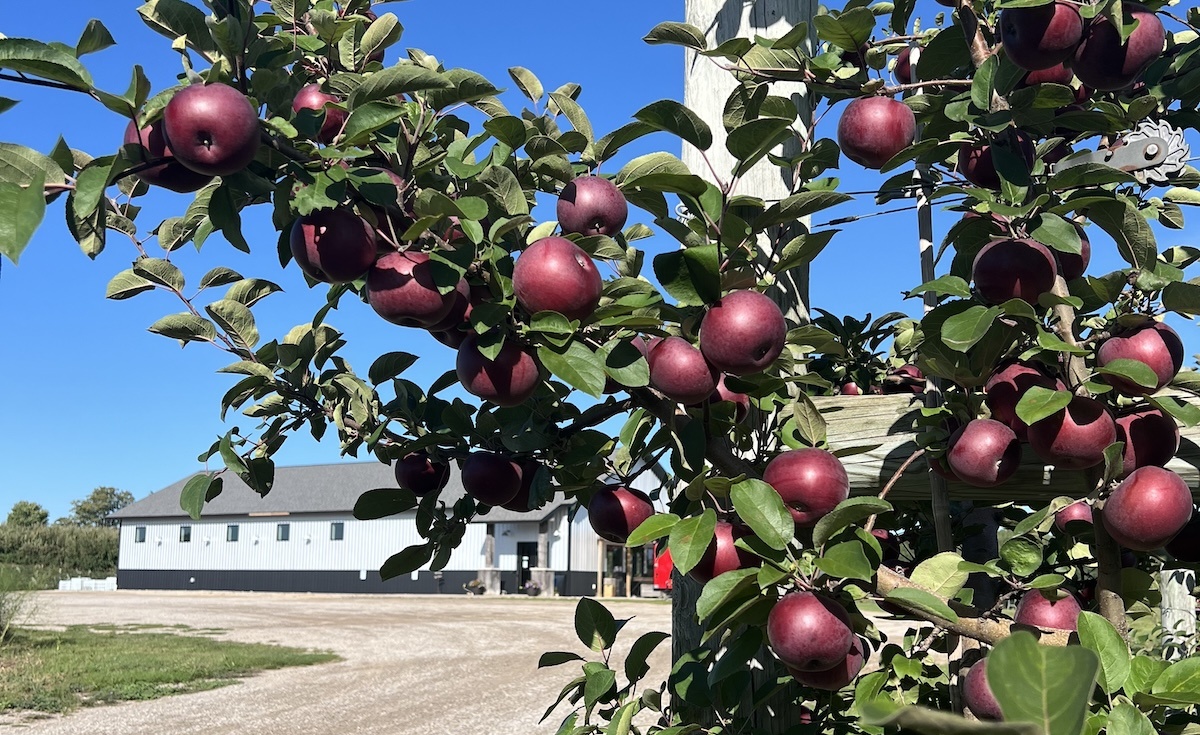
Perhaps one of the most definitive signs of fall in northern Michigan is a bushel full of ripe apples. From U-pick at the orchard to perusing at the farmers market, fresh local apples are staple produce and one many look forward to all year.
Northern Express connected with two local apple farmers to get the latest on this season’s apple harvest. Kristie Altonen is the owner of Altonen Orchards, a multi-generational farm based in Williamsburg. (Altonen is also the tasting room manager at the affiliated Townline Ciderworks in Elk Rapids.) Isaiah Wunsch is the CEO of Wunsch Farms, a sixth-generation farm located on Old Mission Peninsula.
Express: How is the crop looking compared to last year?
Altonen: “It’s looking quite comparable to last year. Three or four years have been what we would refer to as ‘good’ apple crops, as opposed to cherries that are volatile in the spring to maybe a late freeze. Apples aren’t far enough along at that time, so they escaped some of that potential freeze damage. So they generally do quite well, and they have done quite well the last three or four years. I would say [we’re] on track; there’s a good amount of fruit, good quality fruit.”
Wunsch: “I think that it looks good! Last year was good, but it was a little bit of a smaller crop. This year, I would guess that there are maybe 10 or 15 percent more apples out in the field than there were last year. So we’re up a little bit over 2025, down a little bit over 2024. So it looks like a really, really nice balance. With cherries, you always want as many cherries as you can possibly get. With apples, they can over-crop. So I think we have a really nice balance between the kind of volume that we need for that ceiling before you start to see quality declining. So it looks like a really good volume.”
Express: What varieties are you growing?
Altonen: “We grow several varieties, 20+ varieties and also 20+ varieties of cider apples, which are completely different from eating apples, which are also referred to as dessert apples. Our main seller is Honeycrisp … [but we also grow] Chisel Gold, Zestar, Paula Red, and there’s something called the Premier Honeycrisp. It’s like a sister to the Honeycrisp that we’re all used to, but it just ripens earlier. It doesn’t last as long as a typical Honeycrisp, but it gives you that flavor and that texture earlier than you would typically get a Honeycrisp.”
Wunsch: “The main varieties that we grow are Honeycrisp, Johnny Gold, Northern Spy, McIntosh, Empire, Yellow Delicious, and a whole bunch of other ones. We have at least 15 different apple varieties.”
Express: Where do the apples end up? U-Pick, market, wholesale?
Altonen: “We sell them at our two retail locations, one on US-31, one on M-72. We also sell them for commercial use, some of those end users are things like GoGo Squeeze, which is very popular with children. They also end up in some fresh packs in the state when you sell commercially. But we also use some for juice, you know, that goes into our cider at our tasting room.”
Wunsch: “We do primarily wholesale. We run a little U-pick every fall out on our main farm, which is on the north end of Old Mission. And the cool thing about our apple U-pick is that we donate one pound of apples for every pound of apples that people [pick]. So we sell the apples at the typical grocery store retail price. But then because people are out there picking them, we donate one pound for every pound that we sell to food banks like Food Rescue of Northwest Michigan.”
Express: What have been some challenges this year with weather, pests, invasive species? Any lingering issues from the storms in April?
Altonen: “[Apples] can get damage from wind and things like hail. Fortunately, we haven’t had hail at our primary locations for growing apples in Williamsburg, just south of Elk Rapids, and we also have a farm north of Elk Rapids near the 45th parallel. And neither of those locations have had hail yet, fingers crossed. … But there’s still a ways to go because we have apples on the trees until early October to mid-October.
“There has been the disease pressure with the moisture. So that can introduce things like pests or bacteria or something called fire blight. It’s when you see an apple or a pear tree that looks like it’s been burnt. It’s a bacteria called erwinia amylovora—it’s not at all good for the orchard. So you have to be really careful to remove it. You have to dip shears into a bleach or alcohol solution and cut and do that every single time to cut it away from the tree so it doesn’t spread.”
Wunsch: “The Old Mission Peninsula mostly came out of the frost this spring unscathed. So we had generally a pretty good crop of cherries on Old Mission, but we were definitely the aberration regionally. Most of my friends in the industry and over near Elk Rapids, Torch Lake side, I know were way down from a typical year on cherries this year. Apples actually bloom quite a bit later than cherries—they’re usually two weeks behind cherries—so we had really minimal damage to apples throughout the region.
“So the bigger challenge for us this year was the excessive moisture that we had in July. We had almost twice as much rain this July as we would have in an average July, but it’s been a really good growing year for apples. So the kind of cool and wet weather that can cause problems for cherries, generally, the cool weather doesn’t bother the apples as much, and the wet weather is actually a positive for apples. So we were able to we were able to size the apple crop up nicely.”
Express: What does the future hold for apple farming Up North?
Altonen: “Well, I think of the stress of growing cherries versus the stress of growing apples. I think growing apples is more profitable in the end, at least for us. It seems a little more hopeful or encouraging. You know, potentially new varieties down the road. I mean, that’s always a possibility or something to look forward to, and then we are excited about our cider apples.
“We planted our cider orchard after that storm in 2015—that wind came through our orchard and took down an entire young orchard. So we tore it out, and we were able to find some cider trees late in the season like that and plant those. And they’re just now maturing. They’ve been producing quite well, so we’re always excited about that because those cider apples make a different product.”
Wunsch: “I think apples are definitely more climate resilient than some of our traditional cherry varieties. If you had interviewed me 10 years ago, this year would have been an absolute catastrophe with cherries because we lost a lot of our main season, our historical mainstay variety, to that wet weather. So that was a painful bite, but it was also the first year that we had a lot of newer varieties come into production. Part of our strategy with choosing new varieties has been to select varieties that are better adapted to the more erratic spring temperatures that we’re having and the wetter summer conditions that we have.
“I think that not only are apples more climate resilient, but I think about the success story with apples. The main variety that growers grow in northwest Michigan is Honeycrisp. It’s only 30 years old, and it’s very well adapted to cold climates. It’s a variety that was developed by fruit breeders at the University of Minnesota and it loves the cold climate.
“I think, as a cherry grower, I’m not only looking at maybe I should want some more apples, also, are there other cherry varieties that would work for our industry and work better with the kind of climate that we’re facing in this region now? Because we’re still growing the same tart cherry variety in Traverse City that we were a hundred years ago, but the climate in this region is substantially different than it was a hundred years ago.”


Trending

The Tasting Room Is Now Cellar & Flame
Listen to your customers. That’s the lesson Carolyn Weeks took to heart, and it’s the reason The Tasting Room be… Read More >>
Cozy Cottage Concerts
If you loved Music Under the Pines in the summer, head to Twisted Fish Art Gallery in Elk Rapids for Cottage Concerts! Enjoy… Read More >>
Running toward Fall in Frankfort
Fall festivals are going to be running nonstop from now until November, and Frankfort is no exception! The annual Frankfort … Read More >>